
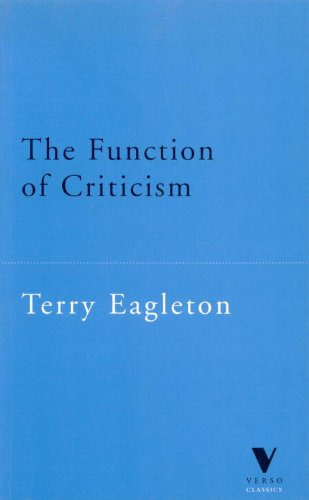
Title
The Function of Criticism: From The Spectator to PostStructuralism (Verso Classics, 3),Used
Sold by Ergodebooks, an authorized reseller.
Returns accepted within 30 days | support@ergodebooks.com
Shipping Information
- Free Standard Shipping — United States only
- Processing Time: 3–5 business days
- Estimated Delivery: 6–10 business days after dispatch
- Double-boxed, fully insured & discreetly packaged
- Tracking number sent via email once dispatched
Returns & Refund
Returns accepted within 30 days of delivery.
Damaged or Defective Item
Free return shipping + replacement or full refund
Wrong Item Received
Free return shipping + replacement or full refund
Change of Mind
Return shipping at customer's expense · 25% restocking fee applies
Payment Option

This wideranging book argues that criticism emerged in early bourgeois society as a central feature of a ?ublic sphere?in which political, ethical, and literary judgements could mingle under the benign rule of reason. The disintegration of this fragile culture brought on a crisis in criticism, whose history since the 18th century has been fraught with ambivalence and anxiety.Eagleton? account embraces Addison and Steele, Johnson and the 19century reviewers, such critics as Arnold and Stephen, the heyday of Scrutiny and New Criticism, and finally the proliferation of avantgarde literary theories such as deconstructionism.The Function of Criticism is nothing less than a history and critique of the ?ritical institution?itself. Eagleton? judgements on individual critics are sharp and illuminating, which his general argument raises crucial questions about the relations between language, literature and politics.
⚠️ WARNING (California Proposition 65):
This product may contain chemicals known to the State of California to cause cancer, birth defects, or other reproductive harm.
For more information, please visit www.P65Warnings.ca.gov.
- Q: How many pages does this book have? A: This book has one hundred thirty-four pages. It provides a comprehensive exploration of the history and critique of criticism.
- Q: What are the dimensions of this book? A: The dimensions are six inches in length, eight and a half inches in height, and a quarter inch in width. This size makes it portable and easy to handle.
- Q: What is the binding type of this book? A: This book is paperback bound. This type of binding offers flexibility and ease of use for readers.
- Q: Who is the author of this book? A: The author is Terry Eagleton. He is a well-known literary theorist and critic.
- Q: What genre does this book belong to? A: This book belongs to the Criticism & Theory genre. It delves into the intersections of literature, politics, and ethics.
- Q: What is the primary focus of this book? A: The primary focus is on the evolution of criticism in literary and political contexts. It discusses the role of criticism in early bourgeois society.
- Q: How does this book address criticism? A: This book critiques the 'critical institution' itself. Eagleton raises important questions about the relationship between language, literature, and politics.
- Q: Is this book suitable for academic use? A: Yes, this book is suitable for academic use. It offers valuable insights for students and scholars of literature and criticism.
- Q: What themes are explored in this book? A: The themes include the history of criticism, political and ethical judgments, and avant-garde literary theories. Eagleton examines various critical perspectives.
- Q: Who published this book? A: This book was published by Verso. Verso is known for its critical and theoretical works in literature.
- Q: What is the reading level of this book? A: The reading level is suitable for adult readers. It may be challenging for younger audiences due to its complex themes.
- Q: How should this book be stored? A: This book should be stored in a dry, cool place away from direct sunlight. Proper storage will help maintain its condition.
- Q: Can I read this book without prior knowledge of literary theory? A: Yes, you can read this book without prior knowledge of literary theory. However, familiarity with basic concepts may enhance understanding.
- Q: What if I receive a damaged book? A: If you receive a damaged book, you should contact the seller for a return or replacement. Most sellers have policies in place for such issues.
- Q: Is this book part of a series? A: Yes, this book is part of the Verso Classics series. The series includes various significant texts in literary and critical theory.
- Q: What makes this book unique? A: This book is unique for its historical perspective on criticism and its analysis of the critical institution itself. Eagleton's insights are both sharp and illuminating.