
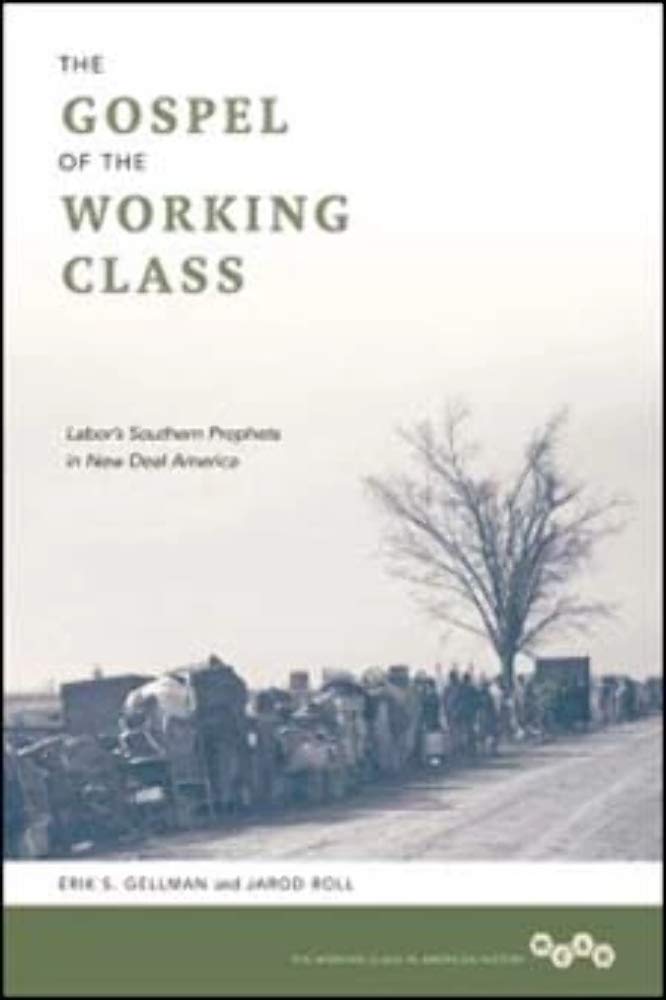
Title
The Gospel of the Working Class: Labor's Southern Prophets in New Deal America (Working Class in American History),Used
Sold by Ergodebooks, an authorized reseller.
Returns accepted within 30 days | support@ergodebooks.com
Shipping Information
- Free Standard Shipping — United States only
- Processing Time: 3–5 business days
- Estimated Delivery: 6–10 business days after dispatch
- Double-boxed, fully insured & discreetly packaged
- Tracking number sent via email once dispatched
Returns & Refund
Returns accepted within 30 days of delivery.
Damaged or Defective Item
Free return shipping + replacement or full refund
Wrong Item Received
Free return shipping + replacement or full refund
Change of Mind
Return shipping at customer's expense · 25% restocking fee applies
Payment Option

In this exceptional dual biography and cultural history, Erik S. Gellman and Jarod Roll trace the influence of two southern activist preachers, one black and one white, who used their ministry to organize the working class in the 1930s and 1940s across lines of gender, race, and geography. Owen Whitfield and Claude Williams, along with their wives Zella Whitfield and Joyce Williams, drew on their bedrock religious beliefs to stir ordinary men and women to demand social and economic justice in the eras of the Great Depression, New Deal, and Second World War.Williams and Whitfield preached a workingclass gospel rooted in the American creed that hard, productive work entitled people to a decent standard of living. Gellman and Roll detail how the two preachers galvanized thousands of farm and industrial workers for the Southern Tenant Farmers Union and the Congress of Industrial Organizations. They also link the activism of the 1930s and 1940s to that of the 1960s and emphasize the central role of the ministers' wives, with whom they established the People's Institute for Applied Religion.This detailed narrative illuminates a cast of characters who became the two couples' closest allies in coordinating a complex network of activists that transcended Jim Crow racial divisions, blurring conventional categories and boundaries to help black and white workers make better lives. In chronicling the shifting contexts of the actions of Whitfield and Williams, The Gospel of the Working Class situates Christian theology within the struggles of some of America's most downtrodden workers, transforming the dominant narratives of the era and offering a fresh view of the promise and instability of religion and civil rights unionism.
⚠️ WARNING (California Proposition 65):
This product may contain chemicals known to the State of California to cause cancer, birth defects, or other reproductive harm.
For more information, please visit www.P65Warnings.ca.gov.
- Q: What is the page count of this book? A: This book has two hundred forty-eight pages. It provides a thorough exploration of labor movements in New Deal America.
- Q: What is the binding type of this book? A: The book is available in paperback binding. This makes it lightweight and portable for easy reading.
- Q: What are the dimensions of this book? A: The book measures six inches in length, zero point seventy-one inches in width, and nine point zero two inches in height.
- Q: Who are the authors of this book? A: The book is authored by Erik S. Gellman and Jarod Roll. They focus on the historical significance of labor activism.
- Q: What category does this book fall into? A: This book is categorized under Labor and Industrial Relations. It explores labor movements and social justice themes.
- Q: How do I read this book? A: You can read this book at your own pace. It is suitable for those interested in history, labor rights, and social justice.
- Q: Is this book suitable for academic study? A: Yes, this book is suitable for academic study. It provides insights into labor activism and is valuable for history courses.
- Q: What themes are covered in this book? A: The book covers themes of social justice, labor rights, and the influence of religion on activism. It examines the intersection of race and class.
- Q: How should I store this book? A: Store this book in a dry, cool place, upright on a shelf. Avoid direct sunlight to prevent fading of the cover.
- Q: Can I lend this book to others? A: Yes, you can lend this book to others. Just ensure it is returned in good condition to maintain its quality.
- Q: What if the book arrives damaged? A: If the book arrives damaged, you can contact the seller for a return or exchange. Make sure to keep the packaging for reference.
- Q: Is there a return policy for this book? A: Yes, there is a return policy for this book. Check the seller's website for specific details on return procedures.
- Q: Is this book appropriate for young readers? A: This book is primarily aimed at adults and older teens. It discusses complex themes that may not be suitable for younger readers.
- Q: Does this book include illustrations or photographs? A: No, this book does not include illustrations or photographs. It focuses on textual content and historical narratives.
- Q: Does this book reference primary sources? A: Yes, this book references primary sources. It utilizes historical documents to support its narrative on labor movements.
- Q: How can I contact support for this book? A: You can contact support through the seller's website or customer service. They can assist with inquiries or issues regarding the book.