
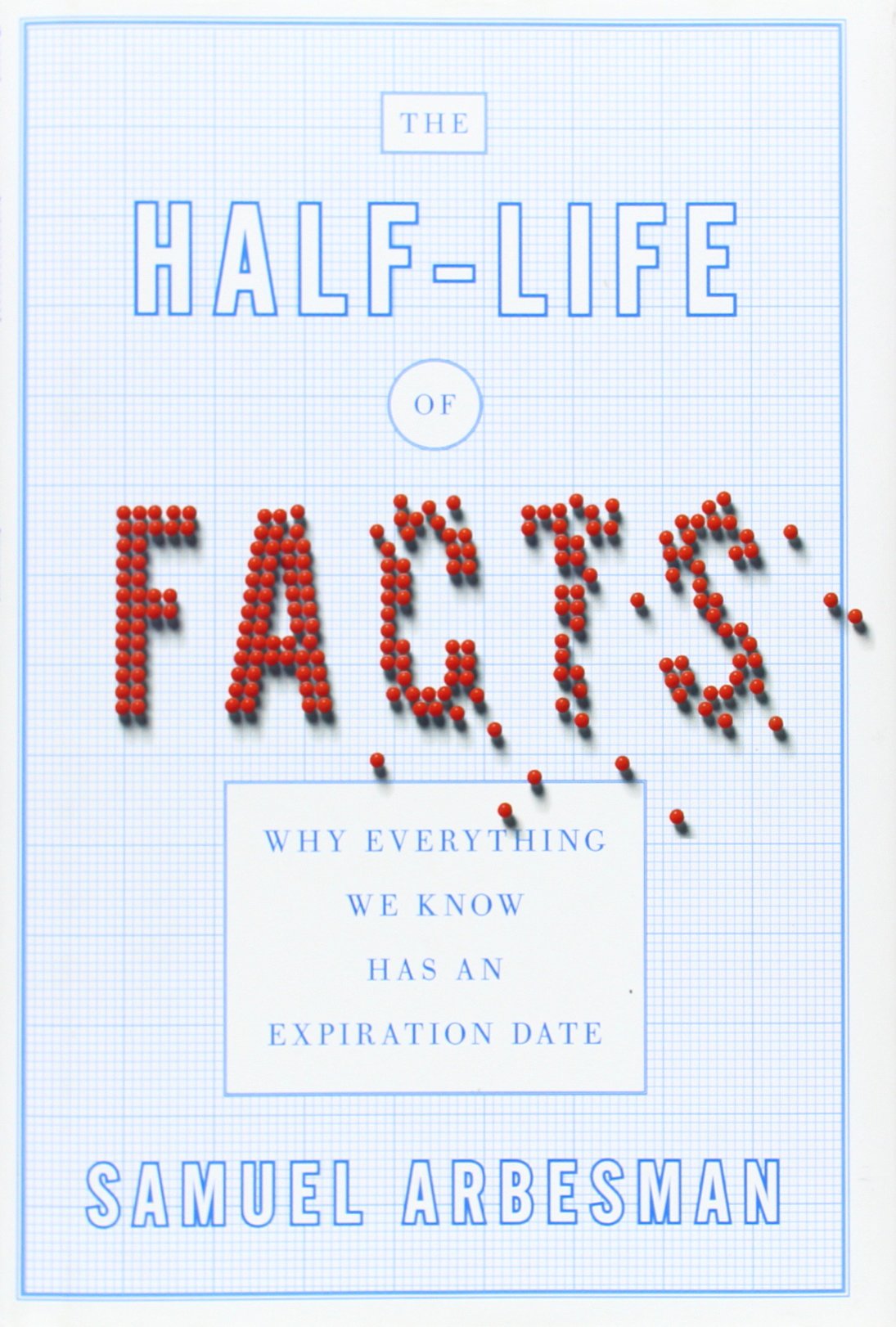
Title
The Halflife Of Facts: Why Everything We Know Has An Expiration Date
Sold by Ergodebooks, an authorized reseller.
Returns accepted within 30 days | support@ergodebooks.com
Shipping Information
- Free Standard Shipping — United States only
- Processing Time: 3–5 business days
- Estimated Delivery: 6–10 business days after dispatch
- Double-boxed, fully insured & discreetly packaged
- Tracking number sent via email once dispatched
Returns & Refund
Returns accepted within 30 days of delivery.
Damaged or Defective Item
Free return shipping + replacement or full refund
Wrong Item Received
Free return shipping + replacement or full refund
Change of Mind
Return shipping at customer's expense · 25% restocking fee applies
Payment Option

New Insights From The Science Of Sciencefacts Change All The Time. Smoking Has Gone From Doctor Recommended To Deadly. We Used To Think The Earth Was The Center Of The Universe And That Pluto Was A Planet. For Decades, We Were Convinced That The Brontosaurus Was A Real Dinosaur. In Short, What We Know About The World Is Constantly Changing.But It Turns Out Theres An Order To The State Of Knowledge, An Explanation For How We Know What We Know. Samuel Arbesman Is An Expert In The Field Of Scientometricsliterally The Science Of Science. Knowledge In Most Fields Evolves Systematically And Predictably, And This Evolution Unfolds In A Fascinating Way That Can Have A Powerful Impact On Our Lives.Doctors With A Rough Idea Of When Their Knowledge Is Likely To Expire Can Be Better Equipped To Keep Up With The Latest Research. Companies And Governments That Understand How Long New Discoveries Take To Develop Can Improve Decisions About Allocating Resources. And By Tracing How And When Language Changes, Each Of Us Can Better Bridge Generational Gaps In Slang And Dialect.Just As We Know That A Chunk Of Uranium Can Break Down In A Measurable Amount Of Timea Radioactive Halflifeso Too Any Given Fields Change In Knowledge Can Be Measured Concretely. We Can Know When Facts In Aggregate Are Obsolete, The Rate At Which New Facts Are Created, And Even How Facts Spread.Arbesman Takes Us Through A Wide Variety Of Fields, Including Those That Change Quickly, Over The Course Of A Few Years, Or Over The Span Of Centuries. He Shows That Much Of What We Know Consists Of Mesofactsfacts That Change At A Middle Timescale, Often Over A Single Human Lifetime. Throughout, He Offers Intriguing Examples About The Face Of Knowledge: What English Majors Can Learn From A Statistical Analysis Of The Canterbury Tales, Why Its So Hard To Measure A Mountain, And Why So Many Parents Still Tell Kids To Eat Their Spinach Because Its Rich In Iron.The Halflife Of Facts Is A Riveting Journey Into The Counterintuitive Fabric Of Knowledge. It Can Help Us Find New Ways To Measure The World While Accepting The Limits Of How Much We Can Know With Certainty.
⚠️ WARNING (California Proposition 65):
This product may contain chemicals known to the State of California to cause cancer, birth defects, or other reproductive harm.
For more information, please visit www.P65Warnings.ca.gov.
- Q: What is the page count of 'The Half-life of Facts'? A: This book has two hundred fifty-six pages. It provides an in-depth exploration of how knowledge evolves over time.
- Q: What is the binding type of this book? A: The binding type is hardcover. This ensures durability and a premium feel for readers.
- Q: Who is the author of 'The Half-life of Facts'? A: The author is Samuel Arbesman. He is an expert in scientometrics and explores the science of knowledge evolution.
- Q: What topics does 'The Half-life of Facts' cover? A: This book covers the evolution of knowledge across various fields. It discusses how facts can change systematically over time.
- Q: What dimensions does 'The Half-life of Facts' have? A: The dimensions are seven point seventy-six inches in length, zero point seventy-five inches in width, and five point fifty-one inches in height.
- Q: How do I read 'The Half-life of Facts' effectively? A: You can read this book by taking notes on key insights. Understanding the examples provided will enhance your grasp of knowledge evolution.
- Q: Is 'The Half-life of Facts' suitable for young readers? A: Yes, it's suitable for young adult readers. The content is educational and presents complex ideas in an accessible manner.
- Q: How can I apply the insights from 'The Half-life of Facts'? A: You can apply these insights by being aware of how your knowledge may become outdated. This can improve decision-making in various areas of life.
- Q: What is the recommended reading level for this book? A: The recommended reading level is high school and above. It delves into complex themes that may require prior knowledge of science.
- Q: How should I store 'The Half-life of Facts' to keep it in good condition? A: Store the book upright on a shelf in a cool, dry place. Avoid exposure to direct sunlight to prevent fading.
- Q: Is 'The Half-life of Facts' safe for children? A: Yes, it is generally safe for older children. The content is educational and thought-provoking, though adult supervision is recommended.
- Q: What precautions should I take when handling this hardcover book? A: Handle it gently to avoid damaging the cover or pages. Keep it away from moisture and sharp objects.
- Q: What if 'The Half-life of Facts' arrives damaged? A: You should contact the retailer for a return or exchange. Most sellers have policies for damaged items.
- Q: Can 'The Half-life of Facts' help me in my professional life? A: Yes, it can improve your understanding of how knowledge changes in your field. This can enhance your decision-making skills.
- Q: How does this book compare to other books in its genre? A: It offers a unique perspective on the evolution of knowledge, unlike many traditional statistics books. It combines scientific insight with engaging examples.