
Title
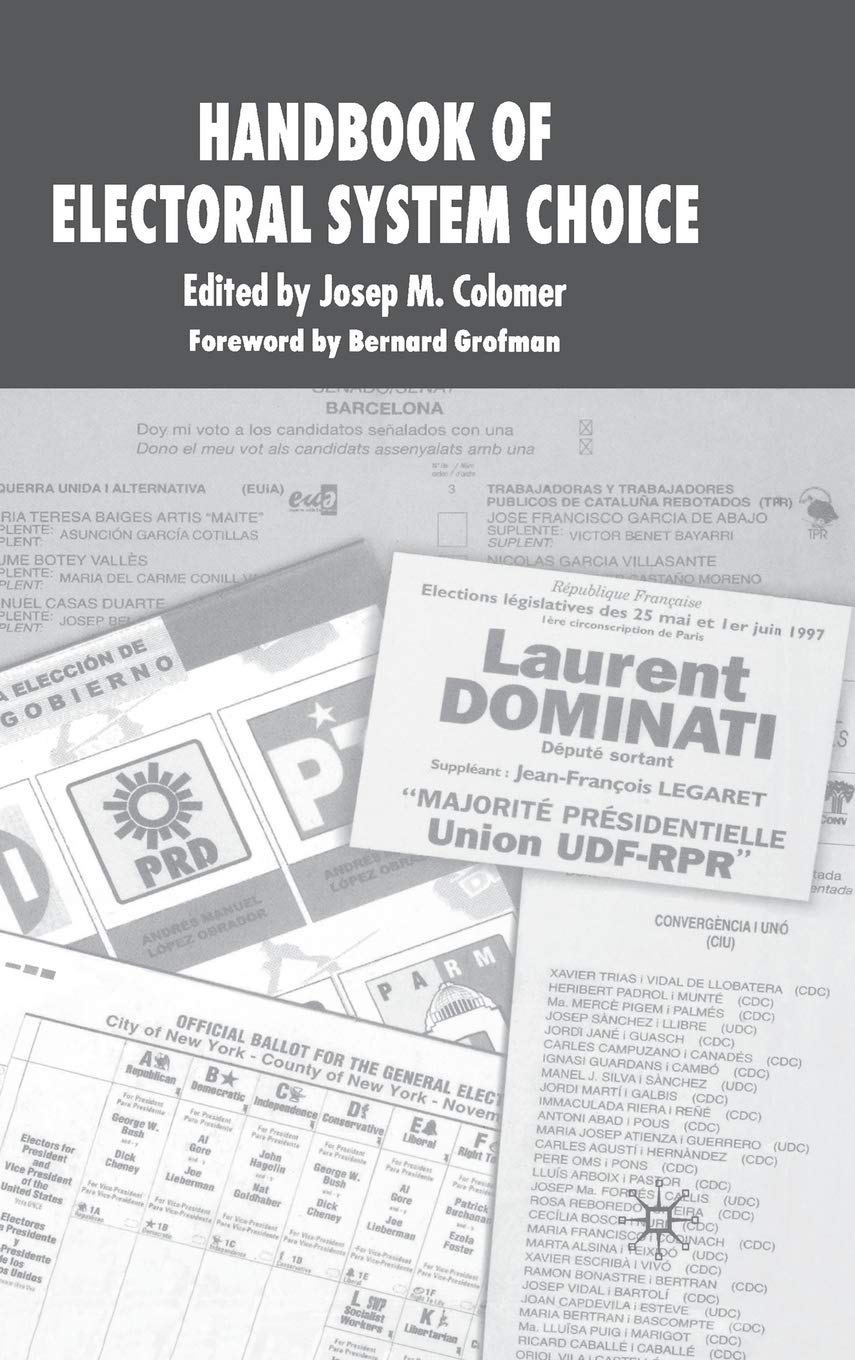
The Handbook of Electoral System Choice,New
Sold by Ergodebooks, an authorized reseller.
Returns accepted within 30 days | support@ergodebooks.com
Shipping Information
- Free Standard Shipping — United States only
- Processing Time: 3–5 business days
- Estimated Delivery: 6–10 business days after dispatch
- Double-boxed, fully insured & discreetly packaged
- Tracking number sent via email once dispatched
Returns & Refund
Returns accepted within 30 days of delivery.
Damaged or Defective Item
Free return shipping + replacement or full refund
Wrong Item Received
Free return shipping + replacement or full refund
Change of Mind
Return shipping at customer's expense · 25% restocking fee applies
Payment Option

Product Description The topic of electoral reform is an extremely timely one. The accelerated expansion of the number of new democracies in the world generates increasing demand for advice on the choice of electoral rules; at the same time, a new reformism in well established democracies seeks new formulae favouring both more representative institutions and more accountable rulers. The Handbook of Electoral System Choice addresses the theoretical and comparative issues of electoral reform in relation to democratization, political strategies in established democracies and the relative performance of different electoral systems. Case studies on virtually every major democracy or democratizing country in the world are included. Review 'Electoral studies have long focused more on the effects than the causes of electoral rules. As Josep Colomer notes in his introduction to this volume,however, the very strength of the effects leads to a natural line of theorizing about causes: Parties introduce new rules in anticipation of their effects onthose parties' future electoral fortunes. The individual essays in this volumeshow that this simple notion plays out in many and sometimes subtle ways inparticular cases. Cumulatively, they provide the most extensive collection wepossess to date. Moreover, Colomer's synoptic overview shows that there is an important general trend visible in the historical record, toward greaterproportionality. Every serious student of electoral systems will want thishandbook on their shelf.' Gary W. Cox, Professor of Political Science, University of California, San Diego'This volume goes a long way in providing the necessary detailed historical evidence about the roots of electoral system change for a large and diverse set of democratic nations throughout recent history. Professor Colomer offers a new and highly original theory of electoral change which lays the groundwork for a radical revision of what has become the common wisdom about the effects of electoral laws. The chapters provide us a wealth of new information and new theoretical insights.' From the Foreword by Bernard Grofman, Professor of Political Science and Mathematical Behavioral Science, University of California, Irvine About the Author GERARD ALEXANDER University of Virginia, USA PATRICK DUNLEAVY London School of Economics and Political Science, UK ERIK ENGSTROM University of North Carolina, Chapel Hill, USA RICHARD L. ENGSTROM University of New Orleans, USA ALBERTO DIAZCAYEROS Stanford University, USA, and ITAM, Mexico ANDREW ELLIS National Democratic Institute, Jakarta, Indonesia CARLOS FLORES JUBERAS University of Valencia, Spain DIEGO GAMBETTA Oxford University, UK MATT GOLDER New York University, USA ALLEN HICKEN University of Michigan, USA MAREK KAMINSKI University of California, Irvine, USA PETR KOPECKY University of Sheffield, UK, and University of Leiden, the Netherlands MARCUS KREUZER Villanova University, USA FABRICE LEHOUCQ CIDE, Mexico LEIF LEWIN University of Uppsala, Sweden GEORG LUTZ University of Berne, Switzerland BEATRIZ MAGALONI Stanford University, USA and ITAM, Mexico HELEN MARGETTS University College, London, UK EVALD MIKKEL University of Tartu, Estonia SUBRATA K. MITRA Ruprecht Karls University, Heidelberg, Germany SHAHENN MOZAFFAR Bridgewater State College, USA JACK H. NAGEL University of Pennsylvania, USA MONIKA A. NALEPA Columbia University, New York, USA GABRIEL L. NEGRETTO CIDE, Mexico JAIRO MARCONI NICOLAU IUPRJ, Rio de Janeiro, Brazil VELLO PETTAI University of Tartu, Estonia ANDREW REYNOLDS University of North Carolina, Chapell Hill, USA MARIAN SAWER Australian National University, Canberra, Australia JOHN W. SCHIEMANN Fairleigh Dickinson University, USA OLGA SHVETSOVA Washington University, St. Louis, USA JUNICHIRO WADA Yokohama City University, Japan LEONARD WANTCHEKON New York University, USA STEVEN WARNER Oxford University, UK
⚠️ WARNING (California Proposition 65):
This product may contain chemicals known to the State of California to cause cancer, birth defects, or other reproductive harm.
For more information, please visit www.P65Warnings.ca.gov.