
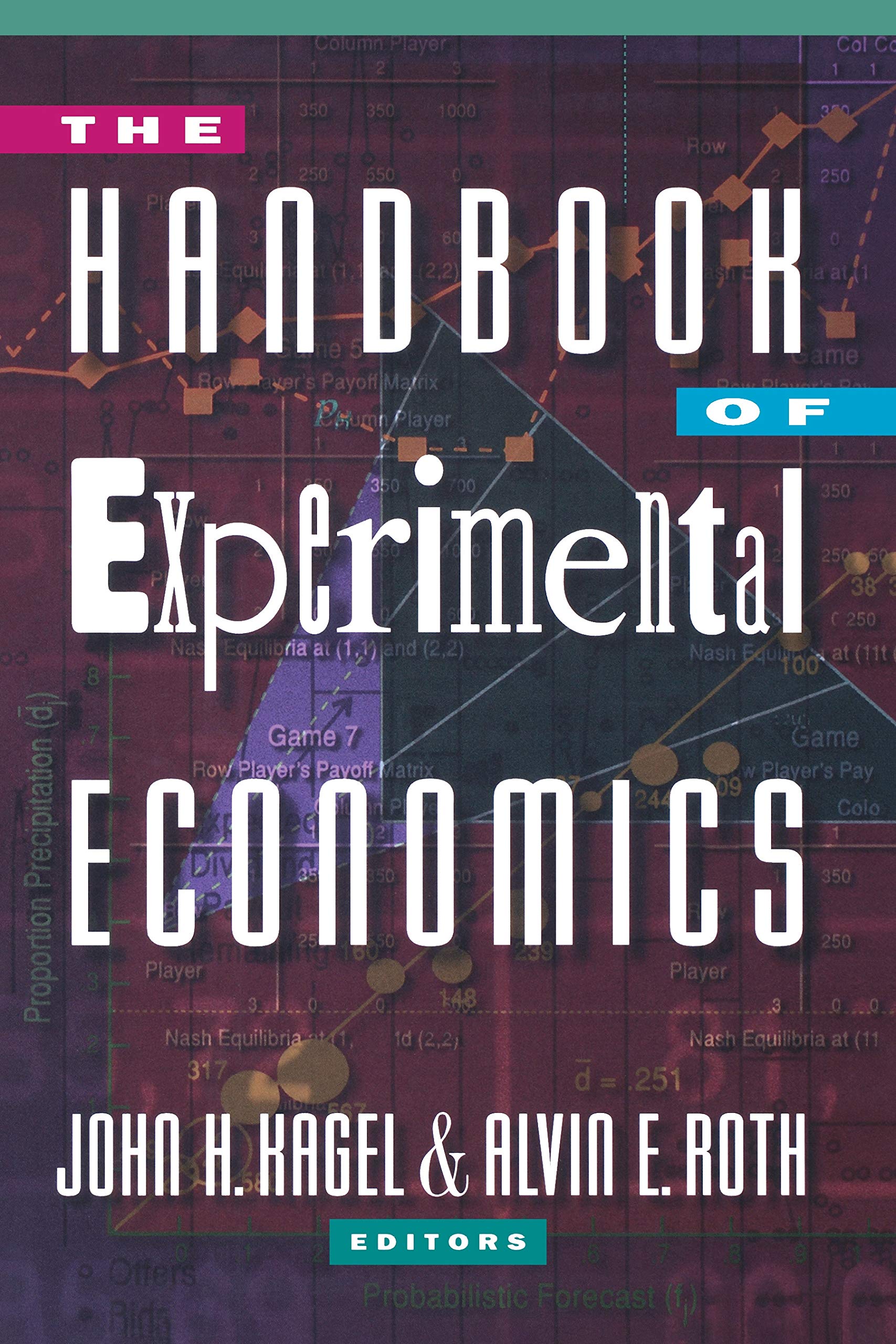
Title
The Handbook of Experimental Economics,Used
Sold by Ergodebooks, an authorized reseller.
Returns accepted within 30 days | support@ergodebooks.com
Shipping Information
- Free Standard Shipping — United States only
- Processing Time: 3–5 business days
- Estimated Delivery: 6–10 business days after dispatch
- Double-boxed, fully insured & discreetly packaged
- Tracking number sent via email once dispatched
Returns & Refund
Returns accepted within 30 days of delivery.
Damaged or Defective Item
Free return shipping + replacement or full refund
Wrong Item Received
Free return shipping + replacement or full refund
Change of Mind
Return shipping at customer's expense · 25% restocking fee applies
Payment Option

This book, which comprises eight chapters, presents a comprehensive critical survey of the results and methods of laboratory experiments in economics. The first chapter provides an introduction to experimental economics as a whole, with the remaining chapters providing surveys by leading practitioners in areas of economics that have seen a concentration of experiments: public goods, coordination problems, bargaining, industrial organization, asset markets, auctions, and individual decision making.The work aims both to help specialists set an agenda for future research and to provide nonspecialists with a critical review of work completed to date. Its focus is on elucidating the role of experimental studies as a progressive research tool so that wherever possible, emphasis is on series of experiments that build on one another. The contributors to the volumeColin Camerer, Charles A. Holt, John H. Kagel, John O. Ledyard, Jack Ochs, Alvin E. Roth, and Shyam Sunderadopt a particular methodological point of view: the way to learn how to design and conduct experiments is to consider how good experiments grow organically out of the issues and hypotheses they are designed to investigate.
⚠️ WARNING (California Proposition 65):
This product may contain chemicals known to the State of California to cause cancer, birth defects, or other reproductive harm.
For more information, please visit www.P65Warnings.ca.gov.
- Q: How many pages does the book have? A: The book has eight hundred sixty-four pages. This extensive length allows for a thorough exploration of experimental economics.
- Q: What are the dimensions of the book? A: The book measures six point seventy-five inches in length, one point seventy-five inches in width, and nine point seventy-six inches in height. These dimensions make it a suitable size for both reading and reference.
- Q: What type of binding does this book have? A: This book is bound in hardcover. Hardcover binding offers durability and protection for frequent use.
- Q: Who is the author of this book? A: The author of the book is John H. Kagel. He is recognized for his contributions to the field of experimental economics.
- Q: What is the main focus of the book? A: The main focus of the book is to provide a critical survey of laboratory experiments in economics. It aims to clarify the role of experimental studies as a progressive research tool.
- Q: Is this book suitable for beginners in economics? A: Yes, the book is suitable for beginners as well as specialists. It includes introductory materials that can help nonspecialists understand experimental economics.
- Q: How can I best utilize this book for research? A: You can utilize this book by reviewing its chapters for insights into various experiments in economics. It helps in setting agendas for future research.
- Q: Are there any prerequisites for understanding this book? A: No specific prerequisites are required. However, a basic understanding of economic principles may enhance comprehension.
- Q: How should I care for this hardcover book? A: To care for this hardcover book, store it upright in a dry place away from direct sunlight. Keep it clean by dusting the cover periodically.
- Q: Is this book safe for children? A: Yes, the book does not contain adult content. However, it is intended for an audience interested in economics.
- Q: Can I return the book if I find it unsatisfactory? A: Yes, you can return the book based on the seller's return policy. Ensure you check the specifics regarding timeframes and conditions for returns.
- Q: What if the book arrives damaged? A: If the book arrives damaged, contact the seller for a replacement or refund. Most sellers have policies in place to address such issues.
- Q: How should I store the book long-term? A: Store the book in a cool, dry environment, preferably on a bookshelf to avoid bending or damage. Keep it away from moisture.
- Q: What topics are covered in the book? A: The book covers various topics including public goods, coordination problems, and individual decision making. Each chapter focuses on specific areas of experimental economics.
- Q: Who are the contributors to this book? A: The contributors include several leading practitioners such as Colin Camerer, Charles A. Holt, and Alvin E. Roth. Their expertise enriches the content of the book.
- Q: What is the publication date of the book? A: The publication date is not specified in the provided details. You may need to check the book for its publication information.