
Title
The Hate Handbook: Oppressors, Victims, and Fighters,Used
Sold by Ergodebooks, an authorized reseller.
Returns accepted within 30 days | support@ergodebooks.com
Shipping Information
- Free Standard Shipping — United States only
- Processing Time: 3–5 business days
- Estimated Delivery: 6–10 business days after dispatch
- Double-boxed, fully insured & discreetly packaged
- Tracking number sent via email once dispatched
Returns & Refund
Returns accepted within 30 days of delivery.
Damaged or Defective Item
Free return shipping + replacement or full refund
Wrong Item Received
Free return shipping + replacement or full refund
Change of Mind
Return shipping at customer's expense · 25% restocking fee applies
Payment Option

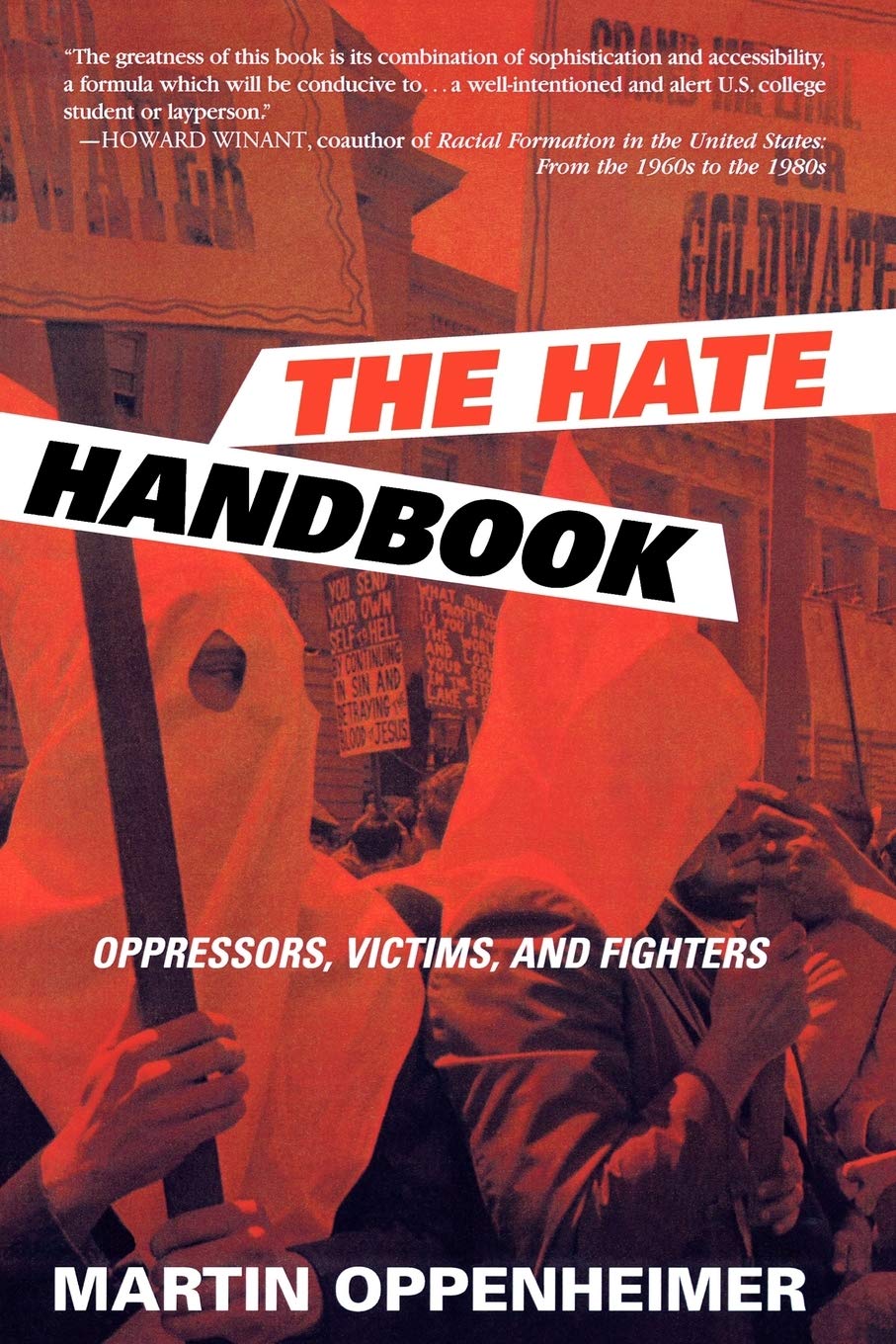
Why, in this supposedly rational, early twentyfirst century, do large groups of people hate other groups of people and murder them wholesale? Pick up the paper any day of the week: Terrorists, torturers, mass murderers in and out of uniform, extremists of all nationalities, races, ethnic groups, and religions. How do such people justify their violence? What motivates them? What social conditions contribute to climates of hatred? How do those victimized by bigotry fight back? In The Hate Handbook: Oppressors, Victims and Fighters Martin Oppenheimer sets out to answer these questions in clear, conversational, and at times shockingly frank prose. Oppenheimer focuses on cases in recent history, from incidents of police brutality to Nazi executions, from wartime aerial bombing to suicide bombers, in order to shed sociological and psychological light on the behavior of both perpetrators and victims. Heralded by many as a terrific book for the layman and scholar alike, The Hate Handbook is an important core text for sociology, social psychology, history and political science courses, especially those focusing on minorities, conflict and social movements.
⚠️ WARNING (California Proposition 65):
This product may contain chemicals known to the State of California to cause cancer, birth defects, or other reproductive harm.
For more information, please visit www.P65Warnings.ca.gov.
- Q: What is the main topic of 'The Hate Handbook'? A: 'The Hate Handbook' explores the complex reasons behind hatred and violence in society, examining the motivations of oppressors, victims, and fighters.
- Q: Who is the author of 'The Hate Handbook'? A: The author of 'The Hate Handbook' is Martin Oppenheimer, who presents a sociological perspective on issues of hatred and conflict.
- Q: What type of binding does 'The Hate Handbook' have? A: 'The Hate Handbook' is available in paperback binding, making it accessible for readers who prefer physical copies.
- Q: How many pages are in 'The Hate Handbook'? A: 'The Hate Handbook' contains 128 pages, providing a concise yet informative examination of its themes.
- Q: When was 'The Hate Handbook' published? A: 'The Hate Handbook' was published on October 12, 2005.
- Q: What condition is the book in? A: 'The Hate Handbook' is listed as a new book in good condition.
- Q: What categories does 'The Hate Handbook' fall under? A: 'The Hate Handbook' is categorized under Ethics & Morality, making it suitable for courses in sociology, social psychology, history, and political science.
- Q: What kind of insights can readers expect from 'The Hate Handbook'? A: Readers can expect clear and frank insights into the sociological and psychological aspects of hatred, supported by historical examples.
- Q: Is 'The Hate Handbook' suitable for academic use? A: 'The Hate Handbook' is regarded as an important core text for academic courses focusing on minorities, conflict, and social movements.
- Q: What unique perspectives does Oppenheimer provide in this book? A: Oppenheimer provides a unique perspective by analyzing contemporary cases of violence, such as police brutality and acts of terrorism, to understand the dynamics of oppressors and victims.