
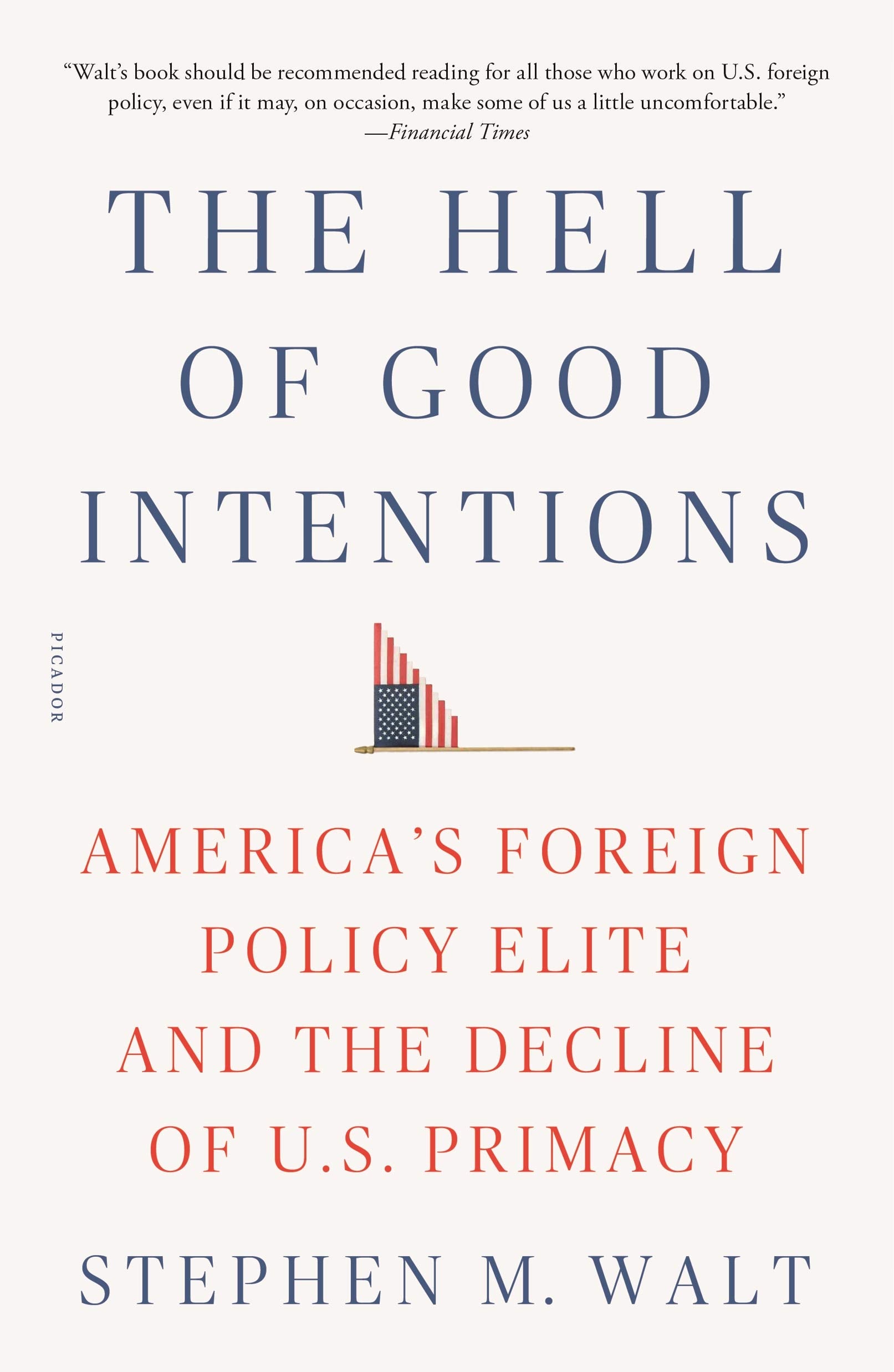
Title
The Hell Of Good Intentions: America'S Foreign Policy Elite And The Decline Of U.S. Primacy
Sold by Ergodebooks, an authorized reseller.
Returns accepted within 30 days | support@ergodebooks.com
Shipping Information
- Free Standard Shipping — United States only
- Processing Time: 3–5 business days
- Estimated Delivery: 6–10 business days after dispatch
- Double-boxed, fully insured & discreetly packaged
- Tracking number sent via email once dispatched
Returns & Refund
Returns accepted within 30 days of delivery.
Damaged or Defective Item
Free return shipping + replacement or full refund
Wrong Item Received
Free return shipping + replacement or full refund
Change of Mind
Return shipping at customer's expense · 25% restocking fee applies
Payment Option

From The New York Timesbestselling Author Stephen M. Walt, The Hell Of Good Intentions Dissects The Faults And Foibles Of Recent American Foreign Policyexplaining Why It Has Been Plagued By Disasters Like The Forever Wars In Iraq And Afghanistan And Outlining What Can Be Done To Fix It.In 1992, The United States Stood At The Pinnacle Of World Power And Americans Were Confident That A New Era Of Peace And Prosperity Was At Hand. Twentyfive Years Later, Those Hopes Have Been Dashed. Relations With Russia And China Have Soured, The European Union Is Wobbling, Nationalism And Populism Are On The Rise, And The United States Is Stuck In Costly And Pointless Wars That Have Squandered Trillions Of Dollars And Undermined Its Influence Around The World.The Root Of This Dismal Record, Walt Argues, Is The American Foreign Policy Establishments Stubborn Commitment To A Strategy Of Liberal Hegemony. Since The End Of The Cold War, Republicans And Democrats Alike Have Tried To Use U.S. Power To Spread Democracy, Open Markets, And Other Liberal Values Into Every Nook And Cranny Of The Planet. This Strategy Was Doomed To Fail, But Its Proponents In The Foreign Policy Elite Were Never Held Accountable And Kept Repeating The Same Mistakes.Donald Trump Won The Presidency Promising To End The Misguided Policies Of The Foreign Policy Blob And To Pursue A Wiser Approach. But His Erratic And Impulsive Style Of Governing, Combined With A Deeply Flawed Understanding Of World Politics, Are Making A Bad Situation Worse. The Best Alternative, Walt Argues, Is A Return To The Realist Strategy Of Offshore Balancing, Which Eschews Regime Change, Nationbuilding, And Other Forms Of Global Social Engineering. The American People Would Surely Welcome A More Restrained Foreign Policy, One That Allowed Greater Attention To Problems Here At Home. This Longoverdue Shift Will Require Abandoning The Futile Quest For Liberal Hegemony And Building A Foreign Policy Establishment With A More Realistic View Of American Power.Cleareyed, Candid, And Elegantly Written, Stephen M. Walts The Hell Of Good Intentions Offers Both A Compelling Diagnosis Of Americas Recent Foreign Policy Follies And A Proven Formula For Renewed Success.
⚠️ WARNING (California Proposition 65):
This product may contain chemicals known to the State of California to cause cancer, birth defects, or other reproductive harm.
For more information, please visit www.P65Warnings.ca.gov.
- Q: How many pages does this book have? A: This book has four hundred pages. It provides a comprehensive analysis of American foreign policy and its implications.
- Q: What is the binding type of this book? A: The binding type is paperback. This makes it lightweight and easy to handle for reading.
- Q: What are the dimensions of this book? A: The dimensions are five point four inches in length, zero point seventy-five inches in width, and eight point twenty-seven inches in height. These measurements make it a convenient size for reading.
- Q: Who is the author of 'The Hell of Good Intentions'? A: The author is Stephen M. Walt. He is a New York Times bestselling author known for his insights into foreign policy.
- Q: What is the main theme of this book? A: The main theme is the critique of America's foreign policy elite and their commitment to liberal hegemony. It discusses the consequences of this approach.
- Q: Is this book suitable for students? A: Yes, this book is suitable for students interested in political science and international relations. It provides valuable insights into U.S. foreign policy.
- Q: How can I apply the concepts from this book? A: You can apply the concepts by analyzing current foreign policy decisions through a realist lens. The book encourages critical thinking about international relations.
- Q: What audience is this book intended for? A: This book is intended for readers interested in foreign policy and international relations. It appeals to both scholars and general readers.
- Q: Can I use this book for a research paper? A: Yes, you can use this book for a research paper. It provides a well-researched perspective on American foreign policy.
- Q: How should I store this book to keep it in good condition? A: Store the book in a cool, dry place away from direct sunlight. This helps preserve the binding and pages.
- Q: Is there any specific care needed for this paperback book? A: No specific care is needed beyond regular handling. Avoid exposing it to moisture to prevent damage.
- Q: What if the book arrives damaged? A: If the book arrives damaged, you should contact the seller for a return or replacement. Most sellers offer a return policy for damaged goods.
- Q: Is this book available in digital format? A: Yes, this book is available in digital format. You can find it on various e-book platforms for convenient access.
- Q: What kind of issues does the book address? A: The book addresses issues related to U.S. foreign policy failures and suggests a shift toward a more realistic approach. It critiques past strategies.
- Q: Are there any specific political theories discussed in the book? A: Yes, the book discusses realist theories in international relations. It emphasizes the need for a more prudent foreign policy.
- Q: Can I find reviews of this book online? A: Yes, you can find numerous reviews of this book online. Many readers and critics have shared their thoughts on its themes and arguments.