
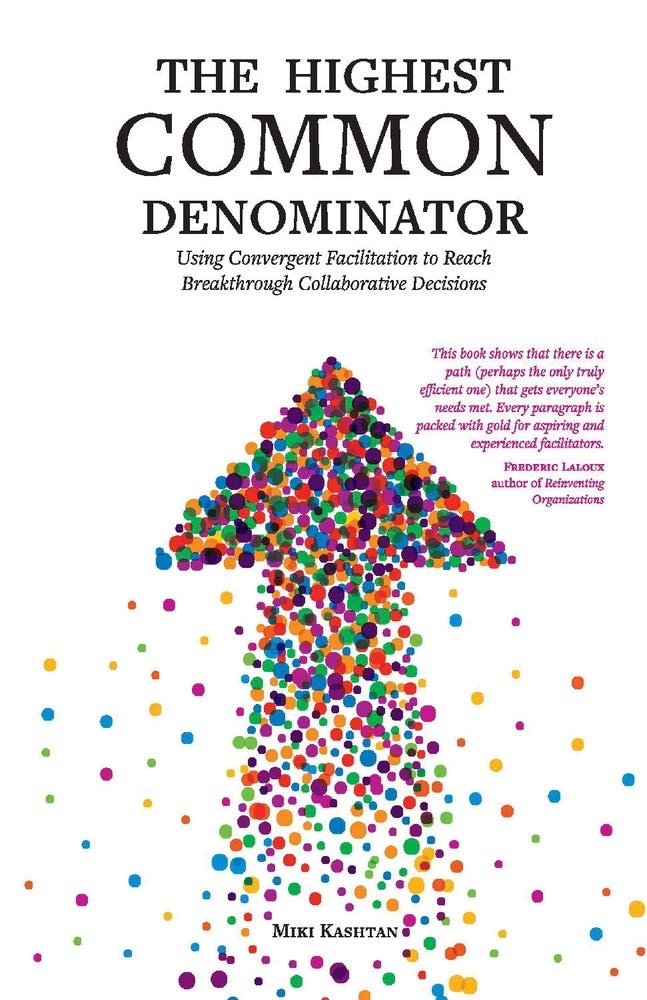
Title
The Highest Common Denominator: Using Convergent Facilitation to Reach Breakthrough Collaborative Decisions,Used
Sold by Ergodebooks, an authorized reseller.
Returns accepted within 30 days | support@ergodebooks.com
Shipping Information
- Free Standard Shipping — United States only
- Processing Time: 3–5 business days
- Estimated Delivery: 6–10 business days after dispatch
- Double-boxed, fully insured & discreetly packaged
- Tracking number sent via email once dispatched
Returns & Refund
Returns accepted within 30 days of delivery.
Damaged or Defective Item
Free return shipping + replacement or full refund
Wrong Item Received
Free return shipping + replacement or full refund
Change of Mind
Return shipping at customer's expense · 25% restocking fee applies
Payment Option

What if people even longtime enemies could transform conflicts into creative dilemmas they feel motivated to solve together in an atmosphere that builds connection and trust? What if employees could leave a meeting empowered and with a joint sense of purpose? What if the positive changes community activists are working so hard to see in the world could have a lasting impact?The traditional ways we make decisions are flawed. Majority rule, topdown orders, compromise, and consensus lead to people feeling disconnected, drained of energy, and unsatisfied. "THE HIGHEST COMMON DENOMINATOR: Using Convergent Facilitation to Reach Breakthrough Collaborative Decisions" presents a better way to make decisions using Convergent Facilitation, the method Miki developed after years of working with groups in a variety of settings. Miki posits that collaborative decisionmaking, where people feel heard and their needs respected in a structured and trusting environment, maximizes willingness and efficiency for all. This can lay the ground for breakthroughs for groups working on challenges, allowing decisions to be made at lightning speed. The process includes three phases that can bring groups to outcomes that are profoundly collaborative and genuinely supported by all.THE HIGHEST COMMON DENOMINATOR gives readers examples, tools, and processes to implement Convergent Facilitation. It includes vivid case studies and practical examples to explain how to guide people towards solutions that integrate everyones needs and concerns and dont require compromise; provides tips on how to keep people on track with the task at hand; and encourages facilitators to invite dissent and engage with it productively.One case study explores the revision of child custody laws in Minnesota. Lawmakers had been struggling for years to write new legislation that would satisfy stakeholders. When Miki began working with them, many regarded each other with deep mistrust and believed no new laws could be created. The process ended with the creation of legislation that was passed nearunanimously by the state legislature. One of the participants later described it as "a transformative experience."In workplace settings, Miki explores how companies can truly achieve a collaborative culture, where employees feel heard and are motivated. Stuart Thorn, retired President and CEO of the Southwire Company, wanted to achieve a truly collaborative culture for his multibilliondollar company, all the while he was experiencing friction between division managers and leadership. After bringing Miki in personally to bring his own team toward convergence, he reflects that after reading THE HIGHEST COMMON DENOMINATOR, "I can see that her ability to draw out insights about the inner workings of organizations is not effortless at all, but rather based on a very conscious, thoughtful, and deliberate approach carefully developed over many years of practice and experimentation. This is good news. It means that Mikis skills are transferable."The procedures described in this book can be used in any kind of settingfrom grassroots social change movements to village councils to corporate boardroomswhere people are having trouble collaborating effectively in a group, which is almost everywhere. With the mounting social, political, and environmental problems of our times, harnessing a groups energy for effective action is essential. And yet many people drift away from organizations they care about due to their inability to sit through meetingswhere tensions may remain unresolved, power differences are not addressed, and solutions that work for all do not seem available.Ultimately, this book is not just about working with groups. It is an entire reexamination and affirmation of the human heart. Facilitation involves transparency on the part of the one leading it, as well as a deep faith and hope in how even impossibleseeming differences can transform into unity.
⚠️ WARNING (California Proposition 65):
This product may contain chemicals known to the State of California to cause cancer, birth defects, or other reproductive harm.
For more information, please visit www.P65Warnings.ca.gov.
- Q: How many pages does this book have? A: This book has three hundred forty pages. It provides a comprehensive exploration of collaborative decision-making methods.
- Q: What is the binding type of this book? A: The book is paperback bound. This allows for flexibility and ease of handling during reading.
- Q: What are the dimensions of the book? A: The dimensions of the book are five point five one inches by eight point five inches by zero point nine one inches. These measurements make it easy to carry and store.
- Q: How do I use this book effectively? A: To use this book effectively, read through the case studies and apply the suggested facilitation methods to your group settings. Engaging with the examples will enhance your understanding of collaborative decision-making.
- Q: Is this book suitable for beginners in facilitation? A: Yes, this book is suitable for beginners. It provides clear explanations and practical tools that anyone can understand and apply.
- Q: Can this book help in workplace settings? A: Yes, this book is designed to improve collaboration in workplace settings. It offers insights on creating a collaborative culture among employees.
- Q: How should I store this book? A: Store this book in a dry place, away from direct sunlight. Keeping it in a cool, dry environment will help preserve its condition.
- Q: Can I lend this book to others? A: Yes, you can lend this book to others. It's a great resource for anyone interested in enhancing group decision-making skills.
- Q: What if the book arrives damaged? A: If the book arrives damaged, you should contact the seller for a return or exchange. Most retailers have policies to address such issues.
- Q: Is there a warranty for this book? A: No, there is typically no warranty for books. However, you can inquire about return policies with the seller.
- Q: What are the key themes of this book? A: The key themes include collaborative decision-making, trust-building, and conflict transformation. These themes are explored through practical examples and case studies.
- Q: Who is the author of this book? A: The author of this book is Miki Kashtan. She is known for her work in facilitation and collaborative decision-making.
- Q: Is there a digital version of this book? A: Yes, there may be a digital version available for purchase. Check with the publisher or online retailers for eBook options.
- Q: What genre does this book belong to? A: This book belongs to the Social Work genre. It focuses on collaborative approaches to decision-making in various social contexts.
- Q: Are there exercises included in this book? A: Yes, the book includes exercises and tools to practice the concepts discussed. Engaging with these exercises can enhance your learning experience.