
Title
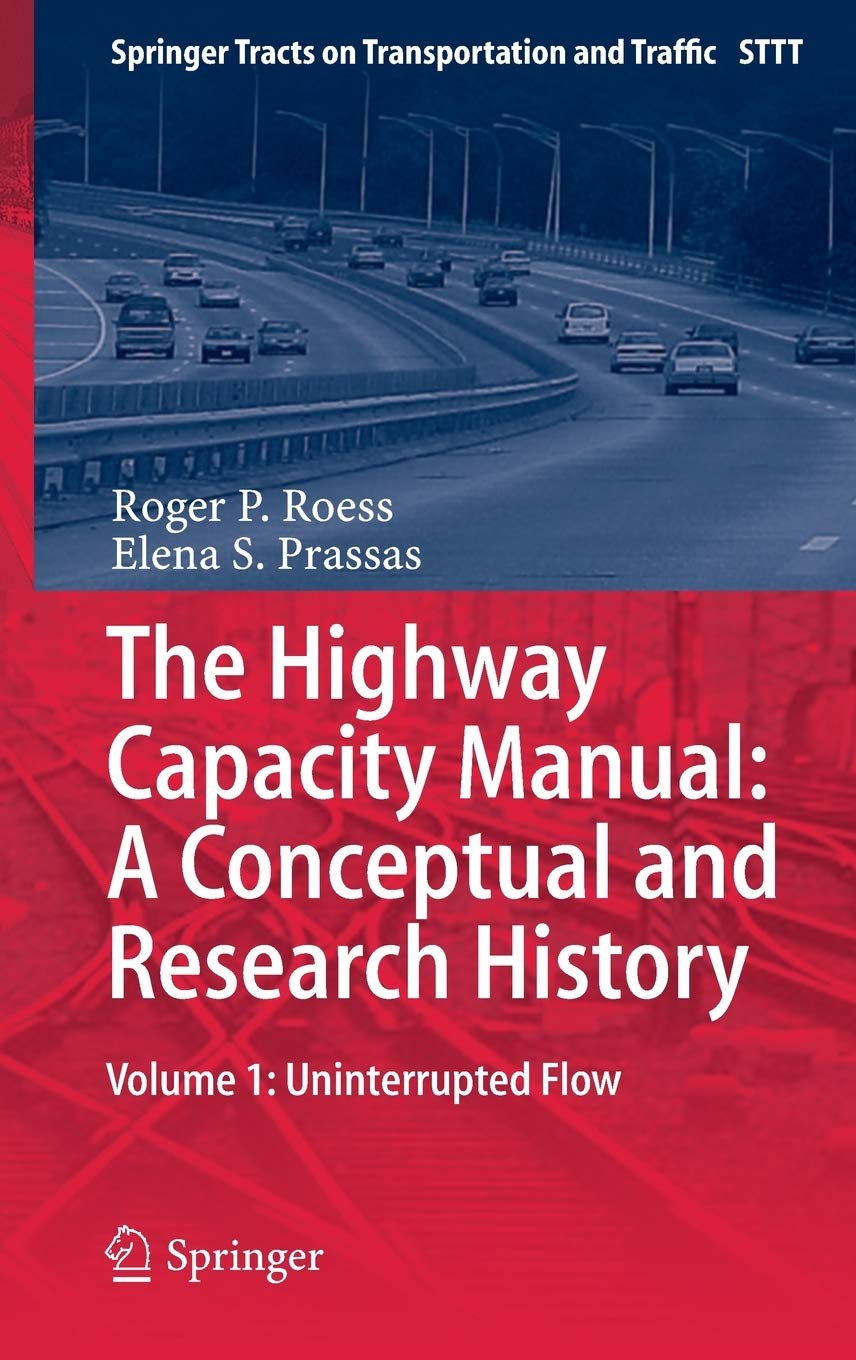
The Highway Capacity Manual: A Conceptual and Research History: Volume 1: Uninterrupted Flow (Springer Tracts on Transportation ,Used
Sold by Ergodebooks, an authorized reseller.
Returns accepted within 30 days | support@ergodebooks.com
Shipping Information
- Free Standard Shipping — United States only
- Processing Time: 3–5 business days
- Estimated Delivery: 6–10 business days after dispatch
- Double-boxed, fully insured & discreetly packaged
- Tracking number sent via email once dispatched
Returns & Refund
Returns accepted within 30 days of delivery.
Damaged or Defective Item
Free return shipping + replacement or full refund
Wrong Item Received
Free return shipping + replacement or full refund
Change of Mind
Return shipping at customer's expense · 25% restocking fee applies
Payment Option

Since 1950, the Highway Capacity Manual has been a standard used in theplanning, design, analysis, and operation of virtually any highway traffic facilityin the United States. It has also been widely used abroad, and has spurred thedevelopment of similar manuals in other countries.The twin concepts of capacity and level of service have been developedin the manual, and methodologies have been presented that allow highwaytraffic facilities to be designed on a common basis, and allow for the analysis ofoperational quality under various traffic demand scenarios. The manual alsoaddresses related pedestrian, bicycle, and transit issues.This book details the fundamental development of the concepts ofcapacity and level of service, and of the specific methodologies developed todescribe them over a wide range of facility types. The book is comprised of twovolumes. Volume 1 (this book) focuses on the development of basic principles,and their application to uninterrupted flow facilities: freeways, multilanehighways, and twolane highways. Weaving, merging, and diverging segmentson freeways and multilane highways are also discussed in detail. Volume 2focuses on interrupted flow facilities: signalized and unsignalized intersections, urban streets and arterials. It is intended to help users of the manual understand how concepts,approaches, and specific methodologies were developed, and to understand theunderlying principles that each embodies. It is also intended to act as a basicreference for current and future researchers who will continue to developnewand improved capacity analysis methodologies for many years to come.
⚠️ WARNING (California Proposition 65):
This product may contain chemicals known to the State of California to cause cancer, birth defects, or other reproductive harm.
For more information, please visit www.P65Warnings.ca.gov.