
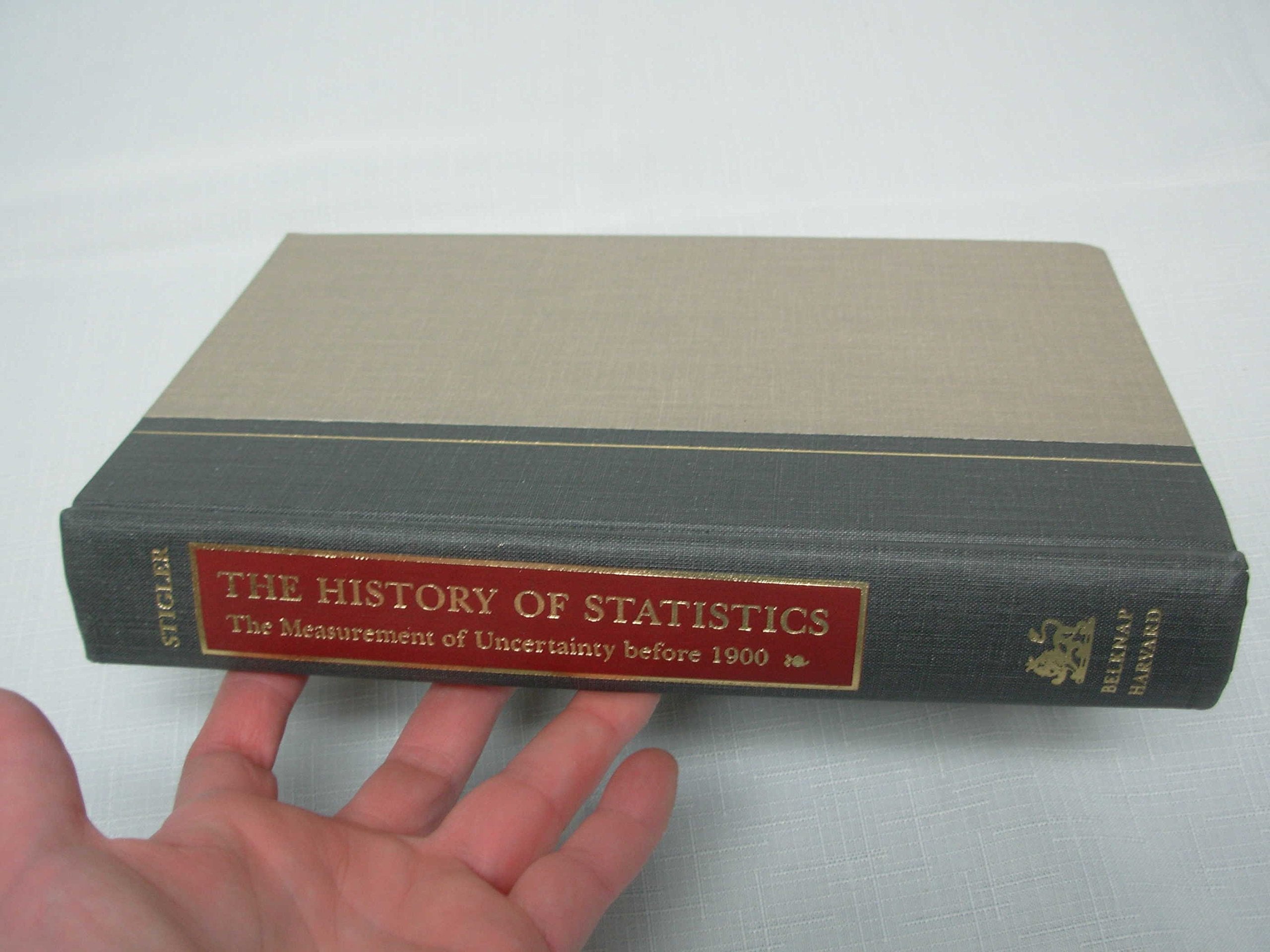
Title
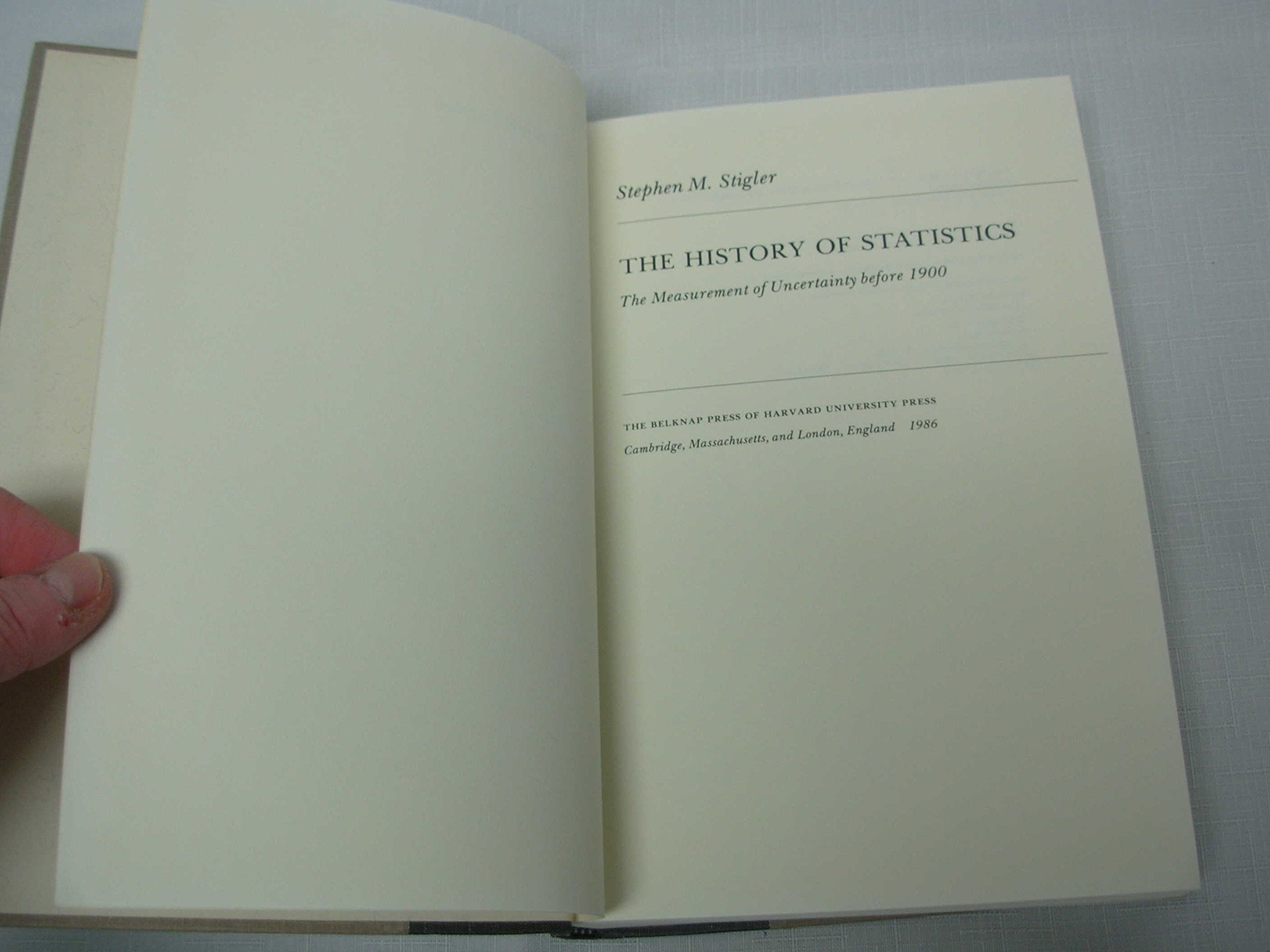
The History Of Statistics: The Measurement Of Uncertainty Before 1900,New
Sold by Ergodebooks, an authorized reseller.
Returns accepted within 30 days | support@ergodebooks.com
Shipping Information
- Free Standard Shipping — United States only
- Processing Time: 3–5 business days
- Estimated Delivery: 6–10 business days after dispatch
- Double-boxed, fully insured & discreetly packaged
- Tracking number sent via email once dispatched
Returns & Refund
Returns accepted within 30 days of delivery.
Damaged or Defective Item
Free return shipping + replacement or full refund
Wrong Item Received
Free return shipping + replacement or full refund
Change of Mind
Return shipping at customer's expense · 25% restocking fee applies
Payment Option

This Magnificent Book Is The First Comprehensive History Of Statistics From Its Beginnings Around 1700 To Its Emergence As A Distinct And Mature Discipline Around 1900. Stephen M. Stigler Shows How Statistics Arose From The Interplay Of Mathematical Concepts And The Needs Of Several Applied Sciences Including Astronomy, Geodesy, Experimental Psychology, Genetics, And Sociology. He Addresses Many Intriguing Questions: How Did Scientists Learn To Combine Measurements Made Under Different Conditions? And How Were They Led To Use Probability Theory To Measure The Accuracy Of The Result? Why Were Statistical Methods Used Successfully In Astronomy Long Before They Began To Play A Significant Role In The Social Sciences? How Could The Introduction Of Least Squares Predate The Discovery Of Regression By More Than Eighty Years? On What Grounds Can The Major Works Of Men Such As Bernoulli, De Moivre, Bayes, Quetelet, And Lexis Be Considered Partial Failures, While Those Of Laplace, Galton, Edgeworth, Pearson, And Yule Are Counted As Successes? How Did Galtons Probability Machine (The Quincunx) Provide Him With The Key To The Major Advance Of The Last Half Of The Nineteenth Century?Stiglers Emphasis Is Upon How, When, And Where The Methods Of Probability Theory Were Developed For Measuring Uncertainty In Experimental And Observational Science, For Reducing Uncertainty, And As A Conceptual Framework For Quantitative Studies In The Social Sciences. He Describes With Care The Scientific Context In Which The Different Methods Evolved And Identifies The Problems (Conceptual Or Mathematical) That Retarded The Growth Of Mathematical Statistics And The Conceptual Developments That Permitted Major Breakthroughs.Statisticians, Historians Of Science, And Social And Behavioral Scientists Will Gain From This Book A Deeper Understanding Of The Use Of Statistical Methods And A Better Grasp Of The Promise And Limitations Of Such Techniques. The Product Of Ten Years Of Research, The History Of Statistics Will Appeal To All Who Are Interested In The Humanistic Study Of Science.
⚠️ WARNING (California Proposition 65):
This product may contain chemicals known to the State of California to cause cancer, birth defects, or other reproductive harm.
For more information, please visit www.P65Warnings.ca.gov.
- Q: How many pages does this book have? A: This book has four hundred twenty-eight pages. It provides a comprehensive exploration of the history and development of statistics.
- Q: What is the binding type of this book? A: This book is a paperback. Paperback bindings are flexible and lightweight, making it easy to handle and read.
- Q: What are the dimensions of this book? A: The book measures six point fourteen inches in length, one point zero seven inches in width, and nine point twenty-five inches in height. These dimensions make it a suitable size for both reading and shelf storage.
- Q: Who is the author of this book? A: The author is Stephen M. Stigler. He is well-known for his contributions to the history of statistics.
- Q: What is the main subject of this book? A: The main subject is the history of statistics. It covers the development of statistical methods from around seventeen hundred to nineteen hundred.
- Q: Is this book suitable for beginners in statistics? A: Yes, this book is suitable for beginners. It provides a foundational understanding of the evolution and significance of statistical methods.
- Q: What kind of insights does this book provide? A: This book provides insights into the interplay between mathematical concepts and applied sciences. Readers will learn about key figures and methods in the development of statistics.
- Q: Can this book help historians of science? A: Yes, historians of science will benefit from this book. It offers a detailed narrative of how statistical methods evolved within various scientific contexts.
- Q: Is this book recommended for social scientists? A: Yes, social scientists will find this book valuable. It highlights the use and limitations of statistical methods in social science research.
- Q: What is the condition of this used book? A: The book is in good condition. It is previously owned but remains a reliable resource for readers.
- Q: What type of research went into this book? A: The book is the product of ten years of research. It reflects a thorough investigation into the history and methodology of statistics.
- Q: Does this book address the works of famous statisticians? A: Yes, the book discusses the works of notable statisticians like Bernoulli, Bayes, and Laplace. It analyzes their contributions and the impact on the field.
- Q: Are there any unique questions explored in this book? A: Yes, the book explores intriguing questions about the evolution of statistical methods. It delves into how these methods were developed and adopted across various fields.
- Q: What is the publisher of this book? A: The publisher is Harvard University Press, specifically under the Belknap Press imprint.
- Q: Is the content of this book relevant for behavioral scientists? A: Yes, the content is relevant for behavioral scientists. It provides a deeper understanding of statistical methods applicable to their research.
- Q: Does this book have a focus on probability theory? A: Yes, the book emphasizes the development of probability theory. It discusses how probability was used to measure uncertainty in scientific studies.