
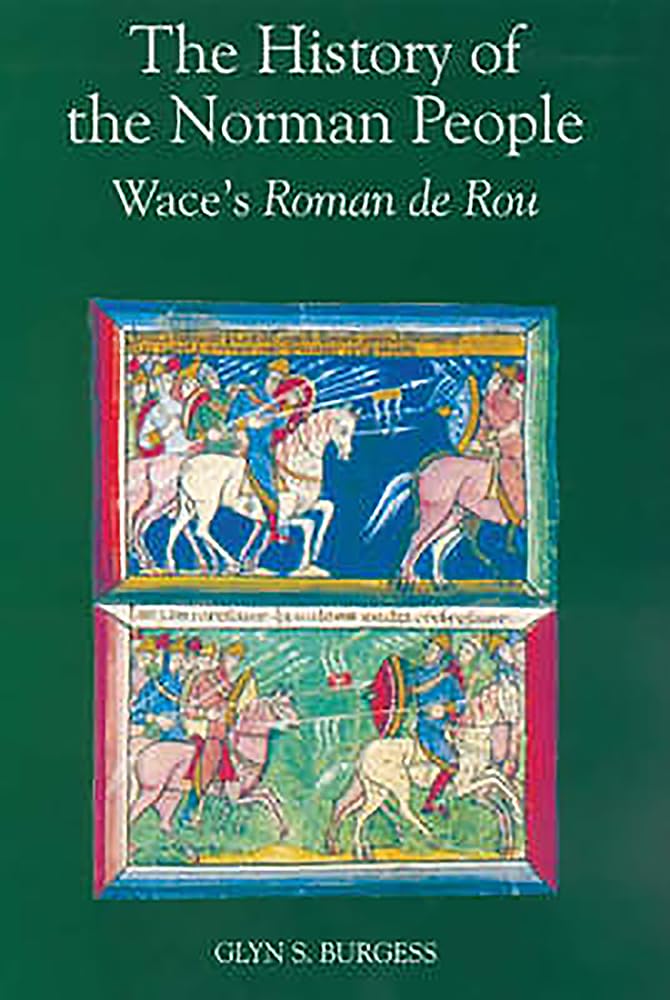
Title
The History of the Norman People: Wace's Roman de Rou,Used
Sold by Ergodebooks, an authorized reseller.
Returns accepted within 30 days | support@ergodebooks.com
Shipping Information
- Free Standard Shipping — United States only
- Processing Time: 3–5 business days
- Estimated Delivery: 6–10 business days after dispatch
- Double-boxed, fully insured & discreetly packaged
- Tracking number sent via email once dispatched
Returns & Refund
Returns accepted within 30 days of delivery.
Damaged or Defective Item
Free return shipping + replacement or full refund
Wrong Item Received
Free return shipping + replacement or full refund
Change of Mind
Return shipping at customer's expense · 25% restocking fee applies
Payment Option

Wace's Roman de Rou relates the origins of Normandy from the time of Rollo (Rou) to the battle of Tinchebray. It was commissioned by Henry II as a way of both celebrating the Norman past and justifying the right of Norman rulers to the throne of England: the accounts it gives of the early life of William the Conqueror and of the battle of Hastings, which occupy a substantial portion of the work, make it a valuable historical document as well as an important work of literature. Wace related the events partly in Alexandrines and partly in the octosyllabic rhyming couplets used by the romance writers of the day; indeed, at a time when the boundary between romance and history was blurred, he created a cast of characters and recounted a series of battles and adventures in a style worthy of any of the great masters of romance. He was also exceptionally good, like other contemporary romance writers, at realistic conversations, such as those between King Harold and his brother Gyrth before the battle of Hastings. As a historian, Wace was dedicated to the truth and willing to undertake personal research in order to verify the accuracyof his statements. As a storyteller, he had the ability to render events more dramatic by showing how they arose from the interplay of human beings.The translation, by GLYN S. BURGESS, is accompanied by full editorial notes(in collaboration with Elisabeth van Houts) and an introduction; the volume is completed by a critical essay by Professor van Houts.GLYN S. BURGESS is Emeritus Professor of the University of Liverpool; ELISABETH VAN HOUTS lectures in medieval history, University of Cambridge.
⚠️ WARNING (California Proposition 65):
This product may contain chemicals known to the State of California to cause cancer, birth defects, or other reproductive harm.
For more information, please visit www.P65Warnings.ca.gov.