
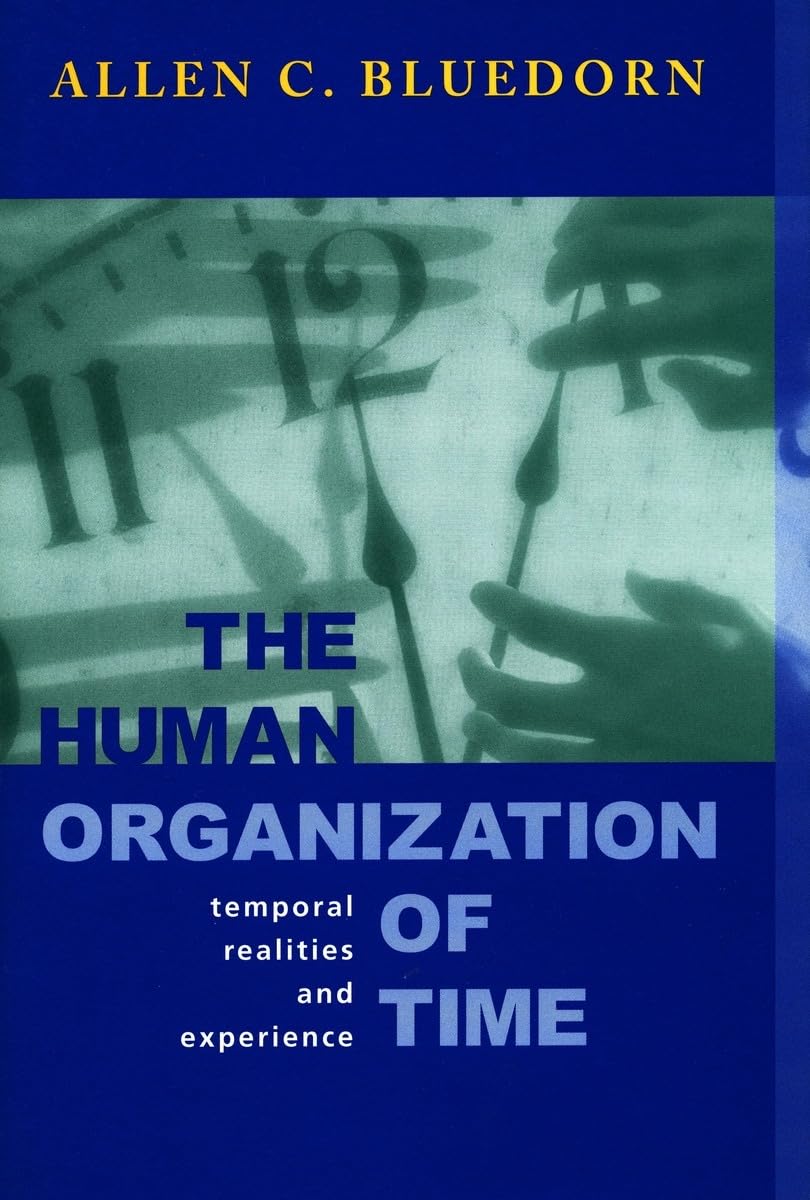
Title
The Human Organization Of Time: Temporal Realities And Experience (Stanford Business Books),Used
Sold by Ergodebooks, an authorized reseller.
Returns accepted within 30 days | support@ergodebooks.com
Shipping Information
- Free Standard Shipping — United States only
- Processing Time: 3–5 business days
- Estimated Delivery: 6–10 business days after dispatch
- Double-boxed, fully insured & discreetly packaged
- Tracking number sent via email once dispatched
Returns & Refund
Returns accepted within 30 days of delivery.
Damaged or Defective Item
Free return shipping + replacement or full refund
Wrong Item Received
Free return shipping + replacement or full refund
Change of Mind
Return shipping at customer's expense · 25% restocking fee applies
Payment Option

What is time then? asked St. Augustine some 1,600 years ago. It was a question he could not answer, and over the centuries that followed, it was one that few scholars dared to address. Yet there are answers to this question of the true nature of time, and this book discusses several of them as a means of approaching its central concern: that humanity creates a variety of times and these different times affect the experiences of lifeas times vary, so does life. Not so much focusing on watches, clocks, and calendars (though these are covered), the author argues that time is a fundamental component of the technological development of humanity. The book addresses the relationships between time and life on three fundamental premises: (1) all times are not the same, (2) all times are social constructions, and (3) the times humanity creates direct the way humanity lives. The book addresses the major ways in which times differ (polychronicity, speed and punctuality, and orientation to past, present and future), how these differences are coordinated (entrainment), and how these differences affect human life, including such extreme effects that produce the best and worst of times. Building on these differences and the effects they produce, the author examines the possibility of humanity consciously creating more good times than bad. Throughout the analysis, a vital connection between time and life gradually emerges, namely, the impact of time on the meaning of life itself. Materials from several disciplines inform the discussions, notably theory and research from the social and behavioral sciences, in particular the organization sciences. The author uses historical examples extensively throughout the book, but also presents new results that derive from original data he has collected. The book will be valuable not only to those involved in the management and organization sciences, but also to sociologists and psychologists, who have largely avoided coming to terms with one of the central issues of human lifetime.
⚠️ WARNING (California Proposition 65):
This product may contain chemicals known to the State of California to cause cancer, birth defects, or other reproductive harm.
For more information, please visit www.P65Warnings.ca.gov.
- Q: What are the dimensions of the book? A: The book measures six inches in length, one point fifteen inches in width, and nine point zero two inches in height.
- Q: How many pages does this book have? A: This book contains three hundred eighty-two pages.
- Q: What type of binding does the book have? A: The book is bound in hardcover.
- Q: Who is the author of 'The Human Organization of Time'? A: The author of this book is Allen C. Bluedorn.
- Q: What is the genre of this book? A: This book is categorized under Time and falls within the realm of business literature.
- Q: Is this book suitable for beginners in the subject? A: Yes, this book is suitable for beginners as it introduces fundamental concepts of time and its impact on life.
- Q: What themes are explored in the book? A: The book explores themes such as the social construction of time and its effects on human experiences.
- Q: How do I approach reading this book? A: You can approach reading this book by engaging with its historical examples and considering the theoretical frameworks presented.
- Q: Can I read this book if I have no background in social sciences? A: Yes, you can read this book without a background in social sciences, as it provides accessible insights into the nature of time.
- Q: How should I store the book to keep it in good condition? A: Store the book upright on a shelf in a cool, dry place to maintain its condition.
- Q: Is there a specific way to clean the book? A: Yes, clean the book by gently wiping the cover with a dry cloth to avoid damage.
- Q: What should I do if the book arrives damaged? A: If the book arrives damaged, you should contact the seller for return or exchange options.
- Q: How do I ensure the book lasts a long time? A: To ensure the book lasts, handle it with care and store it properly, avoiding exposure to moisture.
- Q: Is this book valuable for professionals in organization sciences? A: Yes, this book is valuable for professionals in organization sciences as it addresses key issues related to time management.
- Q: How can this book benefit sociologists? A: This book can benefit sociologists by providing insights into the social implications of time in human life.
- Q: What if I want to return the book after purchase? A: If you want to return the book after purchase, check the return policy outlined by the seller for instructions.