If you have any questions, you are always welcome to contact us. We'll get back to you as soon as possible, withing 24 hours on weekdays.
Customer service
All questions about your order, return and delivery must be sent to our customer service team by e-mail at yourstore@yourdomain.com
Sale & Press
If you are interested in selling our products, need more information about our brand or wish to make a collaboration, please contact us at press@yourdomain.com
Help
If you have any questions, you are always welcome to contact us. We'll get back to you as soon as possible, withing 24 hours on weekdays.
Customer service
All questions about your order, return and delivery must be sent to our customer service team by e-mail at yourstore@yourdomain.com
Sale & Press
If you are interested in selling our products, need more information about our brand or wish to make a collaboration, please contact us at press@yourdomain.com
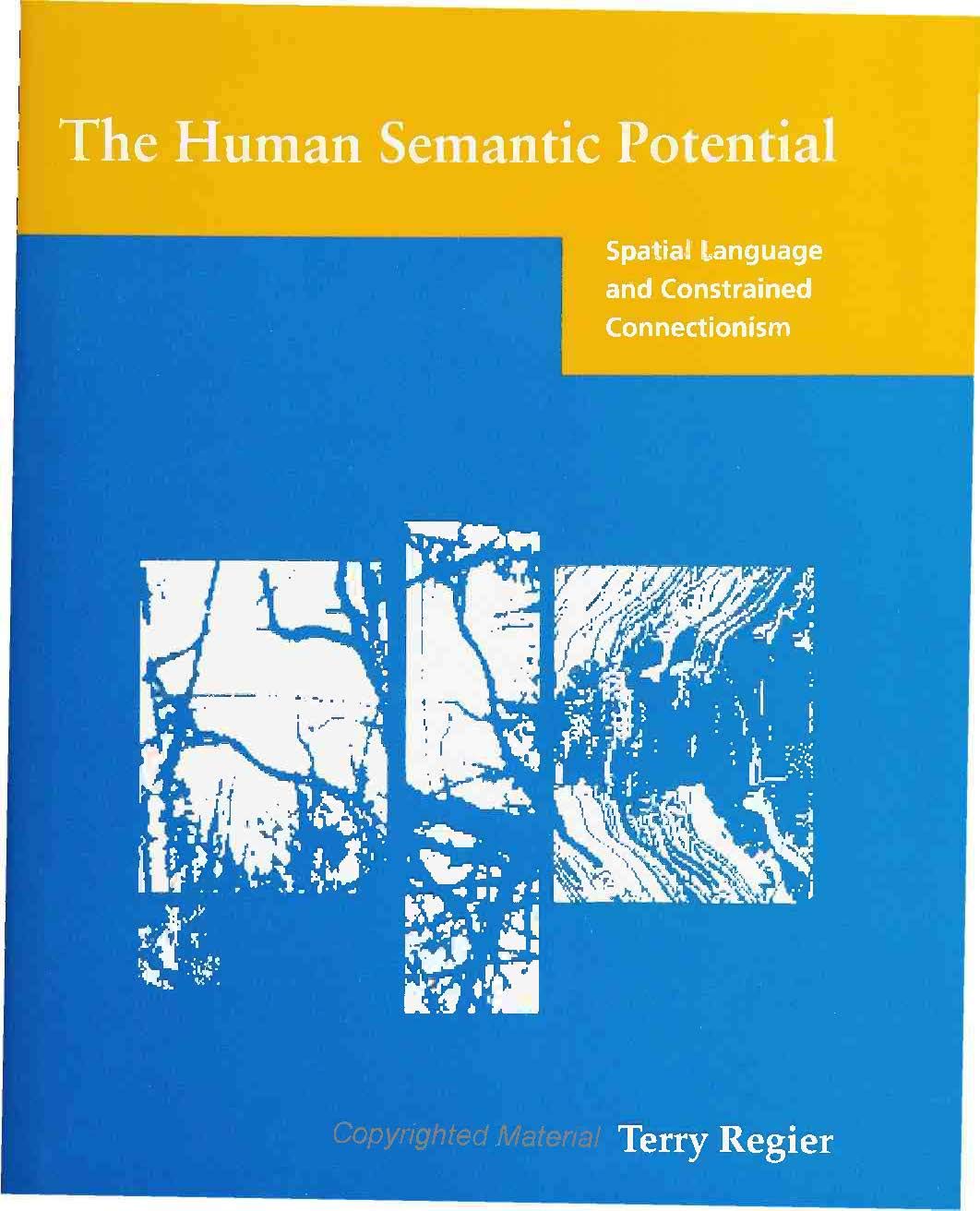
Drawing on ideas from cognitive linguistics, connectionism, and perception, The Human Semantic Potential describes a connectionist model that learns perceptually grounded semantics for natural language in spatial terms. Languages differ in the ways in which they structure space, and Regier's aim is to have the model perform its learning task for terms from any natural language. The system has so far succeeded in learning spatial terms from English, German, Russian, Japanese, and Mixtec.The model views simple movies of twodimensional objects moving relative to one another and learns to classify them linguistically in accordance with the spatial system of some natural language. The overall goal is to determine which sorts of spatial configurations and events are learnable as the semantics for spatial terms and which are not. Ultimately, the model and its theoretical underpinnings are a step in the direction of articulating biologically based constraints on the nature of human semantic systems.Along the way Regier takes up such substantial issues as the attraction and the liabilities of PDP and structured connectionist modeling, the problem of learning without direct negative evidence, and the area of linguistic universals, which is addressed in the model itself. Trained on spatial terms from different languages, the model permits observations about the possible bases of linguistic universals and interlanguage variation.
⚠️ WARNING (California Proposition 65):
This product may contain chemicals known to the State of California to cause cancer,
birth defects, or other reproductive harm.
For MAP (Minimum Advertised Price) violations and Intellectual Property (IP) or Trademark concerns, please contact:
support@ergodebooks.com
⚠️ California Proposition 65 Warning: Some products sold on this website may expose you to chemicals known to the State of California to cause cancer, birth defects, or other reproductive harm. For more information, visit www.P65Warnings.ca.gov.