
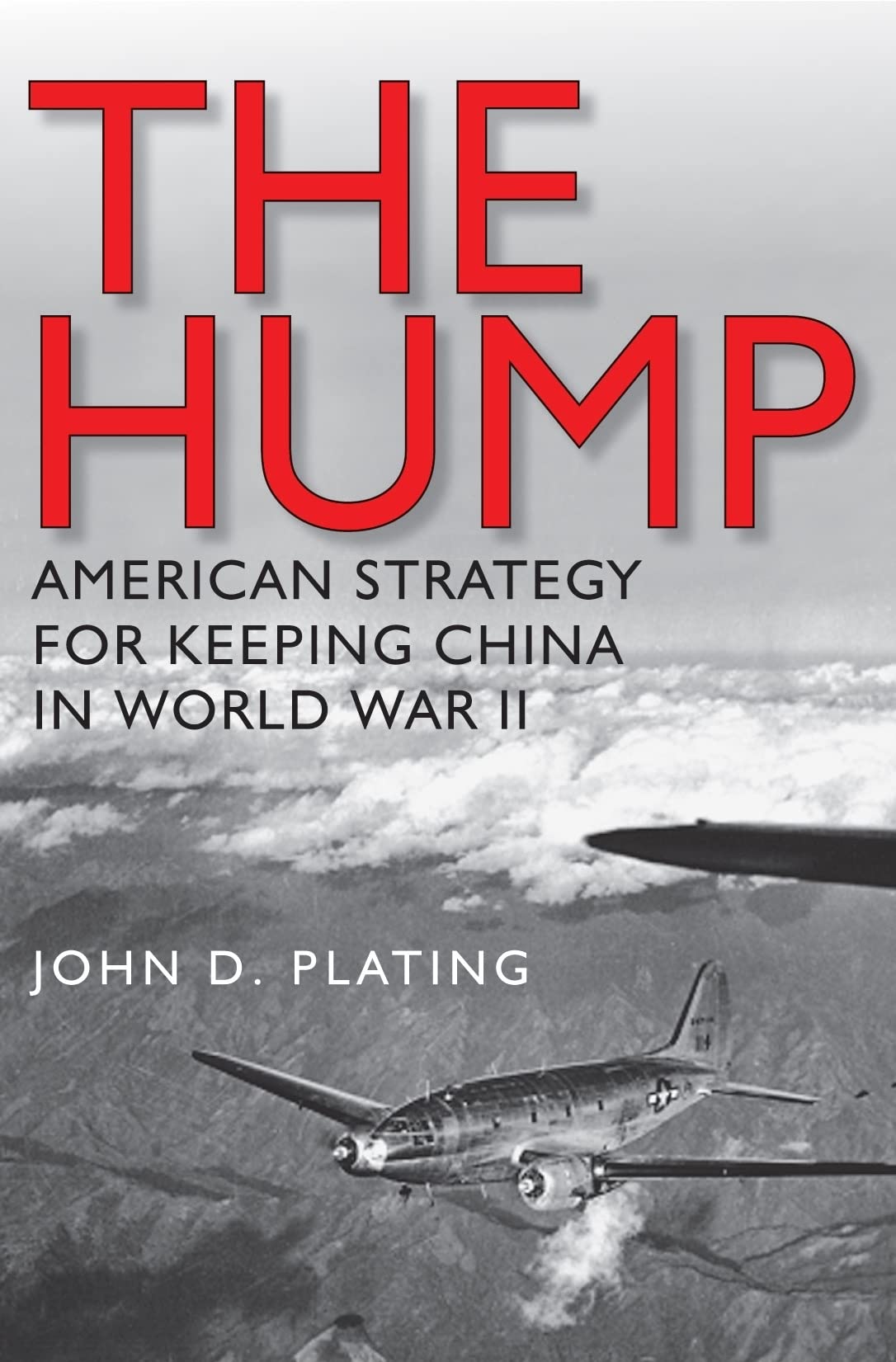
Title
The Hump: America's Strategy for Keeping China in World War II (Volume 134) (WilliamsFord Texas A&M University Military History,Used
Sold by Ergodebooks, an authorized reseller.
Returns accepted within 30 days | support@ergodebooks.com
Shipping Information
- Free Standard Shipping — United States only
- Processing Time: 3–5 business days
- Estimated Delivery: 6–10 business days after dispatch
- Double-boxed, fully insured & discreetly packaged
- Tracking number sent via email once dispatched
Returns & Refund
Returns accepted within 30 days of delivery.
Damaged or Defective Item
Free return shipping + replacement or full refund
Wrong Item Received
Free return shipping + replacement or full refund
Change of Mind
Return shipping at customer's expense · 25% restocking fee applies
Payment Option

Chronicling the most ambitious airlift in history . . .Carried out over arguably the worlds most rugged terrain, in its most inhospitable weather system, and under the constant threat of enemy attack, the transHimalayan airlift of World War II delivered nearly 740,000 tons of cargo to China, making it possible for Chinese forces to wage war against Japan. This operation dwarfed the supply delivery by land over the Burma and Ledo Roads and represented the fullest expression of the U.S. governments commitment to China.In this groundbreaking workthe first concentrated historical study of the worlds first sustained combat airlift operationJohn D. Plating argues that the Hump airlift was initially undertaken to serve as a display of American support for its Chinese ally, which had been at war with Japan since 1937. However, by 1944, with the airlifts capability gaining momentum, American strategists shifted the purpose of air operations to focus on supplying American forces in China in preparation for the U.S.s final assault on Japan. From the standpoint of war materiel, the airlift was the precondition that made possible all other allied military action in the ChinaBurmaIndia theater, where Allied troops were most commonly inserted, supplied, and extracted by air.Drawing on extensive research that includes Chinese and Japanese archives, Plating tells a spellbinding story in a context that relates it to the larger movements of the war and reveals its significance in terms of the development of military air power. The Hump demonstrates the operations farreaching legacy as it became the example and prototype of the Berlin Airlift, the first air battle of the Cold War. The Hump operation also bore significantly on the initial moves of the Chinese Civil War, when Air Transport Command aircraft moved entire armies of Nationalist troops hundreds of miles in mere days in order to prevent Communist forces from being the ones to accept the Japanese surrender.
⚠️ WARNING (California Proposition 65):
This product may contain chemicals known to the State of California to cause cancer, birth defects, or other reproductive harm.
For more information, please visit www.P65Warnings.ca.gov.
- Q: What is 'The Hump' about? A: 'The Hump' chronicles the trans-Himalayan airlift during World War II, detailing how nearly 740,000 tons of cargo were delivered to China, allowing Chinese forces to combat Japan.
- Q: Who is the author of 'The Hump'? A: The author of 'The Hump' is John D. Plating.
- Q: What is the publication date of 'The Hump'? A: 'The Hump' was published on February 8, 2011.
- Q: How many pages does 'The Hump' have? A: 'The Hump' contains 320 pages.
- Q: What format is 'The Hump' available in? A: 'The Hump' is available in hardcover format.
- Q: In what series is 'The Hump' included? A: 'The Hump' is part of the Williams-Ford Texas A&M University Military History Series.
- Q: What condition is the book 'The Hump' in? A: 'The Hump' is listed in 'Good' condition.
- Q: What historical significance does 'The Hump' cover? A: 'The Hump' covers the significance of the airlift in the China-Burma-India theater and its impact on military air power and subsequent operations.
- Q: Is 'The Hump' suitable for students of military history? A: 'The Hump' is suitable for students and enthusiasts of military history, particularly those interested in air operations during World War II.
- Q: Can I find primary sources in 'The Hump'? A: 'The Hump' draws on extensive research, including Chinese and Japanese archives, providing a well-rounded historical perspective.