
Title
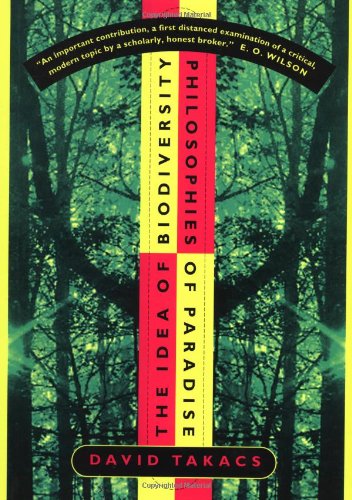
The Idea Of Biodiversity: Philosophies Of Paradise,Used
Sold by Ergodebooks, an authorized reseller.
Returns accepted within 30 days | support@ergodebooks.com
Shipping Information
- Free Standard Shipping — United States only
- Processing Time: 3–5 business days
- Estimated Delivery: 6–10 business days after dispatch
- Double-boxed, fully insured & discreetly packaged
- Tracking number sent via email once dispatched
Returns & Refund
Returns accepted within 30 days of delivery.
Damaged or Defective Item
Free return shipping + replacement or full refund
Wrong Item Received
Free return shipping + replacement or full refund
Change of Mind
Return shipping at customer's expense · 25% restocking fee applies
Payment Option

At Places Distant From Where You Are, But Also Uncomfortably Close,' Writes David Takacs, 'A Holocaust Is Under Way. People Are Slashing, Hacking, Bulldozing, Burning, Poisoning, And Otherwise Destroying Huge Swaths Of Life On Earth At A Furious Pace.' And A Cadre Of Ecologists And Conservation Biologists Has Responded, Vigorously Promoting A New Definition Of Nature: Biodiversityadvocating It In Congress And On The Tonight Show; Whispering It Into The Ears Of Foreign Leaders; Redefining The Boundaries Of Science And Politics, Ethics And Religion, Nature And Our Ideas Of Nature. These Scientists Have Infused The Environmental Movement With New Focus And Direction, But By Engaging In Such Activities, They Jeopardize The Societal Trust That Allows Them To Be Public Spokespersons For Nature In The First Place.The Idea Of Biodiversity Analyzes What Biodiversity Represents To The Biologists Who Operate In Broader Society On Its Behalf, Drawing On Indepth Interviews With The Scientists Most Active Today In The Mission To Preserve Biodiversity, Including Peter Raven, Thomas Lovejoy, Jane Lubchenco, And Paul Ehrlich. Takacs Explores How And Why These Biologists Shaped The Concept Of Biodiversity And Promoted It To Society At Largeexamining Their Definitions Of Biodiversity; Their Opinions About Spirituality And Its Role In Scientific Work; The Notion Of Biodiversity As Something Of Intrinsic Value; And Their Views On Biophilia, E. O. Wilson'S Idea That Humans Are Genetically Predisposed To Love Nature. Takacs Also Looks At The Work Of Twentiethcentury Forerunners Of Today'S Conservation Biologistsaldo Leopold, Charles S. Elton, Rachel Carson, David Ehrenfeldand Points Out Their Contributions To The Current Debates. He Takes Readers To Costa Rica, Where A Group Of Scientists Is Using Biodiversity To Remake Nature And Society. And In An Extended Section, He Profiles The Thoughts And Work Of E. O. Wilson.'When I'M Asked, 'Should We Save This Species Orthat Species, Or This Place Or That Place?' The Answer Is Always 'Yes!' With An Exclamation Point. Because It'S Obvious. And If You Ask Me To Justify It, Then I Switch Into A More Cognitive Consciousness And Can Start Giving You Reasons, Economic Reasons, Aesthetic Reasons. They'Re All Dualistic, In A Sense. But The Feeling That Underlies It Is That 'Yes!' And That 'Yes!' Comes Out Of The Affirmation Of Being Part Of It All, Being Part Of This Whole Evolutionary Process. And Agreeing With Arne Naess That Each Species, Each Entity, Should Be Allowed To Continue Its Evolution And To Live Out Its Destiny... Just Do Its Thing, As We Say. Why Not? And The 'Why Not?' Is There'S Too Many People.'Michael E. Soule, From An Interview In The Idea Of Biodiversity 'An Important Contribution, A First Distanced Examination Of A Critical, Modern Topic By A Scholarly, Honest Broker.'E. O. Wilson, Harvard University
⚠️ WARNING (California Proposition 65):
This product may contain chemicals known to the State of California to cause cancer, birth defects, or other reproductive harm.
For more information, please visit www.P65Warnings.ca.gov.
- Q: What is the page count of 'The Idea of Biodiversity'? A: The book contains five hundred pages. This extensive length allows for in-depth exploration of biodiversity and its implications.
- Q: What are the dimensions of the book? A: The book measures six point five inches in length, one inch in width, and nine point five inches in height. These dimensions make it a standard-sized hardcover.
- Q: Who is the author of 'The Idea of Biodiversity'? A: The author is Professor David Takacs. He brings a scholarly perspective to the topic of biodiversity through interviews with prominent scientists.
- Q: How should I read 'The Idea of Biodiversity'? A: You can read it at your own pace, as it's suitable for both casual readers and academic audiences. The book is designed to be engaging for anyone interested in environmental issues.
- Q: Is there any specific reading level for this book? A: The book is suitable for adult readers and those with a strong interest in environmental science. It delves into complex topics that may require some prior knowledge.
- Q: What type of binding does 'The Idea of Biodiversity' have? A: It features a hardcover binding. This durable format is ideal for long-term use and display.
- Q: How should I care for my copy of 'The Idea of Biodiversity'? A: To keep it in good condition, store it upright in a cool, dry place. Avoid exposure to direct sunlight to prevent fading.
- Q: Is this book safe for children? A: While the book is not specifically targeted at children, it can be suitable for older teens interested in environmental topics. Adult supervision is recommended.
- Q: How do I clean the book if it gets dirty? A: Gently wipe the cover with a dry cloth. For stubborn stains, use a slightly damp cloth, ensuring no moisture seeps into the pages.
- Q: What is the main theme of 'The Idea of Biodiversity'? A: The main theme explores the significance of biodiversity and its promotion by scientists. It discusses the ethical and societal implications of biodiversity conservation.
- Q: How does this book compare to other environmental texts? A: Unlike many environmental books, it incorporates personal interviews with leading scientists, providing unique insights into the movement for biodiversity.
- Q: Is 'The Idea of Biodiversity' suitable for academic study? A: Yes, it is suitable for academic study and is often used in environmental economics courses. Its scholarly approach makes it a valuable resource.
- Q: Can I return the book if I'm not satisfied? A: Yes, most sellers offer a return policy. Check with the retailer for specific guidelines regarding returns.
- Q: What if the book arrives damaged? A: If the book arrives damaged, contact the retailer immediately for a replacement or refund. They typically have procedures in place for such issues.
- Q: How can I find more resources on biodiversity? A: You can explore academic journals, online courses, and environmental organizations for additional resources on biodiversity and conservation efforts.