

Title
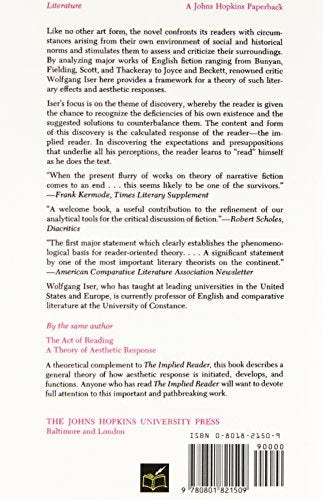

The Implied Reader: Patterns of Communication in Prose Fiction from Bunyan to Beckett,Used
Sold by Ergodebooks, an authorized reseller.
Returns accepted within 30 days | support@ergodebooks.com
Shipping Information
- Free Standard Shipping — United States only
- Processing Time: 3–5 business days
- Estimated Delivery: 6–10 business days after dispatch
- Double-boxed, fully insured & discreetly packaged
- Tracking number sent via email once dispatched
Returns & Refund
Returns accepted within 30 days of delivery.
Damaged or Defective Item
Free return shipping + replacement or full refund
Wrong Item Received
Free return shipping + replacement or full refund
Change of Mind
Return shipping at customer's expense · 25% restocking fee applies
Payment Option

Like no other art form, the novel confronts its readers with circumstances aring from their own environment of social and historical norms and stimulates them to assess and criticize their surroundings. By Analyzing major works of English fiction ranging from Bunyan, Fielding, Scott, and Thackery to Joyce and Beckett, renowned critic Wolfgang Iser here provides a framework for a theory of such literary effects and aesthetic responses.Iser's focus is on the theme of discovery, whereby the reader is given the chance to recognize the deficiencies of his own existence and the suggested solutions to counterbalance them. The content and form of this discovery is the calculated response of the readerthe implied reader. In discovering the expectations and presuppositions that underlie all the perceptions, the reader learns to 'read' himself as he does the text.
⚠️ WARNING (California Proposition 65):
This product may contain chemicals known to the State of California to cause cancer, birth defects, or other reproductive harm.
For more information, please visit www.P65Warnings.ca.gov.
- Q: What is the page count of this book? A: This book has three hundred eighteen pages. It offers a comprehensive exploration of communication patterns in prose fiction.
- Q: What are the dimensions of this book? A: The book measures six inches in length, zero point seven three inches in width, and nine inches in height. These dimensions make it a standard-sized paperback.
- Q: What is the binding type of this book? A: This book is paperback bound. Paperback bindings are lightweight and flexible, making them easy to handle and read.
- Q: Who is the author of this book? A: The author of this book is Wolfgang Iser. He is a renowned critic known for his insights into literature and reader response.
- Q: What genre does this book belong to? A: This book belongs to the Criticism and Theory genre. It examines major works of English fiction from various historical periods.
- Q: How do I read and engage with this book? A: You can engage with this book by critically analyzing the texts it discusses. The author encourages readers to reflect on their own experiences while reading.
- Q: Is this book suitable for beginners in literary theory? A: Yes, this book is suitable for beginners. It provides a framework for understanding literary effects and aesthetic responses in literature.
- Q: What themes can I expect to find in this book? A: The primary theme is discovery, where readers learn to recognize societal deficiencies and suggested solutions through literature.
- Q: How should I care for this paperback book? A: To care for this paperback book, store it in a cool, dry place and avoid exposing it to direct sunlight. This will help maintain its condition.
- Q: Can I lend this book to others? A: Yes, you can lend this book. Just ensure it remains in good condition by handling it carefully during transit.
- Q: What if the book arrives damaged? A: If the book arrives damaged, you should contact the seller for return or replacement options. Most sellers offer a satisfaction guarantee.
- Q: Is there a warranty for this book? A: No, there is typically no warranty for books. However, check the return policy of the retailer for defective items.
- Q: How do I return this book if needed? A: To return this book, follow the return instructions provided by the seller. Usually, you will need to package it securely and send it back.
- Q: What if I have questions about the book's content? A: If you have questions about the book's content, consider reaching out to literary forums or reading groups for discussion and insights.
- Q: Is this book appropriate for academic study? A: Yes, this book is appropriate for academic study. It is a valuable resource for understanding reader-response theory and literary criticism.
- Q: Where can I find additional resources about this book? A: You can find additional resources such as reviews and analysis on literary websites and academic databases. Libraries may also have supplementary materials.