
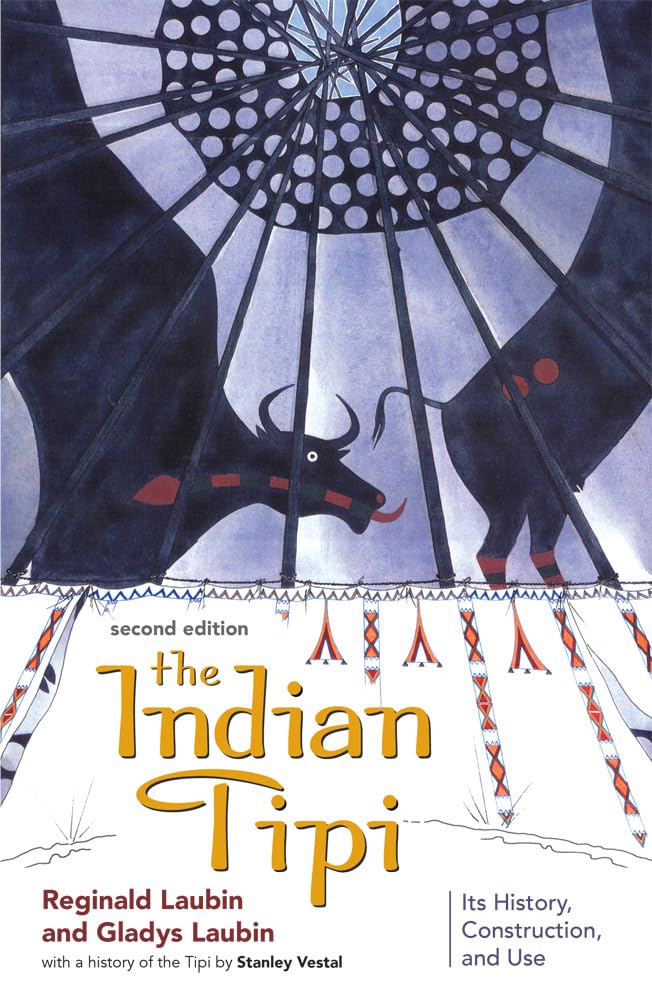
Title
The Indian Tipi: Its History, Construction, and Use, 2nd Edition,New
Sold by Ergodebooks, an authorized reseller.
Returns accepted within 30 days | support@ergodebooks.com
Shipping Information
- Free Standard Shipping — United States only
- Processing Time: 3–5 business days
- Estimated Delivery: 6–10 business days after dispatch
- Double-boxed, fully insured & discreetly packaged
- Tracking number sent via email once dispatched
Returns & Refund
Returns accepted within 30 days of delivery.
Damaged or Defective Item
Free return shipping + replacement or full refund
Wrong Item Received
Free return shipping + replacement or full refund
Change of Mind
Return shipping at customer's expense · 25% restocking fee applies
Payment Option

When the first edition of this book was published in 1957, the art of making a tipi was almost lost, even among American Indians. Since that time a tremendous resurgence of interest in the Indian way of life has occurred, resurgence due in part, at least, to the Laubins' lifelong efforts at preservation and interpretation of Indian culture.As The Indian Tipi makes obvious, the American Indian is both a practical person and a natural artist. Indian inventions are commonly both serviceable and beautiful. Other tents are hard to pitch, hot in summer, cold in winter, poorly lighted, unventilated, easily blown down, and ugly to boot. The conical tipi of the Plains Indian has none of these faults. It can be pitched by one person. It is roomy, well ventilated at all times, cool in summer, well lighted, proof against high winds and heavy downpours, and, with its cheerful fire inside, snug in the severest winter weather. Moreover, its tilted cone, trim smoke flaps, and crown of poles, presenting a different silhouette from every angle, form a shapely, stately dwelling even without decoration.In this new edition the Laubins have retained all the invaluable aspects of the first edition, and have added a tremendous amount of new material on daytoday living in the tipi: the section on Indian cooking has been expanded to include a large number and range of Indian foods and recipes, as well as methods of cooking over an open fire, with a reflector oven, and with a ground oven; there are new sections on making buckskin, making moccasins, and making cradle boards; there is a whole new section on child care and general household hints. Shoshoni, Cree, and Assiniboine designs have been added to the long list of tribal tipi types discussed.This new edition is richly illustrated with color and black and white photographs, and drawings to aid in constructing and living in the tipi. It is written primarily for the interested amateur, and will appeal to anyone who likes camping, the outofdoors, and American Indian lore.
⚠️ WARNING (California Proposition 65):
This product may contain chemicals known to the State of California to cause cancer, birth defects, or other reproductive harm.
For more information, please visit www.P65Warnings.ca.gov.
- Q: What is the main focus of 'The Indian Tipi' book? A: The book primarily focuses on the history, construction, and use of the tipi, highlighting its cultural significance among American Indians and providing practical guidance for building and living in one.
- Q: What new content is included in the second edition? A: The second edition includes expanded sections on Indian cooking, additional topics on making buckskin, moccasins, cradle boards, and new insights into child care and household tips.
- Q: How many pages does the book contain? A: The book contains a total of 384 pages.
- Q: What type of illustrations are included in the book? A: The book features both color and black and white photographs, along with drawings that assist in understanding the construction and living aspects of the tipi.
- Q: Is 'The Indian Tipi' suitable for beginners? A: Yes, the book is written primarily for the interested amateur, making it accessible and informative for those new to camping and tipi construction.
- Q: Who is the author of 'The Indian Tipi'? A: The author of the book is Reginald Laubin.
- Q: When was the second edition published? A: The second edition was published on September 15, 1989.
- Q: What are some features of the tipi discussed in the book? A: The book discusses the tipi's practicality, including its ventilation, ability to withstand harsh weather, and aesthetic appeal, making it an ideal dwelling for various conditions.
- Q: Does the book cover the cultural significance of the tipi? A: Yes, the book delves into the cultural history of the tipi, emphasizing its importance in the lives of American Indians and its artistic aspects.
- Q: What condition is the book in? A: The book is listed as a used book in good condition.