
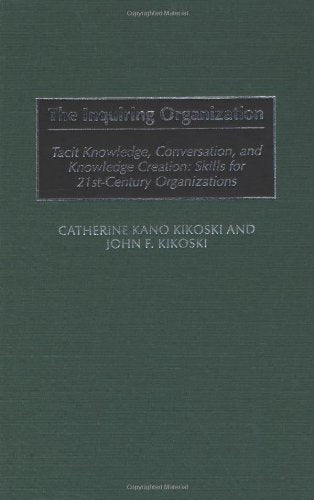
Title
The Inquiring Organization: Tacit Knowledge, Conversation, and Knowledge Creation: Skills for 21stCentury Organizations,Used
Sold by Ergodebooks, an authorized reseller.
Returns accepted within 30 days | support@ergodebooks.com
Shipping Information
- Free Standard Shipping — United States only
- Processing Time: 3–5 business days
- Estimated Delivery: 6–10 business days after dispatch
- Double-boxed, fully insured & discreetly packaged
- Tracking number sent via email once dispatched
Returns & Refund
Returns accepted within 30 days of delivery.
Damaged or Defective Item
Free return shipping + replacement or full refund
Wrong Item Received
Free return shipping + replacement or full refund
Change of Mind
Return shipping at customer's expense · 25% restocking fee applies
Payment Option

This book provides the context and tools to create knowledge via a proven process of inquiry, questions, and conversation. It introduces the theoretical background to explain why, as well as the practical handson skills and processes to demonstrate how, to surface tacit knowledgethat which we know but which we have not yet made explicit in conversation, e.g., background, education, and experienceand create new knowledge in collaboration with colleagues.In the information economy, knowledge is an asset and a currency. The creation of new knowledge, therefore, enhances an organization's position in the marketplace. How do we create new knowledge? We don't do it by learning what is already known. The learning organization is already pass. Instead, we do it by inquirinq, which is a method of bringing tacit knowledge to the forefront of awareneness. The inquiring organization surfaces tacit knowledge, which is what its employees bring to the tabletheir background, education, experience, character, and judgmentand transforms that knowledge into new, explicit knowledge that can be transferred from one employee to another through conversation. That is true knowledge creation, and this book provides the tools, skills, techniques, and processes for executives and professionals in any field to accomplish this task in today's fluid environment.
⚠️ WARNING (California Proposition 65):
This product may contain chemicals known to the State of California to cause cancer, birth defects, or other reproductive harm.
For more information, please visit www.P65Warnings.ca.gov.
- Q: What is the main focus of 'The Inquiring Organization'? A: The main focus of 'The Inquiring Organization' is to explore how tacit knowledge can be surfaced and transformed into explicit knowledge through inquiry, conversation, and collaboration within organizations.
- Q: Who is the author of this book? A: The author of 'The Inquiring Organization' is Catherine Kikoski.
- Q: What are the key skills taught in this book? A: The book teaches practical skills and processes for inquiry, questioning, and conversation that help in surfacing tacit knowledge and creating new knowledge in organizations.
- Q: What is the significance of tacit knowledge in organizations? A: Tacit knowledge is significant because it includes the background, experience, and judgment of employees, which can enhance an organization's competitive position when effectively transformed into explicit knowledge.
- Q: How many pages does the book have? A: The book has a total of 208 pages.
- Q: What type of binding does this book have? A: This book is available in hardcover binding.
- Q: When was 'The Inquiring Organization' published? A: The book was published on July 30, 2004.
- Q: What condition is the book in? A: The book is in new condition.
- Q: Can this book benefit professionals in any field? A: Yes, the tools and techniques provided in the book are applicable to executives and professionals across various fields.
- Q: What is the book's category? A: The book is categorized under Economics.