
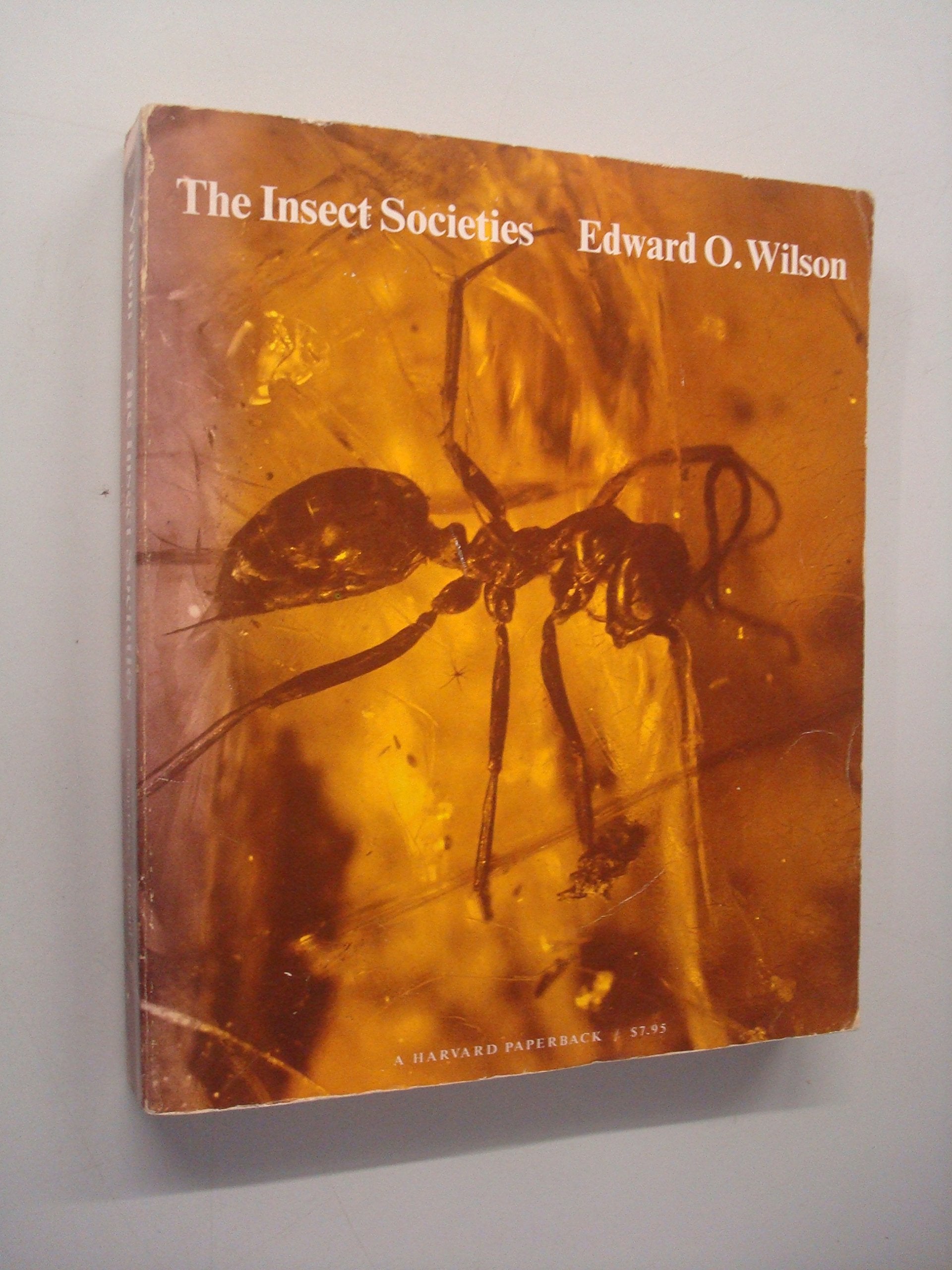
Title
The Insect Societies,Used
Sold by Ergodebooks, an authorized reseller.
Returns accepted within 30 days | support@ergodebooks.com
Shipping Information
- Free Standard Shipping — United States only
- Processing Time: 3–5 business days
- Estimated Delivery: 6–10 business days after dispatch
- Double-boxed, fully insured & discreetly packaged
- Tracking number sent via email once dispatched
Returns & Refund
Returns accepted within 30 days of delivery.
Damaged or Defective Item
Free return shipping + replacement or full refund
Wrong Item Received
Free return shipping + replacement or full refund
Change of Mind
Return shipping at customer's expense · 25% restocking fee applies
Payment Option

View a collection of videos on Professor Wilson entitled 'On the Relation of Science and the Humanities'This book is a work of major importance for the development of environmental and behavioral biology; it covers the classification, evolution, anatomy, physiology, and behavior of the higher social insectsants, social wasps and bees, and termites. Mr. Wilson reinterprets the knowledge of these insects through the concepts of modern biology, from biochemistry to evolutionary theory and population ecology.
⚠️ WARNING (California Proposition 65):
This product may contain chemicals known to the State of California to cause cancer, birth defects, or other reproductive harm.
For more information, please visit www.P65Warnings.ca.gov.
- Q: How many pages does 'The Insect Societies' have? A: This book has five hundred sixty-two pages. It's a comprehensive work covering various aspects of social insects.
- Q: What are the dimensions of 'The Insect Societies'? A: The dimensions are eight and a half inches in length, one point twenty-six inches in width, and ten inches in height.
- Q: What type of binding does 'The Insect Societies' have? A: This book is paperback bound. This makes it flexible and easy to handle.
- Q: Who is the author of 'The Insect Societies'? A: The author is Edward O. Wilson. He is renowned for his work in environmental and behavioral biology.
- Q: What is the main subject of 'The Insect Societies'? A: The book focuses on higher social insects like ants, social wasps, bees, and termites. It explores their biology and behavior.
- Q: Is 'The Insect Societies' suitable for beginners in biology? A: Yes, it's suitable for beginners. The author presents complex concepts in an accessible manner.
- Q: Can I use 'The Insect Societies' for advanced biology studies? A: Yes, it's also suitable for advanced studies. It covers a wide range of topics important for deep understanding.
- Q: What is the reading level of 'The Insect Societies'? A: It's appropriate for high school students and above. The material is detailed yet approachable.
- Q: How should I store 'The Insect Societies' to keep it in good condition? A: Store the book in a cool, dry place. Avoid direct sunlight to prevent fading and damage.
- Q: Are there any special care instructions for 'The Insect Societies'? A: No special care is needed. Just keep it away from moisture and handle it gently.
- Q: What if 'The Insect Societies' arrives damaged? A: If the book arrives damaged, you should contact the seller for a return or replacement. Most sellers have return policies in place.
- Q: Can I return 'The Insect Societies' if I change my mind? A: Yes, you can usually return it if it's within the return period. Check the seller’s return policy for specifics.
- Q: Is 'The Insect Societies' considered a textbook? A: Yes, it can be used as a textbook. It provides extensive information on insect biology.
- Q: Does 'The Insect Societies' include illustrations or images? A: Yes, the book includes various illustrations to enhance understanding of the discussed concepts.
- Q: Is there a glossary in 'The Insect Societies'? A: Yes, the book includes a glossary of terms. This helps readers understand scientific terminology.
- Q: What makes 'The Insect Societies' important in biology? A: It reinterprets insect knowledge through the lens of modern biology, making significant contributions to the field.