
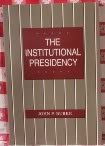
Title
The Institutional Presidency (Interpreting American Politics),Used
Sold by Ergodebooks, an authorized reseller.
Returns accepted within 30 days | support@ergodebooks.com
Shipping Information
- Free Standard Shipping — United States only
- Processing Time: 3–5 business days
- Estimated Delivery: 6–10 business days after dispatch
- Double-boxed, fully insured & discreetly packaged
- Tracking number sent via email once dispatched
Returns & Refund
Returns accepted within 30 days of delivery.
Damaged or Defective Item
Free return shipping + replacement or full refund
Wrong Item Received
Free return shipping + replacement or full refund
Change of Mind
Return shipping at customer's expense · 25% restocking fee applies
Payment Option

Product Description When Franklin Roosevelt decided his administration needed a large executive staff, he instituted dramatic and lasting changes in the federal bureaucracy and in the very nature of the presidency. Today, no president can govern without an enormous White House staff. Yet analysts have disagreed about whether the key to a president's success lies in his ability to understand and adapt to the constraints of this bureaucracy or in his ability to control and even transform it to suit his needs.In The Institutional Presidency John Burke argues that both skills are crucial. Burke examines how the White House staff systemlarger and more powerful than everinteracts with a particular president's management ability and style. He begins by describing the institutional presidency that emerged during the Roosevelt administration and that every modern president inherits. Burke's central argument is that analysts and advisers must examine both the management style of individual presidents and the institutional features of the presidency that transcend particular administrations. The success of an administration, he argues, lies in the degree to which the two models can be drawn upon in the daytoday work of defining and furthering the president's agenda.Burke concludes with a detailed comparison of the Carter and Reagan administrations. He describes Carter as a variant of the collegial manager, and Reagan as more formalistic. In spite of very different approaches to the presidency, he observes, neither was a particularly successful managerand both experienced tellingly similar difficulties coping with the institutional dynamics of the White House staff. Burke also makes some preliminary observations about George Bushwho combines "Eisenhower's more formal procedures with Kennedy's informal, collegial style." Review "Burke offers a useful synthesis of the knowledge that presidencywatchers have gleaned about the formal operations of the White House... The book is ideally suited for use as a supplementary text in presidency and bureaucracy courses, especially those that emphasize policy rather than politics or prerogative." Richard M. Pious, Political Science Quarterly. About the Author John P. Burke is associate professor and chair of the Department of Political Science at the University of Vermont. He is coauthor of How Presidents Test Reality: Decisions on Vietnam, 1954 and 1965 and author of Bureaucratic Responsibility, the latter available from Johns Hopkins.
⚠️ WARNING (California Proposition 65):
This product may contain chemicals known to the State of California to cause cancer, birth defects, or other reproductive harm.
For more information, please visit www.P65Warnings.ca.gov.