
Title
The Insubordination Of Signs: Political Change, Cultural Transformation, And Poetics Of The Crisis (Postcontemporary Interventi,Used
Sold by Ergodebooks, an authorized reseller.
Returns accepted within 30 days | support@ergodebooks.com
Shipping Information
- Free Standard Shipping — United States only
- Processing Time: 3–5 business days
- Estimated Delivery: 6–10 business days after dispatch
- Double-boxed, fully insured & discreetly packaged
- Tracking number sent via email once dispatched
Returns & Refund
Returns accepted within 30 days of delivery.
Damaged or Defective Item
Free return shipping + replacement or full refund
Wrong Item Received
Free return shipping + replacement or full refund
Change of Mind
Return shipping at customer's expense · 25% restocking fee applies
Payment Option

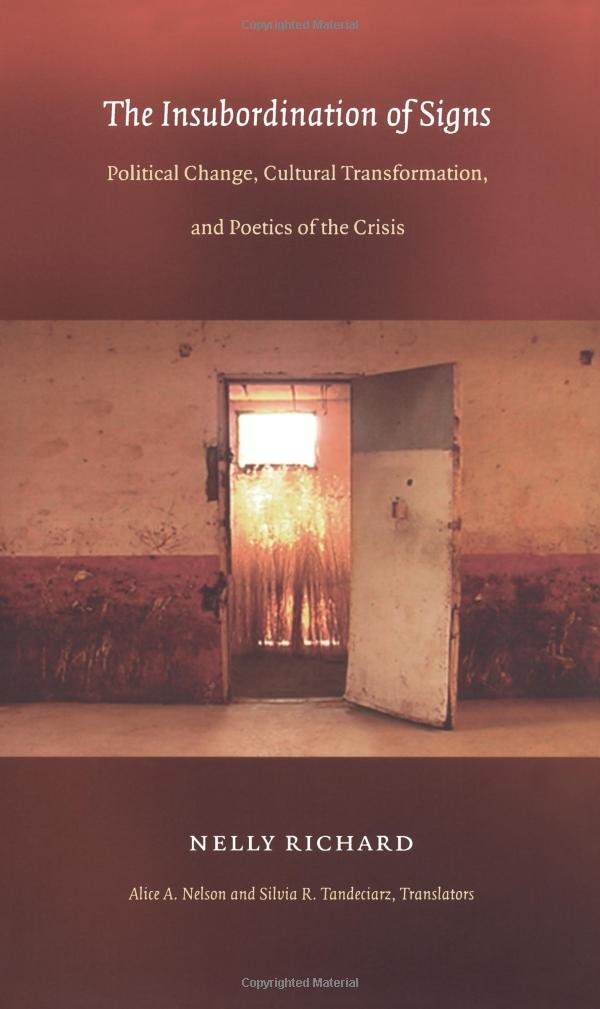
Nelly Richard is one of the most prominent cultural theorists writing in Latin America today. As a participant in Chiles neoavantgarde, Richard worked to expand the possibilities for cultural debate within the constraints imposed by the Pinochet dictatorship (19731990), and she has continued to offer incisive commentary about the countrys transition to democracy. Well known as the founder and director of the influential journal Revista de crtica cultural, based in Santiago, Richard has been central to the dissemination throughout Latin America of work by key contemporary thinkers, including Nstor Garca Canclini, Jacques Derrida, Fredric Jameson, and Diamela Eltit. Her own writing provides rigorous considerations of Latin American identity, postmodernism, gender, neoliberalism, and strategies of political and cultural resistance.In The Insubordination of Signs Richard theorizes the cultural reactionsparticularly within the realms of visual arts, literature, and the social sciencesto the oppression of the Chilean dictatorship. She reflects on the role of memory in the historical shadow of the military regime and on the strategies offered by marginal discourses for critiquing institutional systems of power. She considers the importance of Walter Benjamin for the theoretical selfunderstanding of the Latin American intellectual left, and she offers revisionary interpretations of the Chilean neoavantgarde in terms of its relationships with the traditional left and postmodernism. Exploring the gap between Chiles new left social sciences and its new scene aesthetic and critical practices, Richard discusses how, with the return of democracy, the energies that had set in motion the democratizing process seemed to exhaust themselves as cultural debate was attenuated in order to reduce any risk of a return to authoritarianism.
⚠️ WARNING (California Proposition 65):
This product may contain chemicals known to the State of California to cause cancer, birth defects, or other reproductive harm.
For more information, please visit www.P65Warnings.ca.gov.