If you have any questions, you are always welcome to contact us. We'll get back to you as soon as possible, withing 24 hours on weekdays.
Customer service
All questions about your order, return and delivery must be sent to our customer service team by e-mail at yourstore@yourdomain.com
Sale & Press
If you are interested in selling our products, need more information about our brand or wish to make a collaboration, please contact us at press@yourdomain.com
Help
If you have any questions, you are always welcome to contact us. We'll get back to you as soon as possible, withing 24 hours on weekdays.
Customer service
All questions about your order, return and delivery must be sent to our customer service team by e-mail at yourstore@yourdomain.com
Sale & Press
If you are interested in selling our products, need more information about our brand or wish to make a collaboration, please contact us at press@yourdomain.com
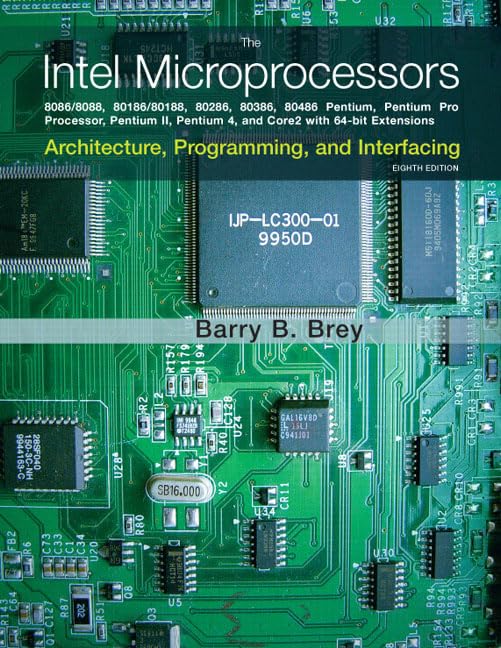
For introductorylevel Microprocessor courses in the departments of Electronic Engineering Technology, Computer Science, or Electrical Engineering.The INTEL Microprocessors: 8086/8088, 80186/80188, 80286, 80386, 80486, Pentium, Pentium Pro Processor, Pentium II, Pentium III, Pentium 4, and Core2 with 64bit Extensions, 8e provides a comprehensive view of programming and interfacing of the Intel family of Microprocessors from the 8088 through the latest Pentium 4 and Core2 microprocessors. The text is written for students who need to learn about the programming and interfacing of Intel microprocessors, which have gained wide and at times exclusive application in many areas of electronics, communications, and control systems, particularly in desktop computer systems. A major new feature of this eighth edition is an explanation of how to interface C/C++ using Visual C++ Express (a free download from Microsoft) with assembly language for both the older DOS and the Windows environments. Many applications include Visual C++ as a basis for learning assembly language using the inline assembler. Updated sections that detail new events in the fields of microprocessors and microprocessor interfacing have been added. Organized in an orderly and manageable format, this text offers more than 200 programming examples using the Microsoft Macro Assembler program and provides a thorough description of each of the Intel family members, memory systems, and various I/O systems.
⚠️ WARNING (California Proposition 65):
This product may contain chemicals known to the State of California to cause cancer,
birth defects, or other reproductive harm.
For MAP (Minimum Advertised Price) violations and Intellectual Property (IP) or Trademark concerns, please contact:
support@ergodebooks.com
⚠️ California Proposition 65 Warning: Some products sold on this website may expose you to chemicals known to the State of California to cause cancer, birth defects, or other reproductive harm. For more information, visit www.P65Warnings.ca.gov.