If you have any questions, you are always welcome to contact us. We'll get back to you as soon as possible, withing 24 hours on weekdays.
Customer service
All questions about your order, return and delivery must be sent to our customer service team by e-mail at yourstore@yourdomain.com
Sale & Press
If you are interested in selling our products, need more information about our brand or wish to make a collaboration, please contact us at press@yourdomain.com
Help
If you have any questions, you are always welcome to contact us. We'll get back to you as soon as possible, withing 24 hours on weekdays.
Customer service
All questions about your order, return and delivery must be sent to our customer service team by e-mail at yourstore@yourdomain.com
Sale & Press
If you are interested in selling our products, need more information about our brand or wish to make a collaboration, please contact us at press@yourdomain.com
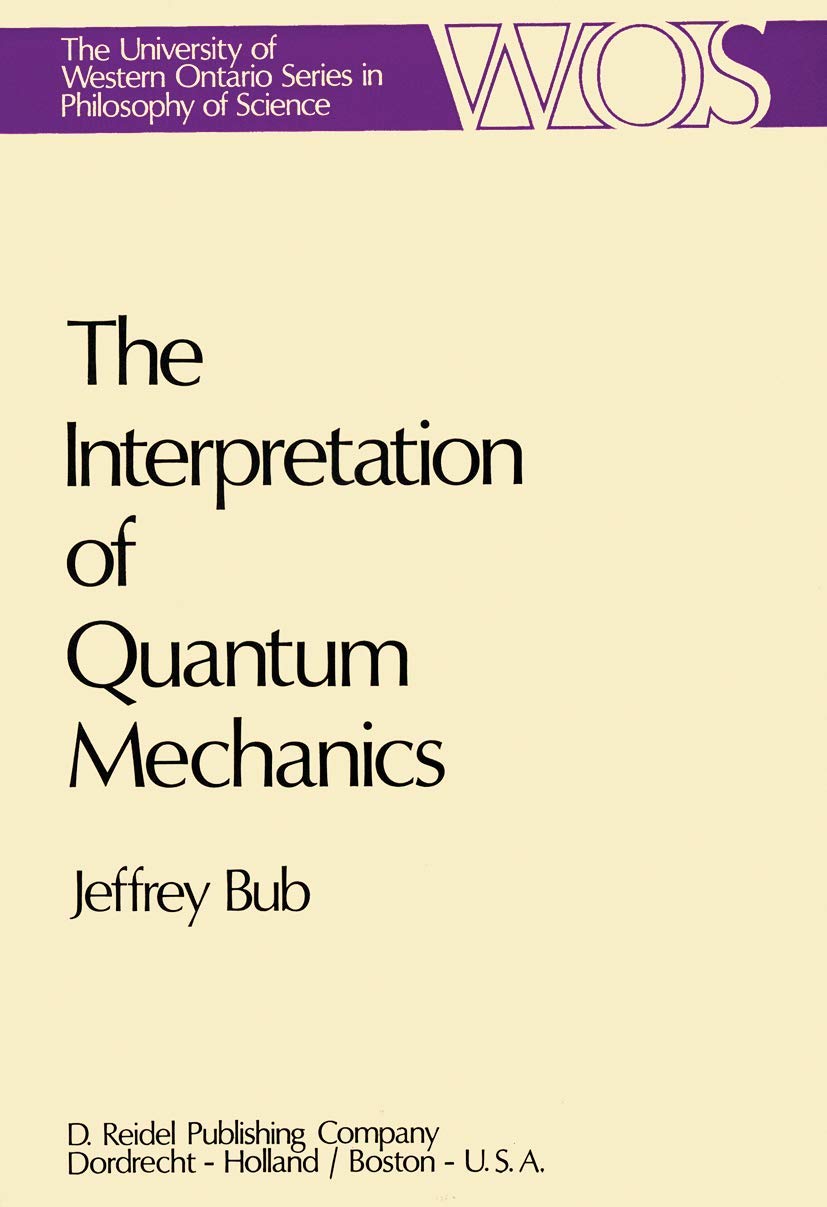
This book is a contribution to a problem in foundational studies, the problem of the interpretation of quantum mechanics, in the sense of the theoretical significance of the transition from classical to quantum mechanics. The obvious difference between classical and quantum mechanics is that quantum mechanics is statistical and classical mechanics isn't. Moreover, the statistical character of the quantum theory appears to be irreducible: unlike classical statistical mechanics, the probabilities are not generated by measures on a probability space, i. e. by distributions over atomic events or classical states. But how can a theory of mechanics be statistical and complete? Answers to this question which originate with the Copenhagen inter pretation of Bohr and Heisenberg appeal to the limited possibilities of measurement at the microlevel. To put it crudely: Those little electrons, protons, mesons, etc. , are so tiny, and our fingers so clumsy, that when ever we poke an elementary particle to see which way it will jump, we disturb the system radically so radically, in fact, that a considerable amount of information derived from previous measurements is no longer applicable to the system. We might replace our fingers by finer probes, but the finest possible probes are the elementary particles them selves, and it is argued that the difficulty really arises for these.
⚠️ WARNING (California Proposition 65):
This product may contain chemicals known to the State of California to cause cancer,
birth defects, or other reproductive harm.
For MAP (Minimum Advertised Price) violations and Intellectual Property (IP) or Trademark concerns, please contact:
support@ergodebooks.com
⚠️ California Proposition 65 Warning: Some products sold on this website may expose you to chemicals known to the State of California to cause cancer, birth defects, or other reproductive harm. For more information, visit www.P65Warnings.ca.gov.