If you have any questions, you are always welcome to contact us. We'll get back to you as soon as possible, withing 24 hours on weekdays.
Customer service
All questions about your order, return and delivery must be sent to our customer service team by e-mail at yourstore@yourdomain.com
Sale & Press
If you are interested in selling our products, need more information about our brand or wish to make a collaboration, please contact us at press@yourdomain.com
Help
If you have any questions, you are always welcome to contact us. We'll get back to you as soon as possible, withing 24 hours on weekdays.
Customer service
All questions about your order, return and delivery must be sent to our customer service team by e-mail at yourstore@yourdomain.com
Sale & Press
If you are interested in selling our products, need more information about our brand or wish to make a collaboration, please contact us at press@yourdomain.com
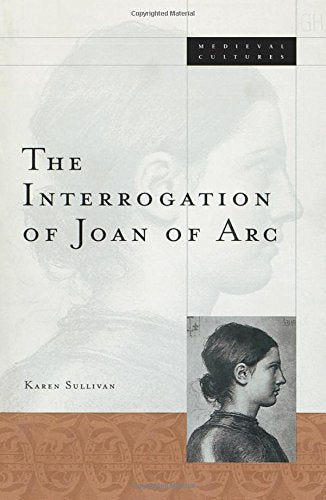
The transcripts of Joan of Arc's trial for heresy at Rouen in 1431 and the minutes of her interrogation have long been recognized as our best source of information about the Maid of Orleans. Historians generally view these legal texts as a precise account of Joan's words and, by extension, her beliefs. Focusing on the minutes recorded by clerics, however, Karen Sullivan challenges the accuracy of the transcript. In The Interrogation of Joan of Arc, she rereads the record not as a perfect reflection of a historical personality's words, but as a literary text resulting from the collaboration between Joan and her interrogators.Sullivan provides an illuminating and innovative account of Joan's trial and interrogation, placing them in historical, social, and religious context. In the fifteenth century, interrogation was a method of truthgathering identified not with people like Joan, who was uneducated, but with clerics, like those who tried her. When these clerics questioned Joan, they did so as scholastics educated at the University of Paris, as judges and assistants to judges, and as pastors trained in hearing confessions.The Interrogation of Joan of Arc traces Joan's conflicts with her interrogators not to differing political allegiances, but to fundamental differences between clerical and lay cultures. Sullivan demonstrates that the figure depicted in the transcripts as Joan of Arc is a complex, multifaceted persona that results largely from these cultural differences. Discerning and innovative, this study suggests a powerful new interpretive model and redefines our sense of Joan and her time.
⚠️ WARNING (California Proposition 65):
This product may contain chemicals known to the State of California to cause cancer,
birth defects, or other reproductive harm.
For MAP (Minimum Advertised Price) violations and Intellectual Property (IP) or Trademark concerns, please contact:
support@ergodebooks.com
⚠️ California Proposition 65 Warning: Some products sold on this website may expose you to chemicals known to the State of California to cause cancer, birth defects, or other reproductive harm. For more information, visit www.P65Warnings.ca.gov.