If you have any questions, you are always welcome to contact us. We'll get back to you as soon as possible, withing 24 hours on weekdays.
Customer service
All questions about your order, return and delivery must be sent to our customer service team by e-mail at yourstore@yourdomain.com
Sale & Press
If you are interested in selling our products, need more information about our brand or wish to make a collaboration, please contact us at press@yourdomain.com
Help
If you have any questions, you are always welcome to contact us. We'll get back to you as soon as possible, withing 24 hours on weekdays.
Customer service
All questions about your order, return and delivery must be sent to our customer service team by e-mail at yourstore@yourdomain.com
Sale & Press
If you are interested in selling our products, need more information about our brand or wish to make a collaboration, please contact us at press@yourdomain.com
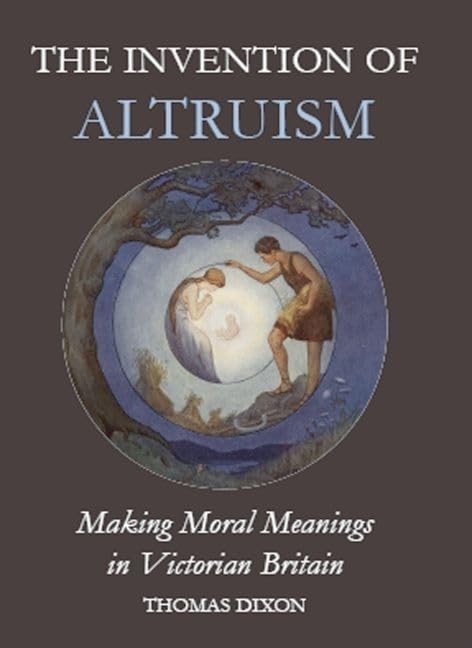
"Altruism" was coined by the French sociologist Auguste Comte in the early 1850s as a theoretical term in his 'cerebral theory' and as the central ideal of his atheistic "Religion of Humanity." In The Invention of Altruism, Thomas Dixon traces this new language of 'altruism' as it spread through British culture between the 1850s and the 1900s, and in doing so provides a new portrait of Victorian moral thought.Drawing attention to the importance of Comtean positivism in setting the agenda for debates about science and religion, this volume challenges received ideas about both Charles Darwin and Herbert Spencer as moral philosophers. Darwin saw sympathy and love, not only selfishness and competition, throughout the natural world. Spencer was the instigator of an AntiAggression League and an advocate of greater altruism in Britain's dealings with the "lower races." It also sheds light on the rise of popular socialism in the 1880s, on the creation of the idealist 'altruist' in novels of the 1890s, and on the individualistic philosophies of Friedrich Nietzsche, Oscar Wilde, and G. E. Mooreauthors considered by some to be representative of fin de sicle "egomania."This wideranging study in the history of ideas is highly relevant to contemporary debates about altruism, evolution, religion, and ethics.
⚠️ WARNING (California Proposition 65):
This product may contain chemicals known to the State of California to cause cancer,
birth defects, or other reproductive harm.
For MAP (Minimum Advertised Price) violations and Intellectual Property (IP) or Trademark concerns, please contact:
support@ergodebooks.com
⚠️ California Proposition 65 Warning: Some products sold on this website may expose you to chemicals known to the State of California to cause cancer, birth defects, or other reproductive harm. For more information, visit www.P65Warnings.ca.gov.