
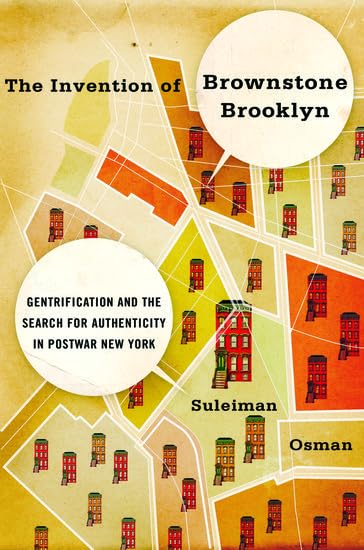
Title

The Invention of Brownstone Brooklyn: Gentrification and the Search for Authenticity in Postwar New York,New
Sold by Ergodebooks, an authorized reseller.
Returns accepted within 30 days | support@ergodebooks.com
Shipping Information
- Free Standard Shipping — United States only
- Processing Time: 3–5 business days
- Estimated Delivery: 6–10 business days after dispatch
- Double-boxed, fully insured & discreetly packaged
- Tracking number sent via email once dispatched
Returns & Refund
Returns accepted within 30 days of delivery.
Damaged or Defective Item
Free return shipping + replacement or full refund
Wrong Item Received
Free return shipping + replacement or full refund
Change of Mind
Return shipping at customer's expense · 25% restocking fee applies
Payment Option

Considered one of the city's most notorious industrial slums in the 1940s and 1950s, Brownstone Brooklyn by the 1980s had become a postindustrial landscape of hip bars, yoga studios, and beautifully renovated, wildly expensive townhouses. In The Invention of Brownstone Brooklyn, Suleiman Osman offers a groundbreaking history of this unexpected transformation. Challenging the conventional wisdom that New York City's renaissance started in the 1990s, Osman locates the origins of gentrification in Brooklyn in the cultural upheavals of the 1960s and 1970s. Gentrification began as a grassroots movement led by young and idealistic white college graduates searching for 'authenticity' and life outside the burgeoning suburbs. Where postwar city leaders championed slum clearance and modern architecture, 'brownstoners' (as they called themselves) fought for a new romantic urban ideal that celebrated historic buildings, industrial lofts and traditional ethnic neighborhoods as a refuge from an increasingly technocratic society. Osman examines the emergence of a 'slowgrowth' progressive coalition as brownstoners joined with poorer residents to battle city planners and local machine politicians. But as brownstoners migrated into poorer areas, race and class tensions emerged, and by the 1980s, as newspapers parodied yuppies and antigentrification activists marched through increasingly expensive neighborhoods, brownstoners debated whether their search for authenticity had been a success or failure.
⚠️ WARNING (California Proposition 65):
This product may contain chemicals known to the State of California to cause cancer, birth defects, or other reproductive harm.
For more information, please visit www.P65Warnings.ca.gov.
- Q: What is 'The Invention of Brownstone Brooklyn' about? A: This book explores the transformation of Brownstone Brooklyn from an industrial slum in the mid-20th century to a trendy area filled with bars and upscale homes, highlighting the roots of gentrification in the cultural movements of the 1960s and 1970s.
- Q: Who is the author of this book? A: The author is Suleiman Osman, who provides a detailed historical analysis of Brooklyn's gentrification.
- Q: What is the publication date of this book? A: The book was published on March 9, 2011.
- Q: How many pages does 'The Invention of Brownstone Brooklyn' have? A: The book has 360 pages.
- Q: What type of binding does this book have? A: This book is available in hardcover binding.
- Q: Is this book in new condition? A: Yes, 'The Invention of Brownstone Brooklyn' is in new condition.
- Q: What category does this book fall under? A: The book is categorized under State & Local history.
- Q: What edition of the book is available? A: The available edition is the first edition.
- Q: What themes are explored in the book? A: The book explores themes of gentrification, urban authenticity, race, and class tensions in Brooklyn.
- Q: Does the book include a discussion on the impact of gentrification? A: Yes, it discusses the impact of gentrification, including the tensions between new residents and existing communities.