
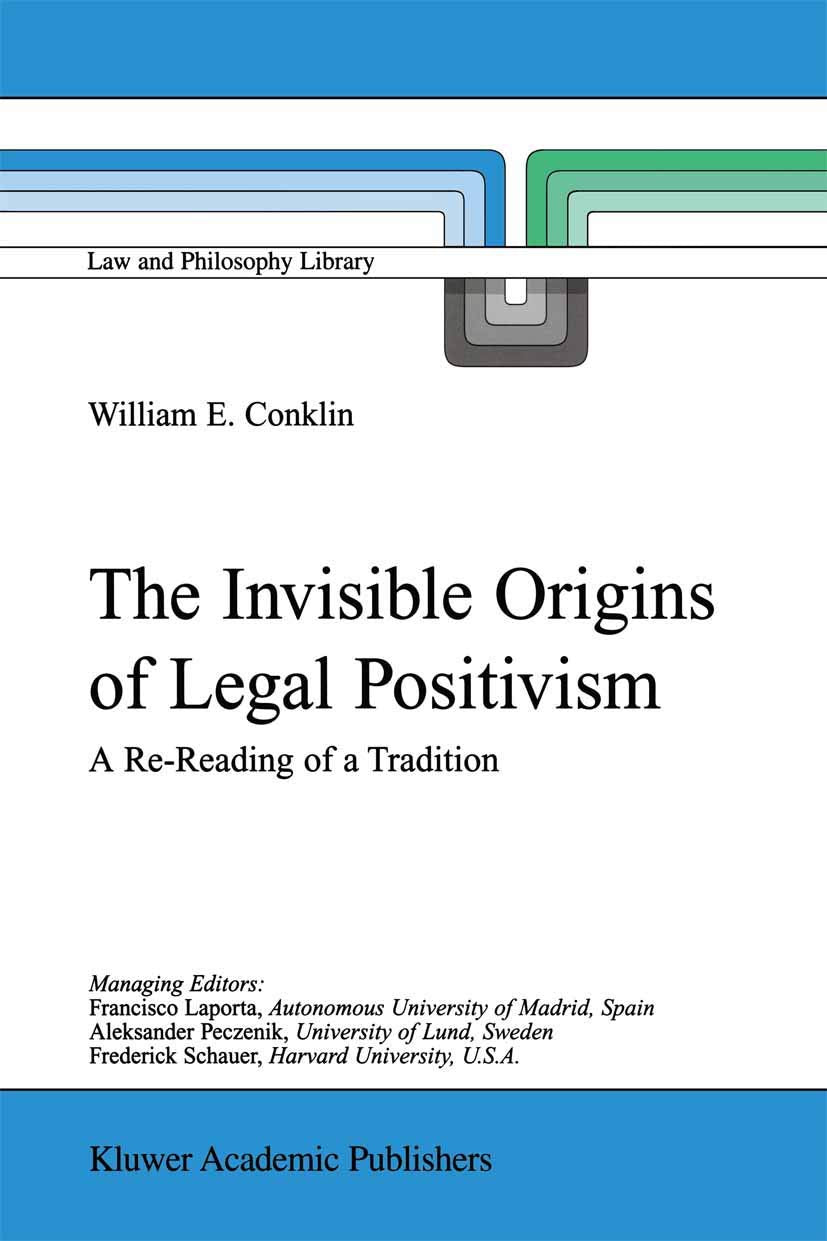
Title
The Invisible Origins of Legal Positivism: A ReReading of a Tradition (Law and Philosophy Library, 52),New
Sold by Ergodebooks, an authorized reseller.
Returns accepted within 30 days | support@ergodebooks.com
Shipping Information
- Free Standard Shipping — United States only
- Processing Time: 3–5 business days
- Estimated Delivery: 6–10 business days after dispatch
- Double-boxed, fully insured & discreetly packaged
- Tracking number sent via email once dispatched
Returns & Refund
Returns accepted within 30 days of delivery.
Damaged or Defective Item
Free return shipping + replacement or full refund
Wrong Item Received
Free return shipping + replacement or full refund
Change of Mind
Return shipping at customer's expense · 25% restocking fee applies
Payment Option

Conklin's thesis is that the tradition of modern legal positivism, beginning with Thomas Hobbes, postulated different senses of the invisible as the authorising origin of humanly posited laws. Conklin rereads the tradition by privileging how the canons share a particular understanding of legal language as written. Leading philosophers who have espoused the tenets of the tradition have assumed that legal language is written and that the authorising origin of humanly posited rules/norms is inaccessible to the written legal language. Conklin's rereading of the tradition teases out how each of these leading philosophers has postulated that the authorising origin of humanly posited laws is an unanalysable externality to the written language of the legal structure. As such, the authorising origin of posited rules/norms is inaccessible or invisible to their written language.What is this authorising origin? Different forms include an originary author, an a priori concept, and an immediacy of bonding between person and laws. In each case the origin is unwritten in the sense of being inaccessible to the authoritative texts written by the officials of civil institutions of the sovereign state.Conklin sets his thesis in the context of the legal theory of the polis and the prepolis of Greek tribes. The author claims that the problem is that the tradition of legal positivism of a modern sovereign state excises the experiential, or bodily, meanings from the written language of the posited rules/norms, thereby forgetting the very prelegal authorising origin of the posited norms that each philosopher admits as offering the finality that legal reasoning demands if it is to be authoritative.
⚠️ WARNING (California Proposition 65):
This product may contain chemicals known to the State of California to cause cancer, birth defects, or other reproductive harm.
For more information, please visit www.P65Warnings.ca.gov.