
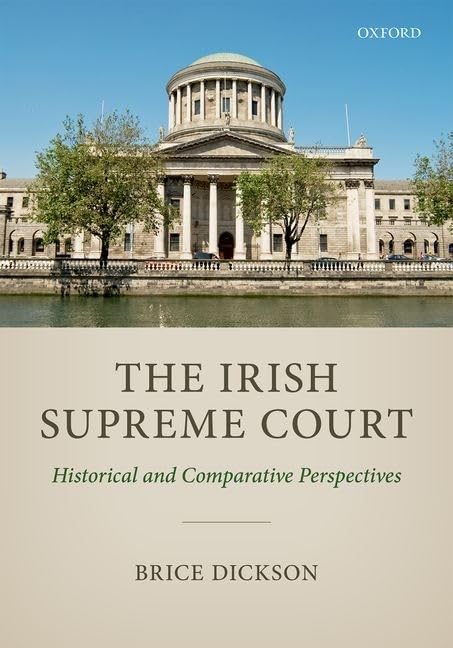
Title
The Irish Supreme Court: Historical and Comparative Perspectives,Used
Sold by Ergodebooks, an authorized reseller.
Returns accepted within 30 days | support@ergodebooks.com
Shipping Information
- Free Standard Shipping — United States only
- Processing Time: 3–5 business days
- Estimated Delivery: 6–10 business days after dispatch
- Double-boxed, fully insured & discreetly packaged
- Tracking number sent via email once dispatched
Returns & Refund
Returns accepted within 30 days of delivery.
Damaged or Defective Item
Free return shipping + replacement or full refund
Wrong Item Received
Free return shipping + replacement or full refund
Change of Mind
Return shipping at customer's expense · 25% restocking fee applies
Payment Option

This book examines the jurisprudence of the Supreme Court of Ireland since its creation in 1924. It sets out the origins of the Court, explains how it operated during the life of the Irish Free State (19221937), and considers how it has developed various fields of law under Ireland's 1937 Constitution, especially after the 'recreation' of the Court in 1961.As well as constitutional law, the book looks at the Court's views on the status and legal system of Northern Ireland, administrative law, criminal justice and personal and family law. There are also chapters on the Supreme Court's interaction with European Union law and with the European Convention on Human Rights. The argument throughout is that, while the Court has been well served by many of its judges, who on occasion have manifested a healthy degree of judicial activism, there are still several legal fields in which the Court has not developed its jurisprudence as clearly or as imaginatively as it might have done. It has often displayed undue conservatism and deference. For many years its performance was hampered by its extreme workload, generated by its inability to control the number of appeals brought to it. However, the creation of a new Court of Appeal in 2014 has freed up the Supreme Court to act in a manner more analogous to that adopted by supreme courts in other common law countries. The Court's future looks bright.
⚠️ WARNING (California Proposition 65):
This product may contain chemicals known to the State of California to cause cancer, birth defects, or other reproductive harm.
For more information, please visit www.P65Warnings.ca.gov.