
Title
The Irony of Regulatory Reform: The Deregulation of American Telecommunications,Used
Sold by Ergodebooks, an authorized reseller.
Returns accepted within 30 days | support@ergodebooks.com
Shipping Information
- Free Standard Shipping — United States only
- Processing Time: 3–5 business days
- Estimated Delivery: 6–10 business days after dispatch
- Double-boxed, fully insured & discreetly packaged
- Tracking number sent via email once dispatched
Returns & Refund
Returns accepted within 30 days of delivery.
Damaged or Defective Item
Free return shipping + replacement or full refund
Wrong Item Received
Free return shipping + replacement or full refund
Change of Mind
Return shipping at customer's expense · 25% restocking fee applies
Payment Option

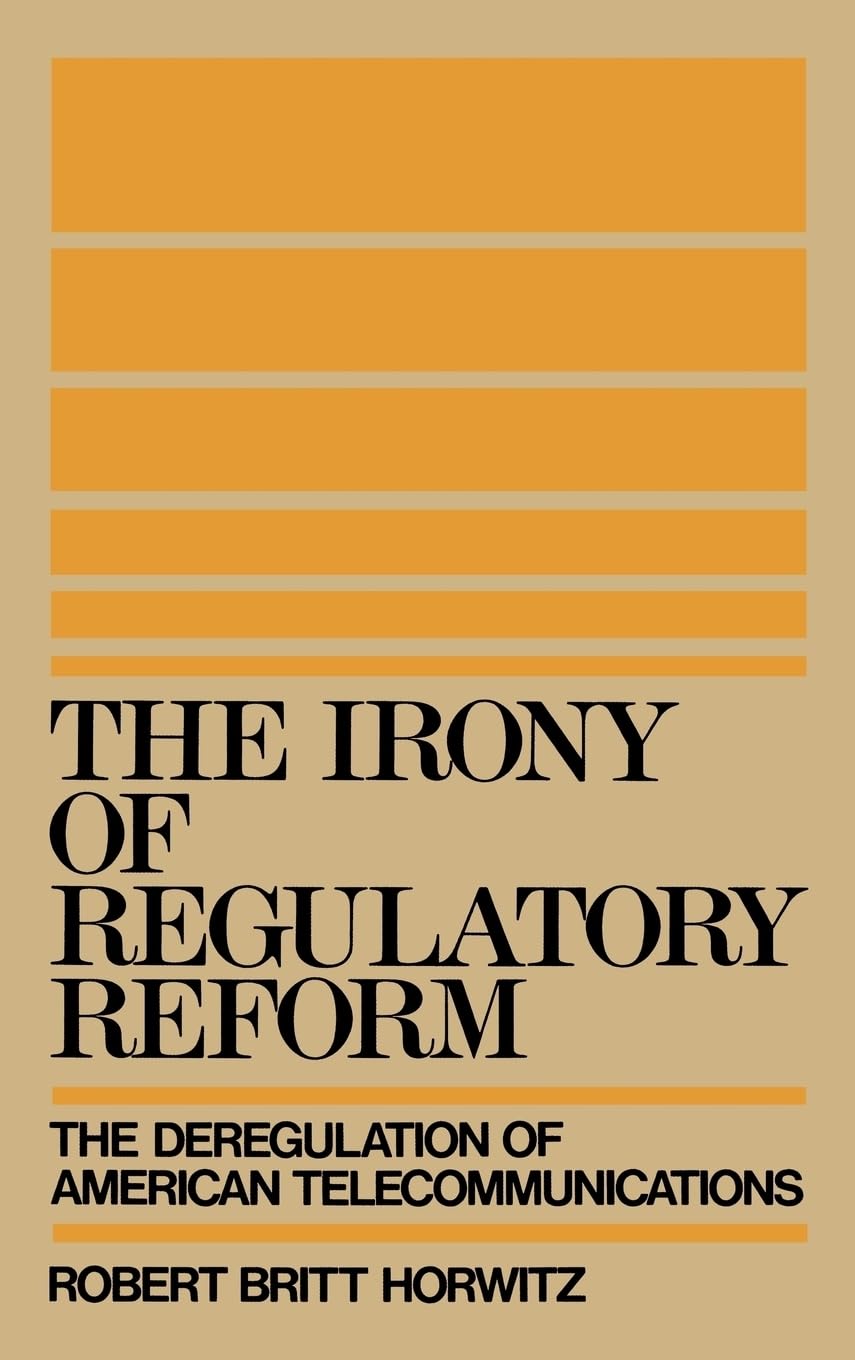
Deregulation was a political buzzword of the early 1980's. The Reagan Administration came to power on a platform dedicated to getting government 'off the backs of the people.' Deregulation promised to lower inflation, raise productivity, and reverse the sagging fortunes of American industry. And proponents declared deregulation morally right because it constituted a rollback of the arbitrary power of the state in favor of individual initiative and liberty. But the actual politics of deregulation, including the momentous breakup of AT&T, had already turned out to be far more complex than this rhetoric suggested. In The Irony of Regulatory Reform Horwitz examines the history of telecommunicationsboth telephone and broadcastto build a compelling new theory of regulation. Against the backdrop of modern theories of the state, he presents a sweeping survey of the history of regulation in America, delineating three distinct periods of regulatory genesis and, correspondingly, three discrete types of agencies. Horwitz shows the underlying irony that while antiregulation rhetoric was aimed at the socalled 'social' regulatory agencies, in practice it has been the 'economic' agencies that have been deregulated, often with vehement opposition from the industries affected. Within the context of this broader theory, telecommunications is a fascinating industry to study, because it determines the character of our marketplace of ideas, because it has been an arena of great technological transformation, and because of its fundamental role in anchoring the socalled 'information age.' Horwitz unveils the complex mosaic of forceseconomic, political, legal, and technologicalthat undermined the traditional regulation of telecommunications and precipitated deregulation.
⚠️ WARNING (California Proposition 65):
This product may contain chemicals known to the State of California to cause cancer, birth defects, or other reproductive harm.
For more information, please visit www.P65Warnings.ca.gov.