If you have any questions, you are always welcome to contact us. We'll get back to you as soon as possible, withing 24 hours on weekdays.
Customer service
All questions about your order, return and delivery must be sent to our customer service team by e-mail at yourstore@yourdomain.com
Sale & Press
If you are interested in selling our products, need more information about our brand or wish to make a collaboration, please contact us at press@yourdomain.com
Help
If you have any questions, you are always welcome to contact us. We'll get back to you as soon as possible, withing 24 hours on weekdays.
Customer service
All questions about your order, return and delivery must be sent to our customer service team by e-mail at yourstore@yourdomain.com
Sale & Press
If you are interested in selling our products, need more information about our brand or wish to make a collaboration, please contact us at press@yourdomain.com
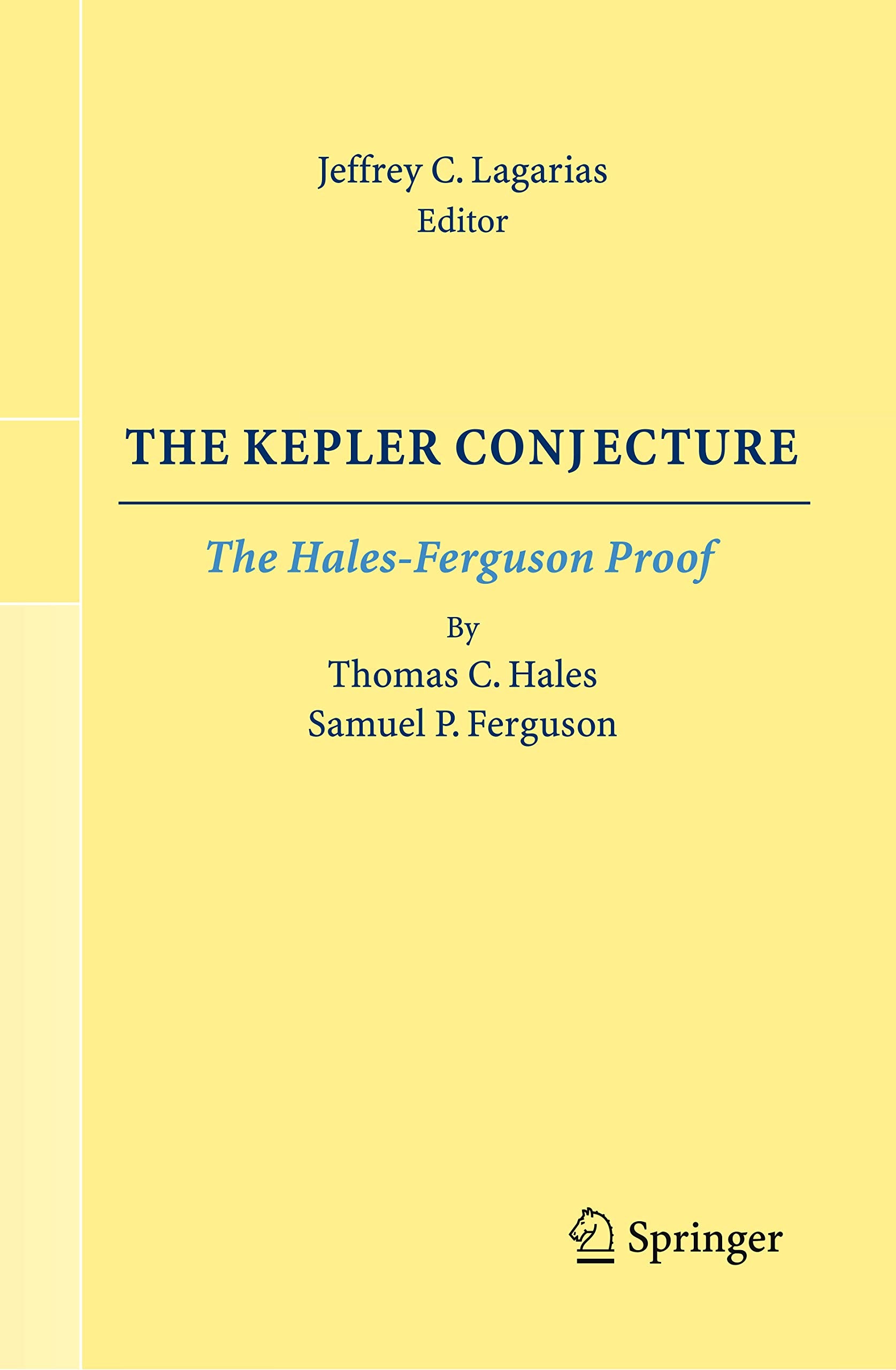
The Kepler conjecture, one of geometry's oldest unsolved problems, was formulated in 1611 by Johannes Kepler and mentioned by Hilbert in his famous 1900 problem list. The Kepler conjecture states that the densest packing of threedimensional Euclidean space by equal spheres is attained by the cannonball' packing. In a landmark result, this was proved by Thomas C. Hales and Samuel P. Ferguson, using an analytic argument completed with extensive use of computers.This book centers around six papers, presenting the detailed proof of the Kepler conjecture given by Hales and Ferguson, published in 2006 in a special issue of Discrete & Computational Geometry. Further supporting material is also presented: a followup paper of Hales et al (2010) revising the proof, and describing progress towards a formal proof of the Kepler conjecture. For historical reasons, this book also includes two early papers of Hales that indicate his original approach to the conjecture.The editor's two introductory chapters situate the conjecture in a broader historical and mathematical context. These chapters provide a valuable perspective and are a key feature of this work.
⚠️ WARNING (California Proposition 65):
This product may contain chemicals known to the State of California to cause cancer,
birth defects, or other reproductive harm.
For MAP (Minimum Advertised Price) violations and Intellectual Property (IP) or Trademark concerns, please contact:
support@ergodebooks.com
⚠️ California Proposition 65 Warning: Some products sold on this website may expose you to chemicals known to the State of California to cause cancer, birth defects, or other reproductive harm. For more information, visit www.P65Warnings.ca.gov.