If you have any questions, you are always welcome to contact us. We'll get back to you as soon as possible, withing 24 hours on weekdays.
Customer service
All questions about your order, return and delivery must be sent to our customer service team by e-mail at yourstore@yourdomain.com
Sale & Press
If you are interested in selling our products, need more information about our brand or wish to make a collaboration, please contact us at press@yourdomain.com
Help
If you have any questions, you are always welcome to contact us. We'll get back to you as soon as possible, withing 24 hours on weekdays.
Customer service
All questions about your order, return and delivery must be sent to our customer service team by e-mail at yourstore@yourdomain.com
Sale & Press
If you are interested in selling our products, need more information about our brand or wish to make a collaboration, please contact us at press@yourdomain.com
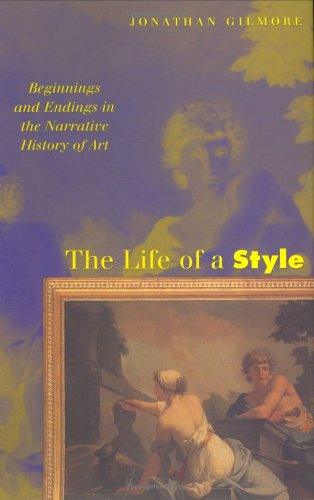
What does it mean to say that a form of art is 'exhausted', that an artist has brought his or her work as far as it can go, that modernism began with Edouard Manet, or that cubism reached a natural ending in 1914 (even if members of that movement continued to paint in a cubist style)? Contemporary theories of art history tend to treat such issues as matters of narrative form, of the manner in which history is represented with beginnings, turning points, and endings belonging to the narrative itself, and not constrained by historical fact. In The Life of a Style, Jonathan Gilmore claims that such narrative developments inhere in the history of art itself.By exploring such topics as the discovery of perspective, neoclassical models of composition, the end of cubism, and the evolution of Jackson Pollock's paintings, Gilmore proposes a way of understanding how artistic styles develop in an internal or organic fashion and how their development relates to their social and biographical contexts. In Gilmore's view, there are intrinsic limits to a style, limits that are present from its beginning but that emerge only as, or after, it reaches the end of its history.
⚠️ WARNING (California Proposition 65):
This product may contain chemicals known to the State of California to cause cancer,
birth defects, or other reproductive harm.
For MAP (Minimum Advertised Price) violations and Intellectual Property (IP) or Trademark concerns, please contact:
support@ergodebooks.com
⚠️ California Proposition 65 Warning: Some products sold on this website may expose you to chemicals known to the State of California to cause cancer, birth defects, or other reproductive harm. For more information, visit www.P65Warnings.ca.gov.