
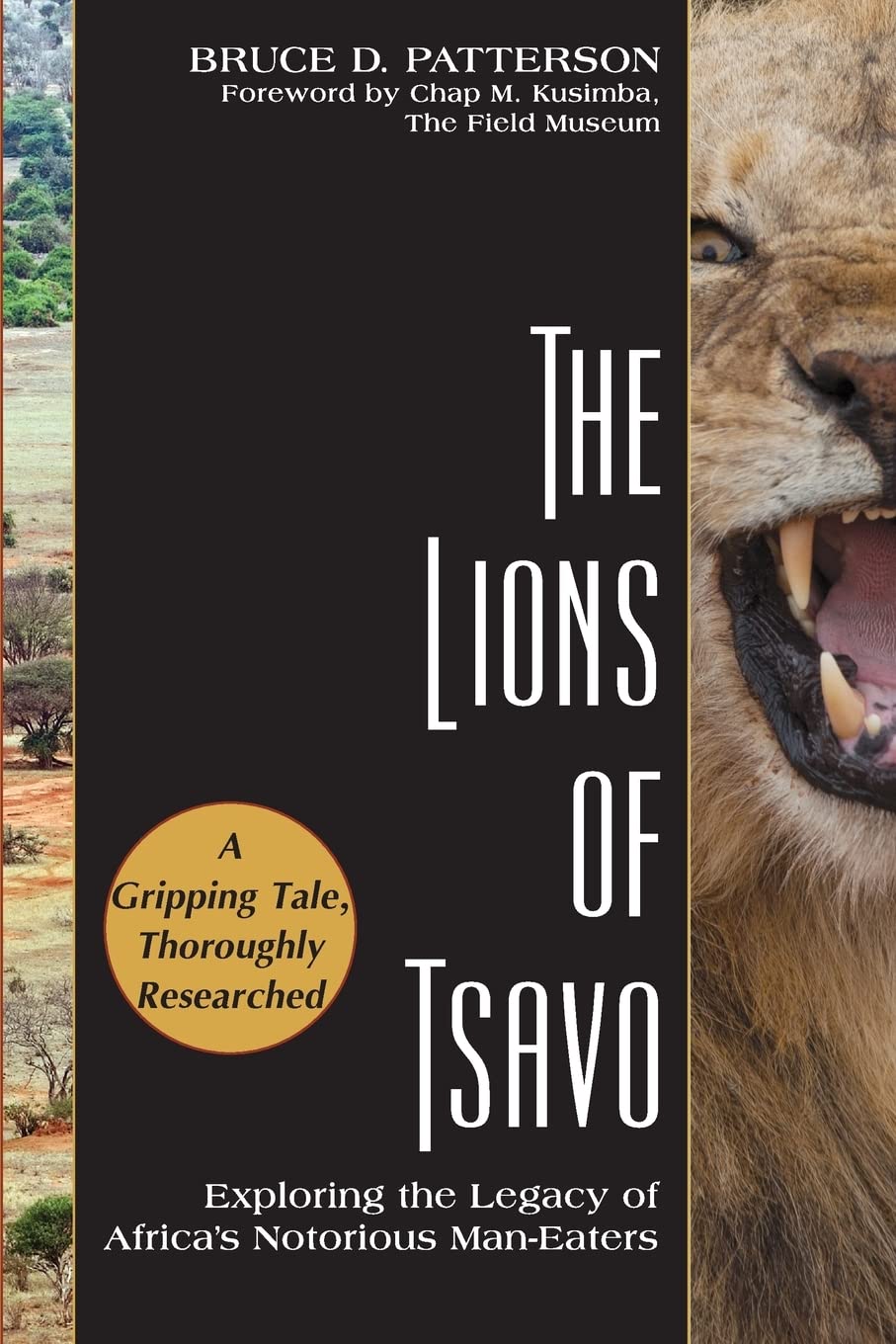
Title
The Lions of Tsavo: Exploring the Legacy of Africa's Notorious ManEaters,Used
Sold by Ergodebooks, an authorized reseller.
Returns accepted within 30 days | support@ergodebooks.com
Shipping Information
- Free Standard Shipping — United States only
- Processing Time: 3–5 business days
- Estimated Delivery: 6–10 business days after dispatch
- Double-boxed, fully insured & discreetly packaged
- Tracking number sent via email once dispatched
Returns & Refund
Returns accepted within 30 days of delivery.
Damaged or Defective Item
Free return shipping + replacement or full refund
Wrong Item Received
Free return shipping + replacement or full refund
Change of Mind
Return shipping at customer's expense · 25% restocking fee applies
Payment Option

A little over a century ago, at the height of European colonial expansion in Africa, the British undertook a transKenya railroad from Mombasa on the Indian Ocean to Lake Victoria. One hundred and thirty miles in, at what is now the Tsavo National Park, one of the world's largest wildlife preserves, nature struck back in the form of two male lions who began to systematically hunt, kill, and devour railroad workers, claiming 135 lives.The story of the Tsavo maneaters has captivated the public's imagination for more than a century while giving rise to considerable scientific debate. What compelled those lions to prey on human beings was it a matter of necessity, selfdefense, or simply one of opportunity? Is there something about maneless lions that makes them especially prone to becoming maneaters, or is human predation by lions more common than we have been led to believe? What can the events of 1898 teach us about the extraordinary Tsavo lions and about lions in general?In an effort to answer these questions, Bruce Patterson, principal investigator of the Tsavo Research Program and curator at the Field Museum in Chicago, where the Tsavo maneaters are on exhibit, has conducted extensive field research throughout the region. Working from original accounts, he retells the story of those bloody nights in Kenya and, in a balanced discussion of competing narratives, he presents forensic evidence that the maneating behavior exhibited in 1898 was likely due to pathology, but argues that most maneaters and stockraiders today result from human encroachment on wild habitats. He also delves into the evolutionary biology, anatomy and physiology, social behavior, and hunting strategies of the king of predators. In the process, he comes the somewhat disconcerting conclusion that, for lions, once they have tasted human flesh, "maneating quickly becomes a habit, a routine, a way of life."
⚠️ WARNING (California Proposition 65):
This product may contain chemicals known to the State of California to cause cancer, birth defects, or other reproductive harm.
For more information, please visit www.P65Warnings.ca.gov.