
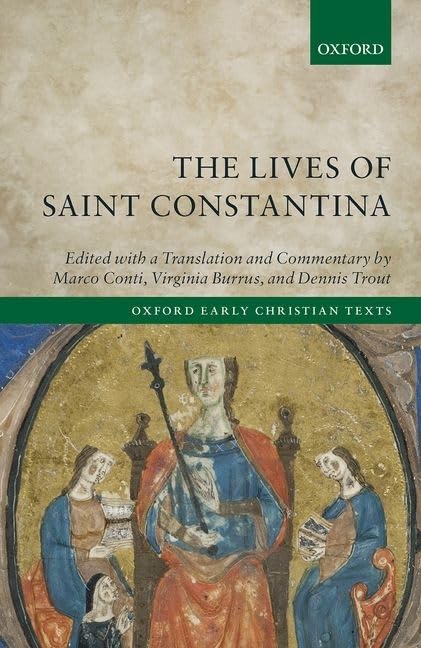
Title
The Lives of Saint Constantina: Introduction, Translations, and Commentaries (Oxford Early Christian Texts),Used
Sold by Ergodebooks, an authorized reseller.
Returns accepted within 30 days | support@ergodebooks.com
Shipping Information
- Free Standard Shipping — United States only
- Processing Time: 3–5 business days
- Estimated Delivery: 6–10 business days after dispatch
- Double-boxed, fully insured & discreetly packaged
- Tracking number sent via email once dispatched
Returns & Refund
Returns accepted within 30 days of delivery.
Damaged or Defective Item
Free return shipping + replacement or full refund
Wrong Item Received
Free return shipping + replacement or full refund
Change of Mind
Return shipping at customer's expense · 25% restocking fee applies
Payment Option

Constantina, daughter of the fourthcentury emperor Constantine who so famously converted to Christianity, deserves a place of her own in the history of Christianity. As both poet and churchbuilder, she was an early patron of the Roman cult of the virgin martyr Agnes and was buried ad sanctam in a sumptuously mosaicked mausoleum that still stands. What has been very nearly forgotten is that the twicemarried Constantina also came to be viewed as a virgin saint in her own right, said to have been converted and healed of leprosy by Saint Agnes. This volume publishes for the first time critical editions and English translations of three Latin hagiographies dedicated to the empress, offering an introduction and commentaries to contextualize these virtually unknown works. The earliest and longest of them is the anonymous Life of Saint Constantina likely dating to the mid or late sixth century, reflecting a female monastic setting and featuring both a story of pope Silvester's instruction of Constantina and a striking dialogue between Constantina and twelve virgins who offer speeches in praise of virginity as the summum bonum. A second, slightly later work, On the Feast of Saint Constantia (the misnaming of the saint reflecting common confusion), is a more streamlined account apparently tailored for liturgical use in early seventhcentury Rome; this text is reworked and expanded by the twelfthcentury Roman scholar Nicolaus Maniacoria in his Life of the Blessed Constantia, including a questionandanswer dialogue between Constantina and her two virginal charges Attica and Artemia. These works will be of great interest to students of late ancient and medieval saints' cults, hagiography, monasticism, and women's history.
⚠️ WARNING (California Proposition 65):
This product may contain chemicals known to the State of California to cause cancer, birth defects, or other reproductive harm.
For more information, please visit www.P65Warnings.ca.gov.