
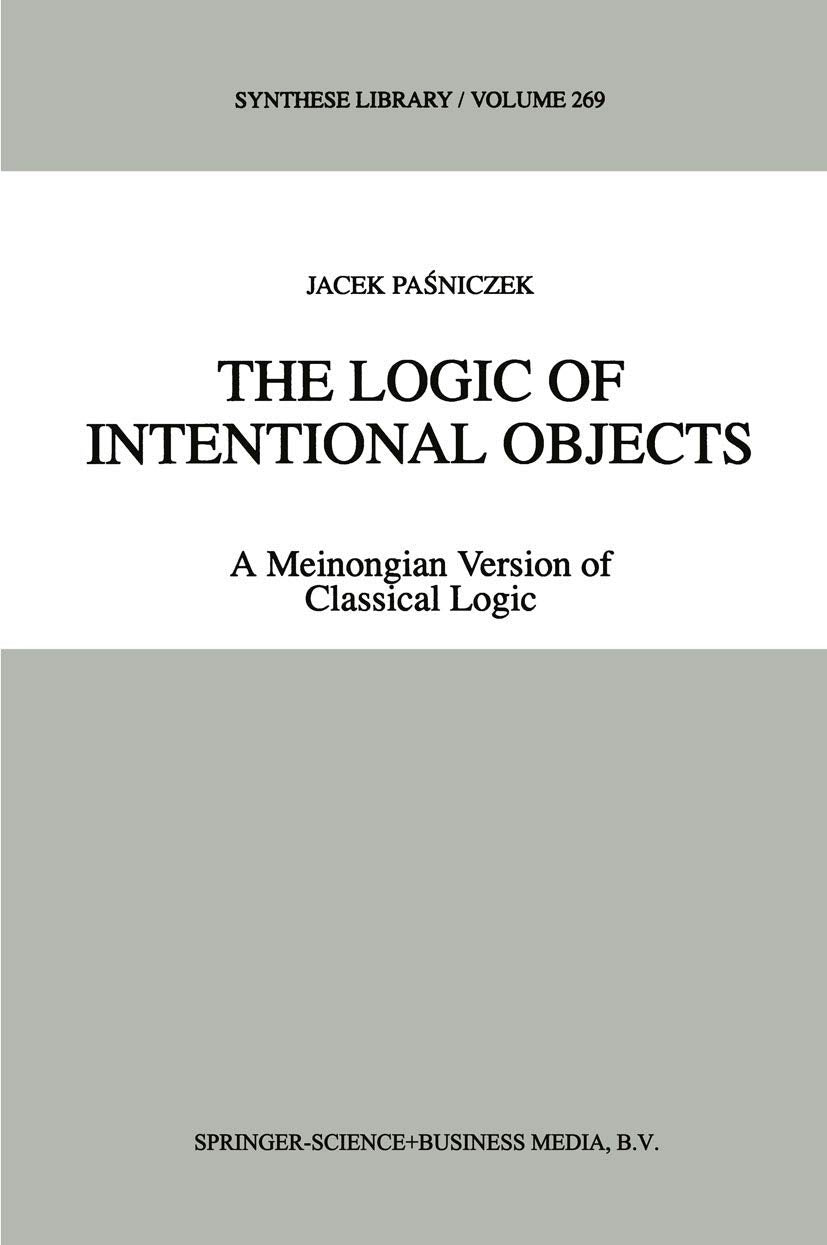
Title
The Logic of Intentional Objects: A Meinongian Version of Classical Logic (Synthese Library, 269),Used
Sold by Ergodebooks, an authorized reseller.
Returns accepted within 30 days | support@ergodebooks.com
Shipping Information
- Free Standard Shipping — United States only
- Processing Time: 3–5 business days
- Estimated Delivery: 6–10 business days after dispatch
- Double-boxed, fully insured & discreetly packaged
- Tracking number sent via email once dispatched
Returns & Refund
Returns accepted within 30 days of delivery.
Damaged or Defective Item
Free return shipping + replacement or full refund
Wrong Item Received
Free return shipping + replacement or full refund
Change of Mind
Return shipping at customer's expense · 25% restocking fee applies
Payment Option

Intentionality is one of the most frequently discussed topics in contemporary phenomenology and analytic philosophy. This book investigates intentionality from the point of view of intentional objects. According to the classical approach to this concept, whatever can be consciously experienced is regarded as an intentional object. Thus, not only ordinary existing individuals but also various kinds of nonexistents and nonindividuals are considered as intentional (including such bizarre entities as quantifier objects: some dog', every dog').Alexius Meinong, an Austrian philosopher, is particularly wellknown as the inventor' of an abundant ontology of objects among which even incomplete and impossible ones, like the round square', find their place. Drawing inspirations from Meinong's ideas, the author develops a simple logic of intentional objects, Mlogic. Mlogic closely resembles classical firstorder logic and, as opposed to the formally complicated contemporary theories of nonexistent objects, it is much more friendly in apprehending and applications. However, despite this resemblance, the ontological content of Mlogic far exceeds that of classical logic. In this book formal investigations are intertwined with philosophical analyses. On the one hand, Mlogic is used as a tool for investigating formal features of intentional objects. On the other hand, the study of intentionality phenomena suggests further ways of extending and modifying Mlogic.Audience: The book is addressed to logicians, cognitive scientists, philosophers of language and metaphysics with either a phenomenological or an analytic background.
⚠️ WARNING (California Proposition 65):
This product may contain chemicals known to the State of California to cause cancer, birth defects, or other reproductive harm.
For more information, please visit www.P65Warnings.ca.gov.