
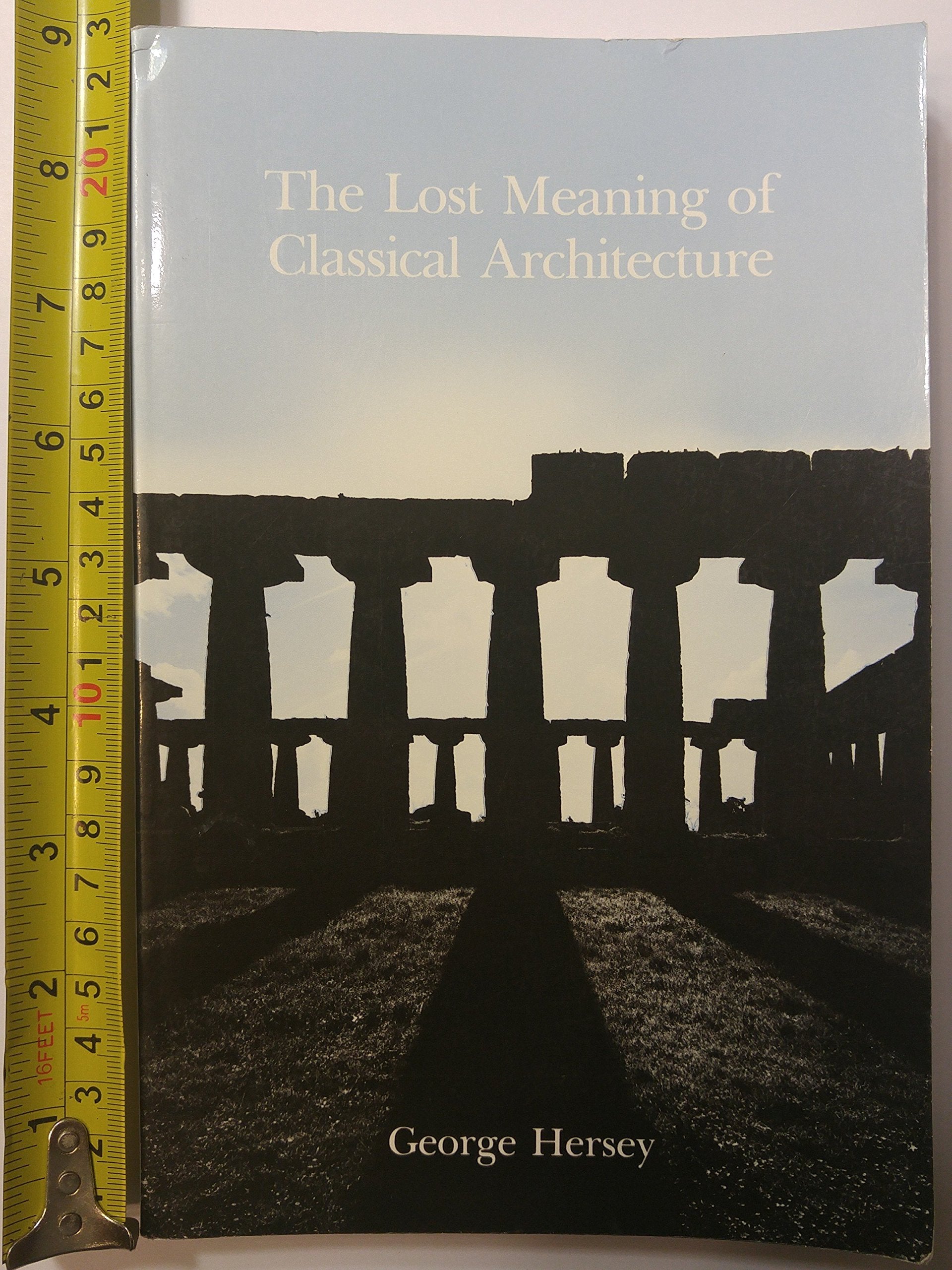
Title
The Lost Meaning Of Classical Architecture: Speculations On Ornament From Vitruvius To Venturi
Sold by Ergodebooks, an authorized reseller.
Returns accepted within 30 days | support@ergodebooks.com
Shipping Information
- Free Standard Shipping — United States only
- Processing Time: 3–5 business days
- Estimated Delivery: 6–10 business days after dispatch
- Double-boxed, fully insured & discreetly packaged
- Tracking number sent via email once dispatched
Returns & Refund
Returns accepted within 30 days of delivery.
Damaged or Defective Item
Free return shipping + replacement or full refund
Wrong Item Received
Free return shipping + replacement or full refund
Change of Mind
Return shipping at customer's expense · 25% restocking fee applies
Payment Option

Why Do Architects Still Use The Classical Orders? Why Use Forms Derived From Ancient Greek Temples When Ancient Greek Religion Has Been Dead For Centuries And When The Way Of Life They Expressed Is Extinct? And Why Decorate A Contemporary Courthouse With The Bones, Eggs, Darts, Claws, And Garlands That An Ancient Greek Would Recognize As The Trappings Of Animal Sacrifice? With These Provocative Questions George Hersey Begins His Recovery Of The Meaning Of Classical Architecture. For The Last Four Centuries, He Shows, Philology And Formalism Have Drained Architecture Of Its Poetry. By Analyzing This Poetrythe Tropes Founded On The Greek Terms For Ornamental Detailhe Reconstructs A Classical Theory About The Origin And Meaning Of The Orders, One That Links Them To Ancient Sacrificial Ritual And Myth.In Doing So, Hersey Reinterprets Key Tales And Taboos That Were Part Of The Cultural Memory Of The Ancient Greeks. His Touchstone Is Vitruvius, Author Of The Only Surviving Classical Treatise On Architecture, Whose Stories About Dorus, Ion, And The Corinthian Maiden, And About The Caryaean Women And Persian Soldiers, Describe The Orders As Records Or Remembrances Of Sacrifice.Hersey Finds Revivals Of This Consciousness In The Italian Renaissance And Throws New Light On The Works Of The Architectural Theorists Francesco Di Giorgio And Ceasare Cesariano, And Also On Raphael'S Disput, Michelangelo'S Tomb Of Julius 11 And Medici Chapel, And Hugues Sambin'S Handbook On Termini.
⚠️ WARNING (California Proposition 65):
This product may contain chemicals known to the State of California to cause cancer, birth defects, or other reproductive harm.
For more information, please visit www.P65Warnings.ca.gov.
- Q: How many pages does this book have? A: This book has two hundred one pages. It provides an in-depth exploration of classical architecture and ornamentation.
- Q: What is the binding type of this book? A: The binding type is paperback. This makes it lightweight and easy to handle while reading.
- Q: What are the dimensions of this book? A: The dimensions are nine point zero two inches in length, five point nine five inches in width, and zero point five three inches in height. This size is convenient for both reading and storage.
- Q: Who is the author of this book? A: The author is George Hersey. He is known for his scholarly work on architecture and its historical significance.
- Q: What is the main theme of this book? A: The main theme is the exploration of classical architecture and its enduring relevance. It examines how ancient traditions influence contemporary design.
- Q: Is this book suitable for beginners in architecture? A: Yes, this book is suitable for beginners. It provides foundational insights into classical architecture, making it accessible for new learners.
- Q: Can I use this book for academic research? A: Yes, this book is excellent for academic research. It includes comprehensive analyses and references to classical texts and architectural theory.
- Q: What type of audience would benefit from this book? A: Students, architecture enthusiasts, and professionals would benefit from this book. It offers valuable perspectives on historical and contemporary architectural practices.
- Q: How should I store this book to keep it in good condition? A: Store this book in a cool, dry place, preferably upright on a shelf. Avoid exposure to direct sunlight to prevent fading.
- Q: How do I clean this book if it gets dirty? A: To clean this book, use a dry, soft cloth. Avoid using water or cleaning solutions, as they may damage the pages.
- Q: What if the book arrives damaged? A: If the book arrives damaged, contact the seller for a return or exchange. Most sellers have policies in place for such situations.
- Q: Is there a warranty on this book? A: No, there is typically no warranty on books. However, return policies vary by seller.
- Q: Can I find similar books on classical architecture? A: Yes, there are many similar books available. Look for titles that focus on the history and theory of architecture for comparable content.
- Q: Is this book available in digital format? A: Yes, this book may be available in digital format. Check online retailers for eBook options.
- Q: Does this book include illustrations or photographs? A: No, this book does not prominently feature illustrations or photographs. It focuses on textual analysis and critical interpretation.