
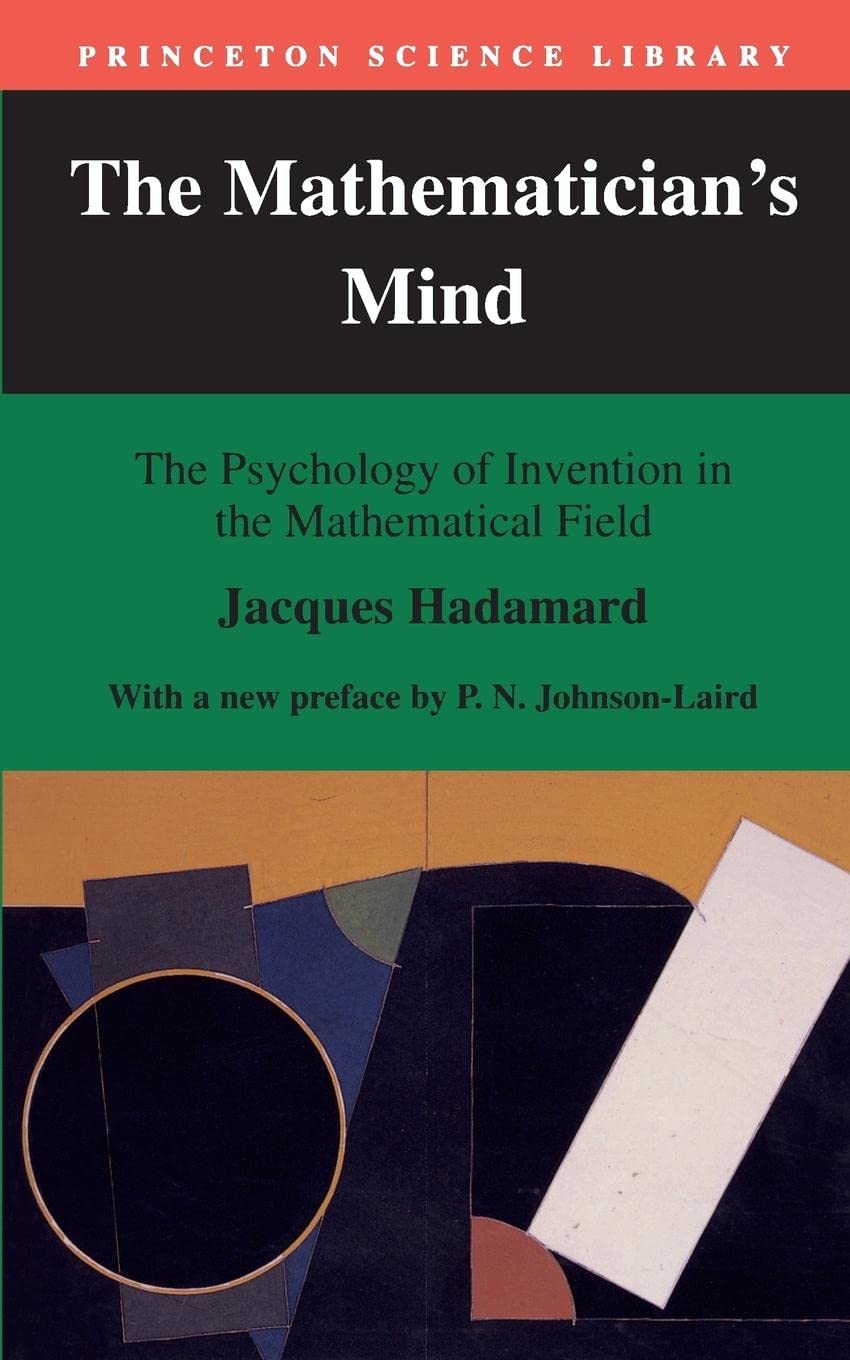
Title
The Mathematician'S Mind,New
Sold by Ergodebooks, an authorized reseller.
Returns accepted within 30 days | support@ergodebooks.com
Shipping Information
- Free Standard Shipping — United States only
- Processing Time: 3–5 business days
- Estimated Delivery: 6–10 business days after dispatch
- Double-boxed, fully insured & discreetly packaged
- Tracking number sent via email once dispatched
Returns & Refund
Returns accepted within 30 days of delivery.
Damaged or Defective Item
Free return shipping + replacement or full refund
Wrong Item Received
Free return shipping + replacement or full refund
Change of Mind
Return shipping at customer's expense · 25% restocking fee applies
Payment Option

Fifty years ago when Jacques Hadamard set out to explore how mathematicians invent new ideas, he considered the creative experiences of some of the greatest thinkers of his generation, such as George Polya, Claude LviStrauss, and Albert Einstein. It appeared that inspiration could strike anytime, particularly after an individual had worked hard on a problem for days and then turned attention to another activity. In exploring this phenomenon, Hadamard produced one of the most famous and cogent cases for the existence of unconscious mental processes in mathematical invention and other forms of creativity. Written before the explosion of research in computers and cognitive science, his book, originally titled The Psychology of Invention in the Mathematical Field, remains an important tool for exploring the increasingly complex problem of mental life.The roots of creativity for Hadamard lie not in consciousness, but in the long unconscious work of incubation, and in the unconscious aesthetic selection of ideas that thereby pass into consciousness. His discussion of this process comprises a wide range of topics, including the use of mental images or symbols, visualized or auditory words, 'meaningless' words, logic, and intuition. Among the important documents collected is a letter from Albert Einstein analyzing his own mechanism of thought.
⚠️ WARNING (California Proposition 65):
This product may contain chemicals known to the State of California to cause cancer, birth defects, or other reproductive harm.
For more information, please visit www.P65Warnings.ca.gov.
- Q: How many pages does 'The Mathematician's Mind' have? A: This book has one hundred sixty-six pages. It's a comprehensive exploration of creativity in mathematics.
- Q: What is the binding type of this book? A: The book is available in paperback binding. This makes it lightweight and easy to handle.
- Q: What are the dimensions of 'The Mathematician's Mind'? A: The book measures five point twenty-five inches in length, zero point thirty-nine inches in width, and eight inches in height.
- Q: Who is the author of this book? A: The author is Jacques Hadamard. He was a renowned mathematician known for his insights into creativity and thought processes.
- Q: What category does this book fall under? A: This book is categorized under Neuropsychology. It delves into the psychological aspects of mathematical creativity.
- Q: Is 'The Mathematician's Mind' suitable for all ages? A: Yes, this book is suitable for a general audience. It explores complex ideas in an accessible manner.
- Q: What are the main themes discussed in the book? A: The book discusses themes like unconscious mental processes, creativity, and the experiences of notable mathematicians.
- Q: How can I apply the concepts from this book? A: You can apply the concepts by reflecting on your creative processes, especially when tackling challenging problems.
- Q: Is this book recommended for students? A: Yes, it's highly recommended for students studying mathematics or psychology. It offers valuable insights into the creative process.
- Q: How do I care for this paperback book? A: To care for the book, keep it in a dry place and avoid exposure to direct sunlight. This helps preserve its condition.
- Q: Can I return the book if I don't like it? A: Yes, you can return the book if it does not meet your expectations. Check the seller's return policy for specifics.
- Q: Is there a warranty on this book? A: No, books typically do not come with a warranty. However, checking for damages upon arrival is advisable.
- Q: What if the book arrives damaged? A: If the book arrives damaged, contact the seller immediately for a replacement or refund.
- Q: Does this book include any illustrations or diagrams? A: No, the book does not include illustrations. It focuses on textual analysis and concepts.
- Q: What makes this book unique? A: This book is unique due to its exploration of the unconscious processes behind mathematical creativity, offering deep psychological insights.