
Title
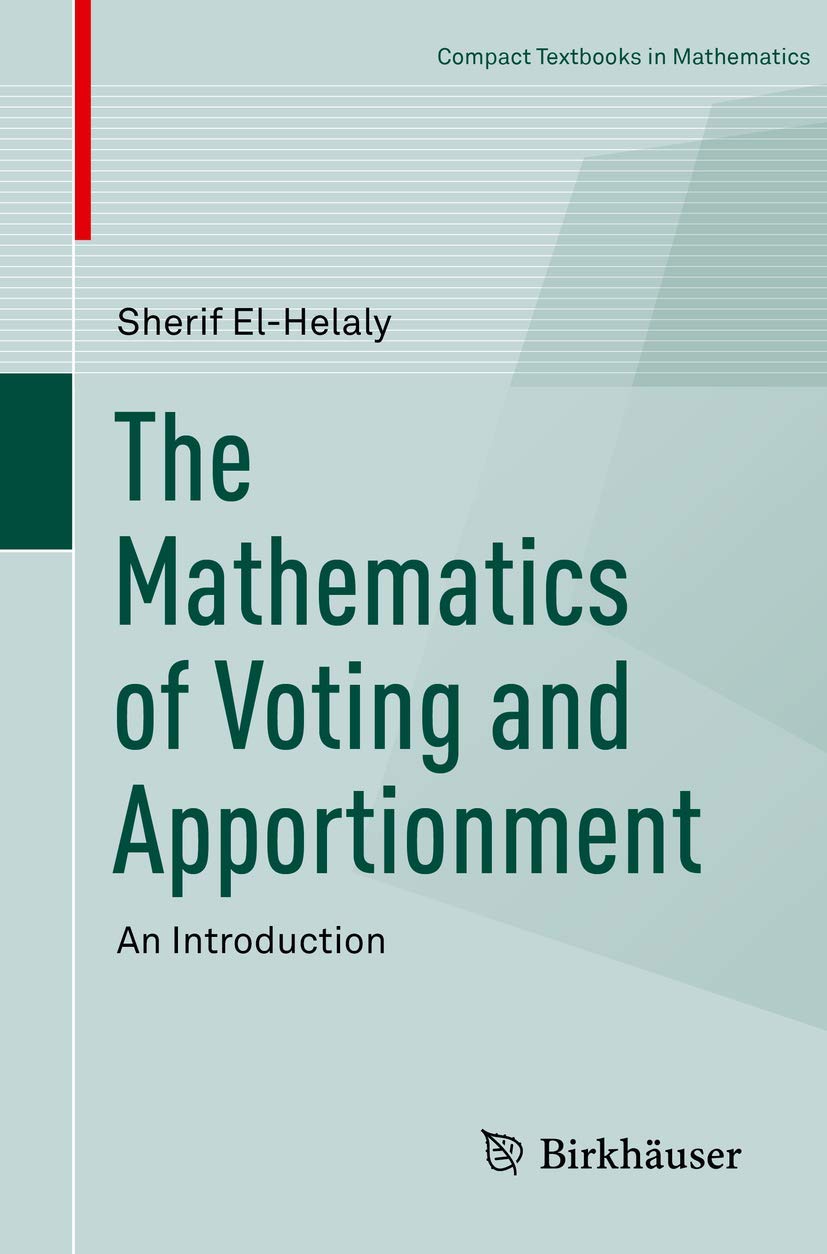
The Mathematics Of Voting And Apportionment: An Introduction (Compact Textbooks In Mathematics)
Sold by Ergodebooks, an authorized reseller.
Returns accepted within 30 days | support@ergodebooks.com
Shipping Information
- Free Standard Shipping — United States only
- Processing Time: 3–5 business days
- Estimated Delivery: 6–10 business days after dispatch
- Double-boxed, fully insured & discreetly packaged
- Tracking number sent via email once dispatched
Returns & Refund
Returns accepted within 30 days of delivery.
Damaged or Defective Item
Free return shipping + replacement or full refund
Wrong Item Received
Free return shipping + replacement or full refund
Change of Mind
Return shipping at customer's expense · 25% restocking fee applies
Payment Option

This Textbook Contains A Rigorous Exposition Of The Mathematical Foundations Of Two Of The Most Important Topics In Politics And Economics: Voting And Apportionment, At The Level Of Upper Undergraduate And Beginning Graduate Students. It Stands Out Among Comparable Books By Providing, In One Volume, An Extensive And Mathematically Rigorous Treatment Of These Two Topics.The Texts Three Chapters Cover Social Choice, Yesno Voting, And Apportionment, Respectively, And Can Be Covered In Any Order, Allowing Teachers Ample Flexibility. Each Chapter Begins With An Elementary Introduction And Several Examples To Motivate The Concepts And To Gradually Lead To More Advanced Material. Landmark Theorems Are Presented With Detailed And Streamlined Proofs; Those Requiring More Complex Proofs, Such As Arrows Theorems On Dictatorship, Gibbards Theorem On Oligarchy, And Grdenfors Theorem On Manipulation, Are Broken Down Into Propositions And Lemmas In Order To Make Them Easier To Grasp. Simple And Intuitive Notations Are Emphasized Over Nonstandard, Overly Complicated Symbols. Additionally, Each Chapter Ends With Exercises That Vary From Computational To Prove Or Disprove Types.The Mathematics Of Voting And Apportionment Will Be Particularly Wellsuited For A Course In The Mathematics Of Voting And Apportionment For Upperlevel Undergraduate And Beginning Graduate Students In Economics, Political Science, Or Philosophy, Or For An Elective Course For Math Majors. In Addition, This Book Will Be A Suitable Read For To Any Curious Mathematician Looking For An Exposition To These Unpublicized Mathematical Applications.No Political Science Prerequisites Are Needed. Mathematical Prerequisites (Included In The Book) Are Minimal: Elementary Concepts In Combinatorics, Graph Theory, Order Relations, And The Harmonic And Geometric Means. What Is Needed Most Is The Level Of Maturity Thatenables The Student To Think Logically, Derive Results From Axioms And Hypotheses, And Intuitively Grasp Logical Notions Such As Contrapositive And Counterexample.
⚠️ WARNING (California Proposition 65):
This product may contain chemicals known to the State of California to cause cancer, birth defects, or other reproductive harm.
For more information, please visit www.P65Warnings.ca.gov.
- Q: How many pages does this book have? A: This book has two hundred seventy-nine pages. It offers a comprehensive exploration of mathematical topics in voting and apportionment.
- Q: What are the dimensions of this book? A: The book measures seven point twenty-two inches in length, zero point forty-three inches in width, and nine point thirty-seven inches in height. These dimensions make it compact and easy to handle.
- Q: What is the binding type of this book? A: This book is available in paperback binding. This makes it lightweight and convenient for students to carry.
- Q: Is this textbook suitable for beginners? A: Yes, this textbook is suitable for upper undergraduate and beginning graduate students. It provides clear explanations and minimal prerequisites in mathematics.
- Q: What topics does this book cover? A: The book covers social choice, yes-no voting, and apportionment. Each chapter is designed to be flexible for teaching.
- Q: Do I need any prerequisites to read this book? A: No political science prerequisites are needed. The mathematical prerequisites are minimal and included in the book.
- Q: How should I care for this textbook? A: To keep the textbook in good condition, store it in a dry place and avoid exposing it to direct sunlight for extended periods. This will help preserve the pages and binding.
- Q: What are the exercise types in this book? A: The exercises vary from computational to 'prove or disprove' types. This variety encourages critical thinking and application of concepts.
- Q: Is this book safe for all readers? A: Yes, this book is appropriate for anyone curious about the mathematics of voting and apportionment. It does not contain any inappropriate content.
- Q: Can this book be used for self-study? A: Yes, this book is ideal for self-study. It provides clear explanations and examples that facilitate independent learning.
- Q: What makes this textbook unique? A: This textbook stands out by offering a rigorous and comprehensive treatment of voting and apportionment in a single volume. It simplifies complex proofs.
- Q: Who is the author of this book? A: The author of this book is Sherif El-Helaly. He provides insightful perspectives on mathematical applications in politics and economics.
- Q: Is this book suitable for math majors? A: Yes, this book is suitable for math majors as an elective course. It exposes students to unpublicized mathematical applications.
- Q: What is the main focus of this textbook? A: The main focus of this textbook is on the mathematical foundations of voting and apportionment. It emphasizes logical thinking and derivation of results.
- Q: Does this book include examples? A: Yes, each chapter begins with several examples to motivate concepts. These examples help bridge basic ideas to more advanced material.