
Title
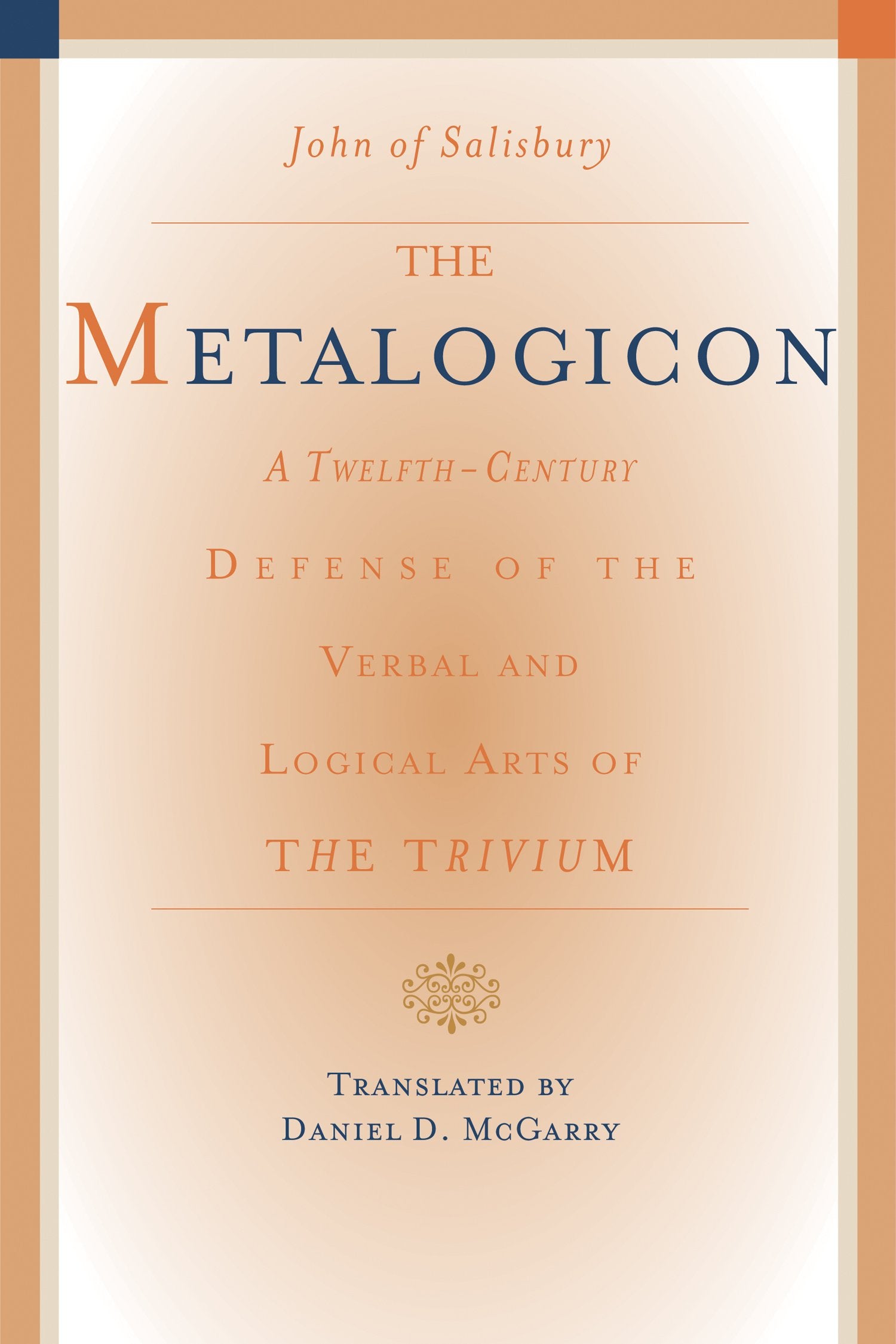
The Metalogicon: A TwelfthCentury Defense of the Verbal and Logical Arts of the Trivium,Used
Sold by Ergodebooks, an authorized reseller.
Returns accepted within 30 days | support@ergodebooks.com
Shipping Information
- Free Standard Shipping — United States only
- Processing Time: 3–5 business days
- Estimated Delivery: 6–10 business days after dispatch
- Double-boxed, fully insured & discreetly packaged
- Tracking number sent via email once dispatched
Returns & Refund
Returns accepted within 30 days of delivery.
Damaged or Defective Item
Free return shipping + replacement or full refund
Wrong Item Received
Free return shipping + replacement or full refund
Change of Mind
Return shipping at customer's expense · 25% restocking fee applies
Payment Option

Written in 1159 and addressed to Thomas Becket, John of Salisbury's The Metalogicon presentsand defendsa thorough study of the liberal arts of grammar, logic, and rhetoric. The very name 'Metalogicon,' a coinage by the author, brings together the Greek meta (on behalf of) and logicon (logic or logical studies). Thus, in naming his text, he also explained it. With this lucid treatise on education, John of Salisbury urges a thorough grounding in the arts of words (oral and written) and reasoning, as these topics are addressed in grammar and logic.The Metalogicon (Contents in brief)Prologue Occasion, Purpose, and General Nature of the WorkBook I The Trivium and GrammarBook II Logic Proper: General ObservationsBook III Logic: Contents (Porphyry and Aristotle)Book IV Logic: Contents and TruthThe study of grammar in John of Salisbury's time included familiarization with the ancient Latin classics, and involved not only a reading of them but also an analysis and imitation of their style. It thus anticipated the humanism of the Renaissance. The study of logic, as it was then pursued, comprised learning and putting into practice the principles of Aristotle's Organon.In The Metalogicon, a leading medieval scholar summarizes the essential lineaments of existing twelfthcentury education, describes his experiences while a student at Chartres and Paris, and affords personal glimpses of such contemporary intellectual leaders as Peter Abelard, Gilbert de la Porre, and Thierry of Chartres.Written more than 950 years ago, The Metalogicon still possesses an invigorating originality that invites readers to refresh themselves at the sources of Western learning.'Grammar is accordingly first among the liberal arts. Necessary for the young, gratifying to the old, and an agreeable solace in solitude, it alone, of all branches of learning, has more utility than show.' Quintilian, quoted by John of Salisbury in The MetalogiconJohn of Salisbury (ca. 11151176) studied with almost all the great masters of the early twelfth century, served as an aid to Thomas Becket, was friend to Pope Hadrian IV, an annoyance if not an enemy to England's King Henry II, and died as Bishop of Chartres.Daniel D. McGarry was a professor of history at Saint Louis University. He died in 1999. His translation of The Metalogicon was the first to appear in any modern language.
⚠️ WARNING (California Proposition 65):
This product may contain chemicals known to the State of California to cause cancer, birth defects, or other reproductive harm.
For more information, please visit www.P65Warnings.ca.gov.