
Title
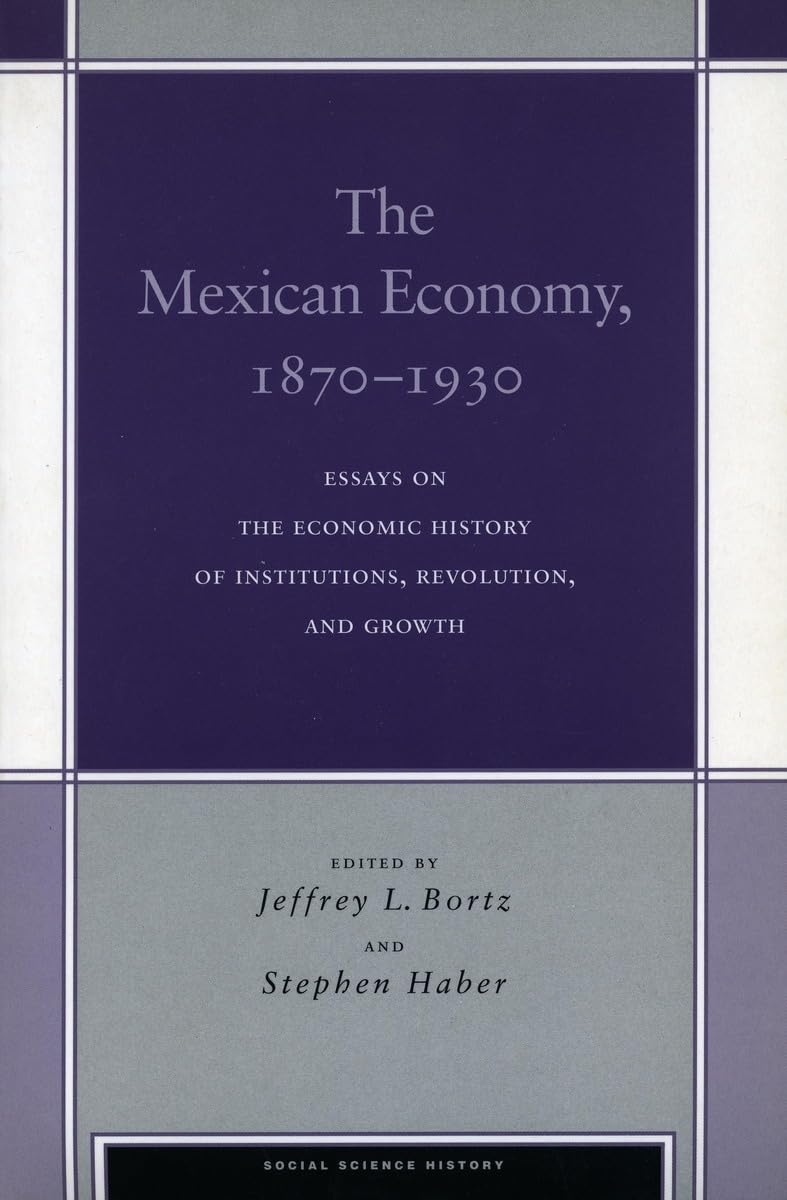
The Mexican Economy, 18701930: Essays On The Economic History Of Institutions, Revolution, And Growth (Social Science History),New
Sold by Ergodebooks, an authorized reseller.
Returns accepted within 30 days | support@ergodebooks.com
Shipping Information
- Free Standard Shipping — United States only
- Processing Time: 3–5 business days
- Estimated Delivery: 6–10 business days after dispatch
- Double-boxed, fully insured & discreetly packaged
- Tracking number sent via email once dispatched
Returns & Refund
Returns accepted within 30 days of delivery.
Damaged or Defective Item
Free return shipping + replacement or full refund
Wrong Item Received
Free return shipping + replacement or full refund
Change of Mind
Return shipping at customer's expense · 25% restocking fee applies
Payment Option

Until the last decades of the nineteenth century, Mexico faced the twin problems of chronic political instability and slow economic growth. During the period of the Porfirio Daz dictatorship (18761911), however, a series of institutional reforms reignited growth and created rents that enabled the Daz government to threaten its opponents with military force or to buy them off.These institutional reforms came out of distinctly political processes, which often had to be brokered among multiple groups of economic elites and regional political bosses. Therefore, they were often structured to encourage investment by specifying property rights or creating streams of rents for particular entrepreneurs. In short, Porfirian Mexico is an excellent natural laboratory in which to investigate not only how institutional change can foment economic growth, but also how specific features of political institutions give rise to specific economic institutions that have both positive and negative effects on growth and distribution.In fact, the distributional consequences of the Porfirian regime gave rise to the Mexican Revolution of 19101917, which produced a further round of dramatic changes in Mexicos political institutions. These changes, in turn, restructured the institutions that governed property rights and those that determined the allocation of rents generated by property rights. This book aims both to identify the crucial institutions and to measure their economic effects.In addressing these issues, the contributors to this volume employ theoretical insights from the New Institutional Economics and statistical hypothesistesting as well as traditional archival methods. Thus, in addition to advancing the field of Latin American economic history by studying the interaction of political and economic institutions during the period 18701930, the book also makes a methodological contribution by using analytic tools not previously employed in the literature.
⚠️ WARNING (California Proposition 65):
This product may contain chemicals known to the State of California to cause cancer, birth defects, or other reproductive harm.
For more information, please visit www.P65Warnings.ca.gov.