If you have any questions, you are always welcome to contact us. We'll get back to you as soon as possible, withing 24 hours on weekdays.
Customer service
All questions about your order, return and delivery must be sent to our customer service team by e-mail at yourstore@yourdomain.com
Sale & Press
If you are interested in selling our products, need more information about our brand or wish to make a collaboration, please contact us at press@yourdomain.com
Help
If you have any questions, you are always welcome to contact us. We'll get back to you as soon as possible, withing 24 hours on weekdays.
Customer service
All questions about your order, return and delivery must be sent to our customer service team by e-mail at yourstore@yourdomain.com
Sale & Press
If you are interested in selling our products, need more information about our brand or wish to make a collaboration, please contact us at press@yourdomain.com
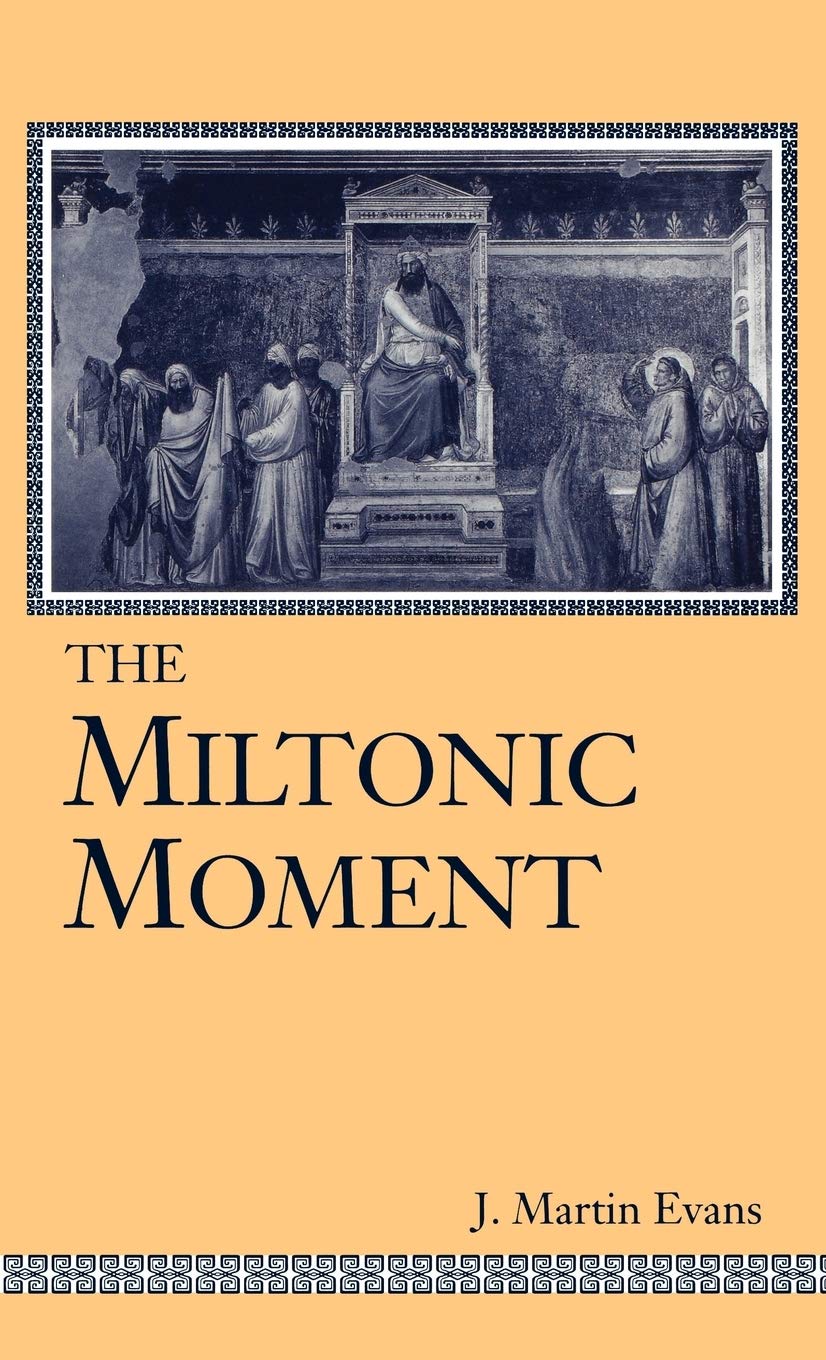
Milton's poems invariably depict the decisive instant in a story, a moment of crisis that takes place just before the action undergoes a dramatic change of course. Such instants look backward to a past that is about to be superseded or repudiated and forward, at the same time, to a future that will immediately begin to unfold. Martin Evans identifies this moment of transition as 'the Miltonic Moment.'This provocative new study focuses primarily on three of Milton's best known early poems: 'On the Morning of Christ's Nativity,' 'A Mask Presented at Ludlow Castle (Comus),' and 'Lycidas.' These texts share a distinctive perceptual and cognitive structure, which Evans defines as characteristically Miltonic, embracing a single moment that is both ending and beginning.The poems communicate a profound sense of intermediacy because they seem to take place between the boundaries that separate events. The works illuniated here, which also include Samson Agonistes and Paradise Regained, are all about transition from one form to another: from paganism to Christianity, from youthful inexperience to moral maturity, and from pastoral retirement to heroic engagement. This transformation is often ideological as well as historical or biographical.Evans shows that the moment of transition is characteristic of all Milton's poetry, and he proposes a new way of reading one of the seminal writers of the seventeenth century. Evans concludes that the narrative reversals in Milton's poetry suggest his constant attempts to bring about an intellectual revolution that, at a time of religious and political change in England, would transform an age.
⚠️ WARNING (California Proposition 65):
This product may contain chemicals known to the State of California to cause cancer,
birth defects, or other reproductive harm.
For MAP (Minimum Advertised Price) violations and Intellectual Property (IP) or Trademark concerns, please contact:
support@ergodebooks.com
⚠️ California Proposition 65 Warning: Some products sold on this website may expose you to chemicals known to the State of California to cause cancer, birth defects, or other reproductive harm. For more information, visit www.P65Warnings.ca.gov.