If you have any questions, you are always welcome to contact us. We'll get back to you as soon as possible, withing 24 hours on weekdays.
Customer service
All questions about your order, return and delivery must be sent to our customer service team by e-mail at yourstore@yourdomain.com
Sale & Press
If you are interested in selling our products, need more information about our brand or wish to make a collaboration, please contact us at press@yourdomain.com
Help
If you have any questions, you are always welcome to contact us. We'll get back to you as soon as possible, withing 24 hours on weekdays.
Customer service
All questions about your order, return and delivery must be sent to our customer service team by e-mail at yourstore@yourdomain.com
Sale & Press
If you are interested in selling our products, need more information about our brand or wish to make a collaboration, please contact us at press@yourdomain.com
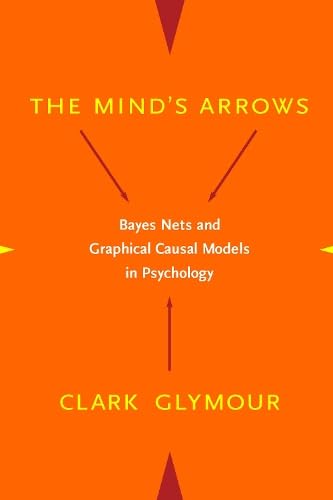
The use of Bayes nets and graphical causal models in the investigation of human learning of causal relations, and in modeling and inference in cognitive psychology.In recent years, small groups of statisticians, computer scientists, and philosophers have developed an account of how partial causal knowledge can be used to compute the effect of actions and how causal relations can be learned, at least by computers. The representations used in the emerging theory are causal Bayes nets or graphical causal models.In his new book, Clark Glymour provides an informal introduction to the basic assumptions, algorithms, and techniques of causal Bayes nets and graphical causal models in the context of psychological examples. He demonstrates their potential as a powerful tool for guiding experimental inquiry and for interpreting results in developmental psychology, cognitive neuropsychology, psychometrics, social psychology, and studies of adult judgment. Using Bayes net techniques, Glymour suggests novel experiments to distinguish among theories of human causal learning and reanalyzes various experimental results that have been interpreted or misinterpretedwithout the benefit of Bayes nets and graphical causal models. The capstone illustration is an analysis of the methods used in Herrnstein and Murray's book The Bell Curve; Glymour argues that new, more reliable methods of data analysis, based on Bayes nets representations, would lead to very different conclusions from those advocated by Herrnstein and Murray.
⚠️ WARNING (California Proposition 65):
This product may contain chemicals known to the State of California to cause cancer,
birth defects, or other reproductive harm.
For MAP (Minimum Advertised Price) violations and Intellectual Property (IP) or Trademark concerns, please contact:
support@ergodebooks.com
⚠️ California Proposition 65 Warning: Some products sold on this website may expose you to chemicals known to the State of California to cause cancer, birth defects, or other reproductive harm. For more information, visit www.P65Warnings.ca.gov.