
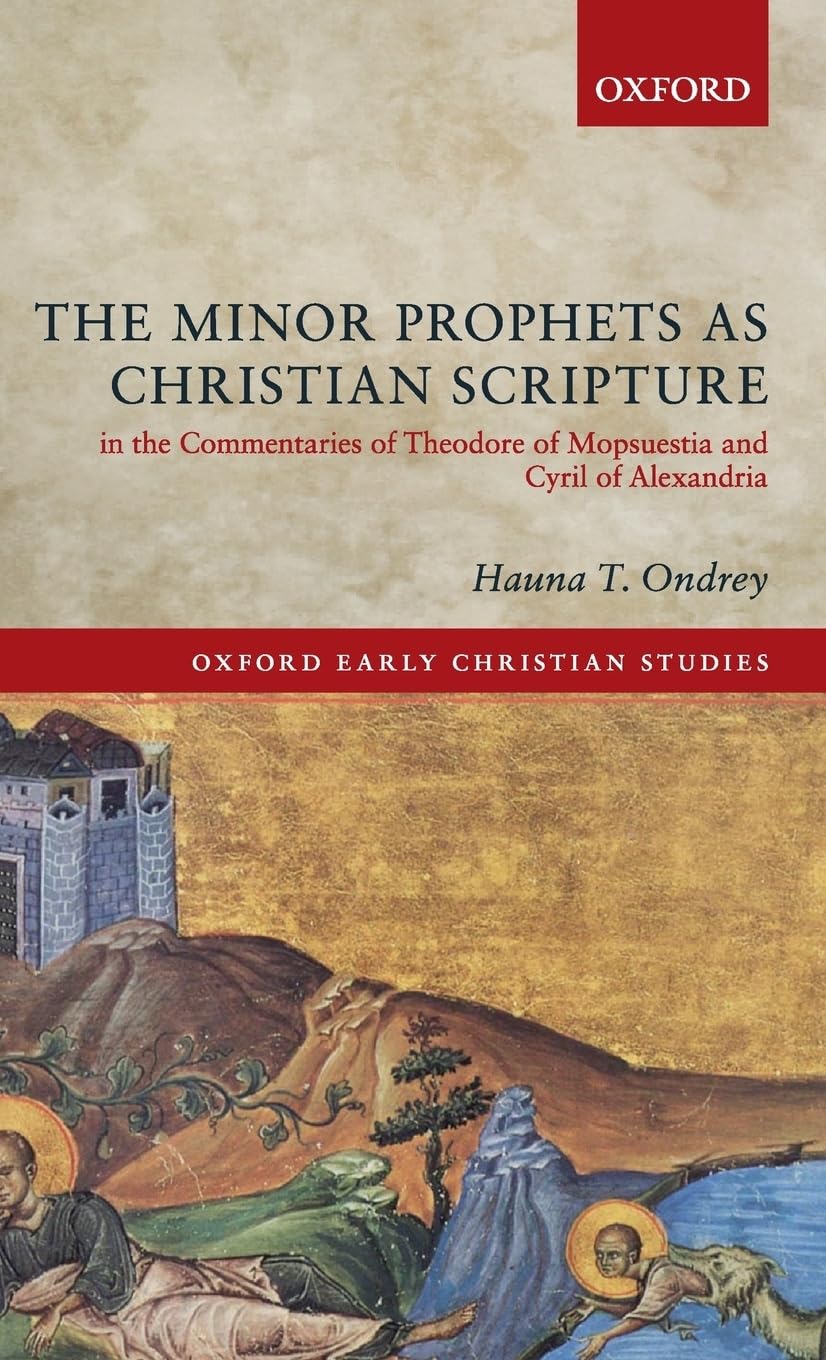
Title
The Minor Prophets as Christian Scripture in the Commentaries of Theodore of Mopsuestia and Cyril of Alexandria (Oxford Early Ch,Used
Sold by Ergodebooks, an authorized reseller.
Returns accepted within 30 days | support@ergodebooks.com
Shipping Information
- Free Standard Shipping — United States only
- Processing Time: 3–5 business days
- Estimated Delivery: 6–10 business days after dispatch
- Double-boxed, fully insured & discreetly packaged
- Tracking number sent via email once dispatched
Returns & Refund
Returns accepted within 30 days of delivery.
Damaged or Defective Item
Free return shipping + replacement or full refund
Wrong Item Received
Free return shipping + replacement or full refund
Change of Mind
Return shipping at customer's expense · 25% restocking fee applies
Payment Option

This work compares the Minor Prophets commentaries of Theodore of Mopsuestia and Cyril of Alexandria, isolating the role each interpreter assigns the Twelve Prophets in their ministry to Old Testament Israel and the texts of the Twelve as Christian scripture. Hauna T. Ondrey argues that Theodore does acknowledge christological prophecies, as distinct from both retrospective accommodation and typology. A careful reading of Cyril's Commentary on the Twelve limits the prospective christological revelation he ascribes to the prophets and reveals the positive role he grants the Mosaic law prior to Christ's advent. Exploring secondly the Christian significance Theodore and Cyril assign to Israel's exile and restoration reveals that Theodore's reading of the Twelve Prophets, while not attempting to be christocentric, is nevertheless selfconsciously Christian. Cyril, unsurprisingly, offers a robust Christian reading of the Twelve, yet this too must be expanded by his focus on the church and concern to equip the church through the ethical paideusis provided by the plain sense of the prophetic text. Revised descriptions of each interpreter lead to the claim that a recent tendency to distinguish the Old Testament interpretation of Theodore (negatively) and Cyril (positively) on the basis of their 'christocentrism' obscures more than it clarifies and polarizes no less than earlier accounts of Antiochene/Alexandrian exegesis. The conclusion argues against replacing old dichotomies with new and advocates rather for an approach that takes seriously Theodore's positive account of the unity and telos of the divine economy and the full range of Cyril's interpretation.
⚠️ WARNING (California Proposition 65):
This product may contain chemicals known to the State of California to cause cancer, birth defects, or other reproductive harm.
For more information, please visit www.P65Warnings.ca.gov.