
Title
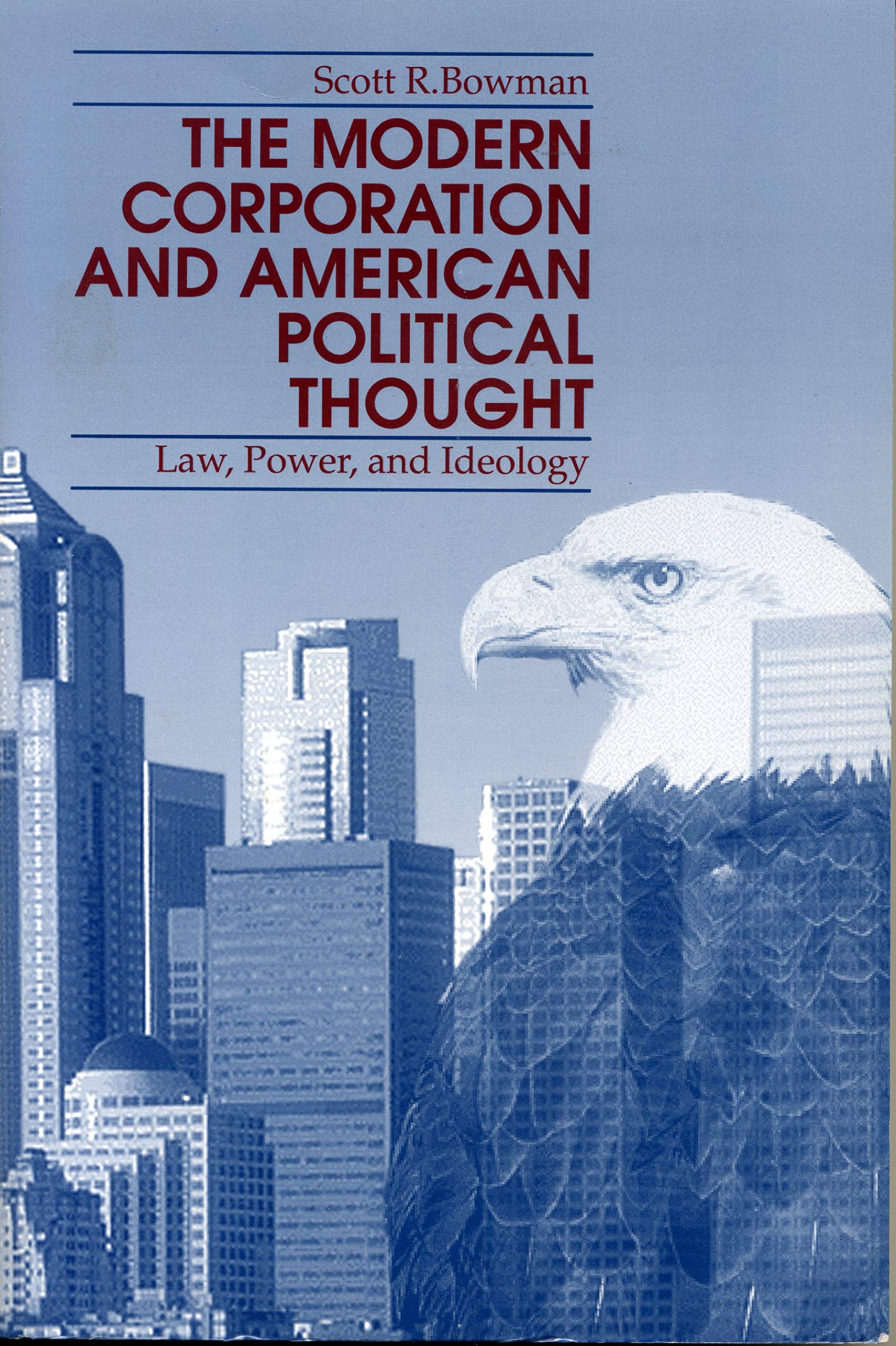
The Modern Corporation and American Political Thought: Law, Power, and Ideology,Used
Sold by Ergodebooks, an authorized reseller.
Returns accepted within 30 days | support@ergodebooks.com
Shipping Information
- Free Standard Shipping — United States only
- Processing Time: 3–5 business days
- Estimated Delivery: 6–10 business days after dispatch
- Double-boxed, fully insured & discreetly packaged
- Tracking number sent via email once dispatched
Returns & Refund
Returns accepted within 30 days of delivery.
Damaged or Defective Item
Free return shipping + replacement or full refund
Wrong Item Received
Free return shipping + replacement or full refund
Change of Mind
Return shipping at customer's expense · 25% restocking fee applies
Payment Option

Despite all that has been written about business and its role in American life, contemporary theories about the modern corporation as a social and political institution have failed to explain adequately the pervasiveness and complexity of corporate power in the twentieth century. Through an analysis of history, law, ideology, and economics that spans two centuries, Scott R. Bowman attempts to offer a complete interpretation of the way corporate power has achieved its dominant position in American society today.In The Modern Corporation and American Political Thought, Bowman demonstrates how judgemade and statutory laws have structured and regulated the growth of corporate power while preserving corporate autonomy. The argument unfolds within a historical framework that reconstructs the evolution of the corporation with reference to its two dimensions of power: internal (within the enterprise) and external (in society at large). Bowman examines and revises Marxist, pluralist, and managerial theories to develop his own political theory about class conflict and corporate power and offers fresh interpretations of the political thought of Herbert Croly, Walter Weyl, Thorstein Veblen, Peter F. Drucker, Adolph A. Berle, and John Kenneth Galbraith. Ultimately, this book sets forth the first political theory that adequately accounts for the power of the modern corporation in all its dimensions.
⚠️ WARNING (California Proposition 65):
This product may contain chemicals known to the State of California to cause cancer, birth defects, or other reproductive harm.
For more information, please visit www.P65Warnings.ca.gov.
- Q: What is the main theme of 'The Modern Corporation and American Political Thought'? A: The main theme of the book explores the evolution of corporate power in American society, examining how legal frameworks and political ideologies have shaped the modern corporation as a dominant social and political institution.
- Q: Who is the author of this book? A: The author of 'The Modern Corporation and American Political Thought' is Scott R. Bowman.
- Q: When was 'The Modern Corporation and American Political Thought' published? A: The book was published on September 15, 1995.
- Q: How many pages does the book contain? A: The book contains a total of 448 pages.
- Q: What type of binding does this book have? A: The book is available in paperback binding.
- Q: What are the key subjects covered in the book? A: Key subjects covered include history, law, ideology, economics, and the analysis of corporate power and its implications in American political thought.
- Q: Is the book suitable for academic study? A: Yes, the book provides a comprehensive analysis and is suitable for academic study, particularly for those interested in economics, political science, and corporate law.
- Q: Does this book provide a new perspective on corporate power? A: Yes, Scott R. Bowman develops a unique political theory that revises existing theories and provides fresh interpretations of the political thought relating to corporate power.
- Q: What is the significance of the book in understanding corporate dynamics? A: The book is significant as it offers an in-depth interpretation of how corporate power has evolved and the legal structures that have facilitated its dominance in society.
- Q: Can I find references to historical figures in the book? A: Yes, the book includes discussions on historical figures such as Herbert Croly, Thorstein Veblen, and John Kenneth Galbraith, among others.