
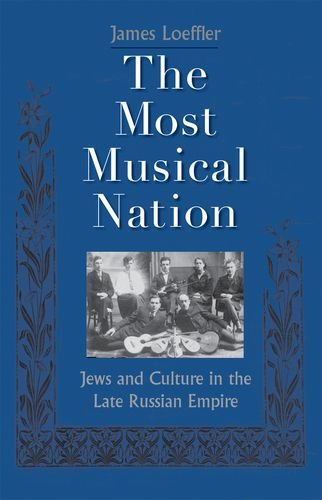
Title
The Most Musical Nation: Jews And Culture In The Late Russian Empire
Sold by Ergodebooks, an authorized reseller.
Returns accepted within 30 days | support@ergodebooks.com
Shipping Information
- Free Standard Shipping — United States only
- Processing Time: 3–5 business days
- Estimated Delivery: 6–10 business days after dispatch
- Double-boxed, fully insured & discreetly packaged
- Tracking number sent via email once dispatched
Returns & Refund
Returns accepted within 30 days of delivery.
Damaged or Defective Item
Free return shipping + replacement or full refund
Wrong Item Received
Free return shipping + replacement or full refund
Change of Mind
Return shipping at customer's expense · 25% restocking fee applies
Payment Option

No image of prerevolutionary Russian Jewish life is more iconic than fiddler on the roof. But in the half century before 1917, Jewish musicians were actually descending from their shtetl roofs and streaming in dazzling numbers to Russia's new classical conservatories. At a time of both rising antiSemitism and burgeoning Jewish nationalism, how and why did Russian music become the gateway to modern Jewish identity? Drawing on previously unavailable archives, this book offers an insightful new perspective on the emergence of Russian Jewish culture.
⚠️ WARNING (California Proposition 65):
This product may contain chemicals known to the State of California to cause cancer, birth defects, or other reproductive harm.
For more information, please visit www.P65Warnings.ca.gov.
- Q: How many pages does the book have? A: This book has two hundred eighty-eight pages. It is a hardcover edition published by Yale University Press.
- Q: What are the dimensions of the book? A: The book measures six point fourteen inches in length, nine point twenty-five inches in height, and zero point ninety-eight inches in width.
- Q: Who is the author of this book? A: The author of this book is James Loeffler. He provides an insightful perspective on Jewish musicians in the late Russian Empire.
- Q: What genre does this book belong to? A: This book belongs to the genre of History and Criticism. It explores the cultural dynamics of Russian Jewish life.
- Q: What is the binding type of the book? A: The book is bound in hardcover. This makes it durable and suitable for long-term use.
- Q: How should I read this book? A: You can read this book at your own pace. It is suitable for anyone interested in Jewish culture and history.
- Q: Is this book suitable for academic use? A: Yes, this book is suitable for academic use. It draws on previously unavailable archives and offers a scholarly perspective.
- Q: What age group is this book appropriate for? A: This book is appropriate for adults and older teens. It covers complex themes related to history and culture.
- Q: Can I use this book for research? A: Yes, you can use this book for research. It includes insights into Russian Jewish culture and music history.
- Q: How do I keep this book in good condition? A: To keep this book in good condition, store it upright in a cool, dry place. Avoid exposing it to direct sunlight.
- Q: Is there any specific care needed for the hardcover? A: No specific care is needed for the hardcover. Just ensure it stays clean and dry to maintain its quality.
- Q: What if I want to return the book? A: You can return the book if it is in its original condition. Check the retailer's return policy for specific instructions.
- Q: What should I do if the book arrives damaged? A: If the book arrives damaged, contact the seller immediately for a replacement or refund. Keep the original packaging for reference.
- Q: Are there any illustrations in the book? A: No, this book does not contain illustrations. It focuses on textual analysis and historical context.
- Q: How does this book compare to others in its genre? A: This book offers a unique perspective on Russian Jewish culture, distinguishing it from other history books that may not focus on music.
- Q: Is the content of this book suitable for general audiences? A: Yes, the content is suitable for general audiences interested in cultural history. However, it may be more engaging for those with a specific interest in Jewish studies.