
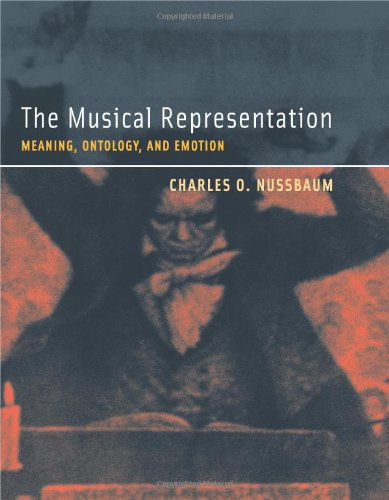
Title
The Musical Representation: Meaning, Ontology, And Emotion (Bradford Books),New
Sold by Ergodebooks, an authorized reseller.
Returns accepted within 30 days | support@ergodebooks.com
Shipping Information
- Free Standard Shipping — United States only
- Processing Time: 3–5 business days
- Estimated Delivery: 6–10 business days after dispatch
- Double-boxed, fully insured & discreetly packaged
- Tracking number sent via email once dispatched
Returns & Refund
Returns accepted within 30 days of delivery.
Damaged or Defective Item
Free return shipping + replacement or full refund
Wrong Item Received
Free return shipping + replacement or full refund
Change of Mind
Return shipping at customer's expense · 25% restocking fee applies
Payment Option

How human musical experience emerges from the audition of organized tones is a riddle of long standing. InThe Musical Representation, Charles Nussbaum offers a philosophical naturalist's solution. Nussbaum founds his naturalistic theory of musical representation on the collusion between the physics of sound and the organization of the human mindbrain. He argues that important varieties of experience afforded by Western tonal art music since 1650 arise through the feeling of tone, the sense of movement in musical space, cognition, emotional arousal, and the engagement, by way of specific emotional responses, of deeply rooted human ideals. Construing the art music of the modern West as representational, as a symbolic system that carries extramusical content, Nussbaum attempts to make normative principles of musical representation explicit and bring them into reflective equilibrium with the intuitions of competent listeners. The human mindbrain, writes Nussbaum, is a living record of its evolutionary history; relatively recent cognitive acquisitions derive from older representational functions of which we are hardly aware. Consideration of musical art can help bring to light the more ancient cognitive functions that underlie modern human cognition.
⚠️ WARNING (California Proposition 65):
This product may contain chemicals known to the State of California to cause cancer, birth defects, or other reproductive harm.
For more information, please visit www.P65Warnings.ca.gov.
- Q: What is the page count of 'The Musical Representation'? A: The book contains three hundred eighty-eight pages. This length provides a comprehensive exploration of musical theory and representation.
- Q: What type of binding does this book have? A: This book is hardcover bound. The hardcover ensures durability and longevity for frequent use.
- Q: Who is the author of 'The Musical Representation'? A: The author is Charles O. Nussbaum. He is known for his philosophical insights into music and its representation.
- Q: What is the recommended reading level for this book? A: This book is suitable for advanced readers and those interested in music theory. It is ideal for students and professionals in philosophy and music.
- Q: How can I apply the concepts from this book? A: You can apply the concepts by analyzing music through Nussbaum's philosophical lens. This book encourages readers to engage with music on a deeper, emotional level.
- Q: Is this book suitable for beginners in music theory? A: No, this book is not ideal for beginners. It is more suited for those with prior knowledge of music theory and philosophy.
- Q: How should I store this hardcover book? A: Store this book upright on a shelf in a cool, dry place. Avoid direct sunlight to preserve the cover and pages.
- Q: Can I clean the cover of this book? A: Yes, you can clean the cover with a soft, dry cloth. Avoid using water or cleaning solutions that may damage the material.
- Q: What should I do if the book arrives damaged? A: Contact the seller immediately for a replacement or refund. Most sellers have policies in place for damaged items.
- Q: How does this book compare to other music theory texts? A: This book focuses on philosophical aspects of music, unlike many theory texts that emphasize technical skills. It's ideal for those exploring deeper meanings in music.
- Q: What topics are covered in this book? A: The book covers topics such as musical ontology, emotion, and the cognitive processes involved in musical experience. It provides a rich theoretical framework.
- Q: Is there a specific audience for this book? A: Yes, this book is aimed at philosophers, musicologists, and advanced students. It is tailored for an academic audience interested in music theory.
- Q: Does this book contain exercises or practical applications? A: No, this book is primarily theoretical and does not include exercises. It focuses on philosophical discussions rather than practical music-making.
- Q: What is the main thesis of 'The Musical Representation'? A: The main thesis is that human musical experience arises from a combination of sound physics and cognitive processes. Nussbaum provides a naturalistic theory of music.
- Q: Can I find references or citations in this book? A: Yes, the book includes references and citations to support its arguments. This is beneficial for academic research and further reading.
- Q: Is this book in a specific category of music literature? A: Yes, the book falls under the category of music theory and philosophy. It is a scholarly work focused on the representation of music.