
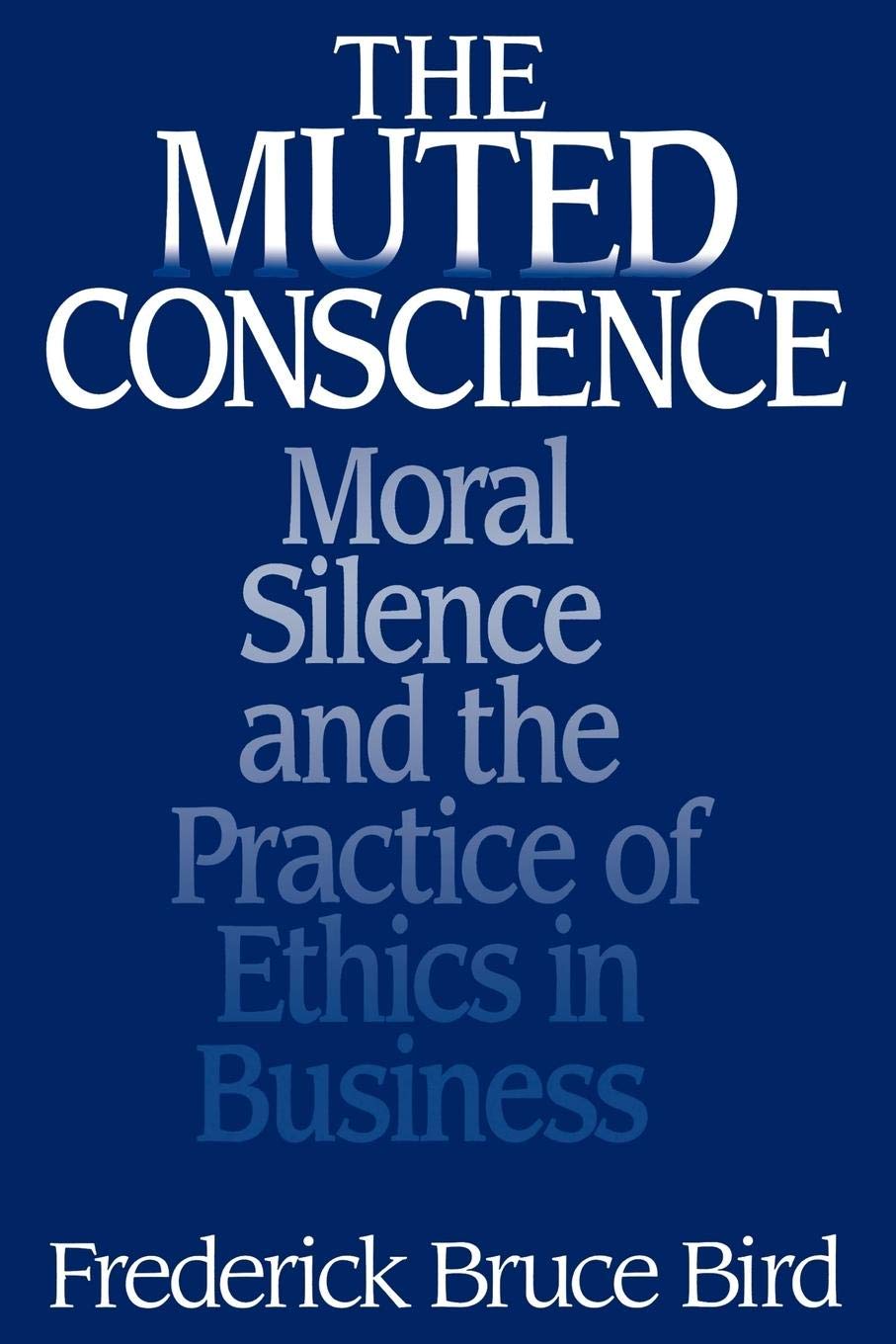
Title
The Muted Conscience: Moral Silence and the Practice of Ethics in Business,New
Sold by Ergodebooks, an authorized reseller.
Returns accepted within 30 days | support@ergodebooks.com
Shipping Information
- Free Standard Shipping — United States only
- Processing Time: 3–5 business days
- Estimated Delivery: 6–10 business days after dispatch
- Double-boxed, fully insured & discreetly packaged
- Tracking number sent via email once dispatched
Returns & Refund
Returns accepted within 30 days of delivery.
Damaged or Defective Item
Free return shipping + replacement or full refund
Wrong Item Received
Free return shipping + replacement or full refund
Change of Mind
Return shipping at customer's expense · 25% restocking fee applies
Payment Option

t's not that most businesspeople lack moral convictions. Rather, they tend not to voice them and are inattentive when others ^Udo. Bird sees this behavior as moral silence, deafness, and blindness, and, following this analogy to the senses, he argues that the practice of ethics is a form of communication. Thus, instead of focusing on specific moral issues, Bird examines the things that stifle communication about moral issuesfactors that have a costly impact on business. His book presents a new view of ethics, in which ethics can be construed as a practical social activity, not a utopian concept to be contemplated in the abstract. With numerous examples and case studies from business life and a logical, sensible analysis of what causes moral silence, deafness, and blindness, Bird's book will be challenging reading not only for professionals and academics in various fields of business, but also for their colleagues in philosophy, religion, and the social sciences.The author begins by discussing the nature of moral silence in contemporary business and asks what kind of problem it is. He examines what it means to voice or not voice moral convictions and what it means to be inattentive or deaf to moral issues. He continues the analogy into moral blindnessthe problem of not perceiving moral issues clearly. From there he explores the consequences of moral silence, deafness, and blindness and traces their causes to a variety of cultural, individual, and organizational factors, all of them interconnected. The book concludes with a way in which businesspeople and others can understand ethics as a social activity in which everyone can and must participate. Bird sees the practice of ethics as a form of conversation, a way in which people establish and maintain agreements among themselves, and in doing so help each other overcome their sensory incapacitations. Bird provides ways in which this can be done, from the use of workshops on interpersonal skills to seminars on conflict resolutiontools and aids that are already prevalent in organizations but that have not, until now, been seen as facilitators of moral awareness and action.
⚠️ WARNING (California Proposition 65):
This product may contain chemicals known to the State of California to cause cancer, birth defects, or other reproductive harm.
For more information, please visit www.P65Warnings.ca.gov.