If you have any questions, you are always welcome to contact us. We'll get back to you as soon as possible, withing 24 hours on weekdays.
Customer service
All questions about your order, return and delivery must be sent to our customer service team by e-mail at yourstore@yourdomain.com
Sale & Press
If you are interested in selling our products, need more information about our brand or wish to make a collaboration, please contact us at press@yourdomain.com
Help
If you have any questions, you are always welcome to contact us. We'll get back to you as soon as possible, withing 24 hours on weekdays.
Customer service
All questions about your order, return and delivery must be sent to our customer service team by e-mail at yourstore@yourdomain.com
Sale & Press
If you are interested in selling our products, need more information about our brand or wish to make a collaboration, please contact us at press@yourdomain.com
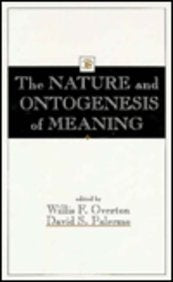
Throughout its evolution, Piaget's theory has placed meaning at the center of all attempts to understand the nature and development of knowing.For Piaget, all knowing whether sensorimotor, representational, or reasoned, and whether directed toward successful problem solutions or toward general understanding is necessarily a construction which arises out of meaning making activity. It was in this context that the editors of this volume approached the board of directors of the Jean Piaget Society with a proposal to organize a recent annual symposium around the topic of the nature and development of meaning. In forming this symposium and in moving from symposium to integrated text, the editors wanted to insure both a breadth and depth to the analysis of the topic.Addressing philosophical, theoretical, and empirical perspectives, this issueoriented volume provides an integrated exploration of the current understanding of the nature and development of meaning. Contemporary issues that frame alternative understandings of the nature of meaning nativist vs. constructivist positions, and computational vs. embodied mind contexts are examined as they impact on the investigation of meaning. Comparative, cognitive, and linguistic developmental dimensions of meaning are described and discussed.
⚠️ WARNING (California Proposition 65):
This product may contain chemicals known to the State of California to cause cancer,
birth defects, or other reproductive harm.
For MAP (Minimum Advertised Price) violations and Intellectual Property (IP) or Trademark concerns, please contact:
support@ergodebooks.com
⚠️ California Proposition 65 Warning: Some products sold on this website may expose you to chemicals known to the State of California to cause cancer, birth defects, or other reproductive harm. For more information, visit www.P65Warnings.ca.gov.