
Title
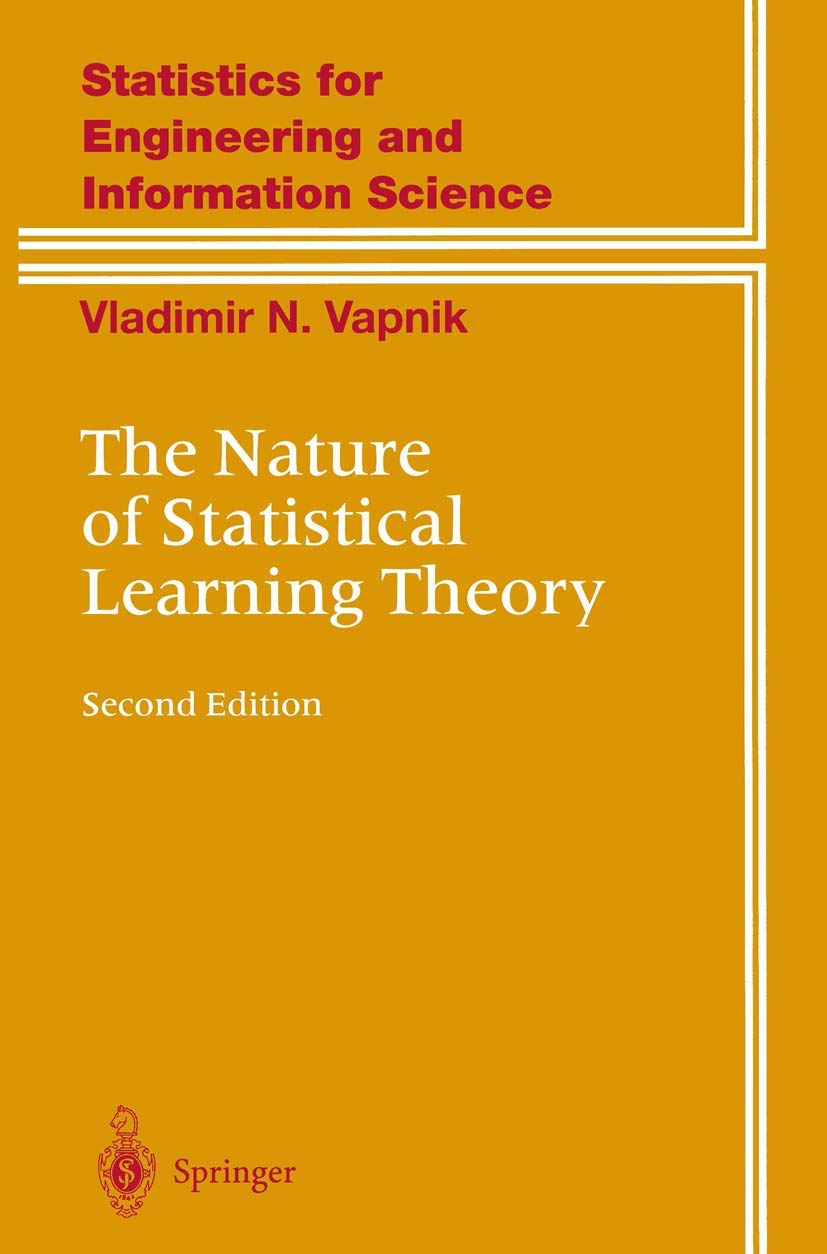
The Nature of Statistical Learning Theory (Information Science and Statistics),Used
Sold by Ergodebooks, an authorized reseller.
Returns accepted within 30 days | support@ergodebooks.com
Shipping Information
- Free Standard Shipping — United States only
- Processing Time: 3–5 business days
- Estimated Delivery: 6–10 business days after dispatch
- Double-boxed, fully insured & discreetly packaged
- Tracking number sent via email once dispatched
Returns & Refund
Returns accepted within 30 days of delivery.
Damaged or Defective Item
Free return shipping + replacement or full refund
Wrong Item Received
Free return shipping + replacement or full refund
Change of Mind
Return shipping at customer's expense · 25% restocking fee applies
Payment Option

The aim of this book is to discuss the fundamental ideas which lie behind the statistical theory of learning and generalization. It considers learning as a general problem of function estimation based on empirical data. Omitting proofs and technical details, the author concentrates on discussing the main results of learning theory and their connections to fundamental problems in statistics. These include: * the setting of learning problems based on the model of minimizing the risk functional from empirical data * a comprehensive analysis of the empirical risk minimization principle including necessary and sufficient conditions for its consistency * nonasymptotic bounds for the risk achieved using the empirical risk minimization principle * principles for controlling the generalization ability of learning machines using small sample sizes based on these bounds * the Support Vector methods that control the generalization ability when estimating function using small sample size. The second edition of the book contains three new chapters devoted to further development of the learning theory and SVM techniques. These include: * the theory of direct method of learning based on solving multidimensional integral equations for density, conditional probability, and conditional density estimation * a new inductive principle of learning. Written in a readable and concise style, the book is intended for statisticians, mathematicians, physicists, and computer scientists. Vladimir N. Vapnik is Technology Leader AT&T LabsResearch and Professor of London University. He is one of the founders of
⚠️ WARNING (California Proposition 65):
This product may contain chemicals known to the State of California to cause cancer, birth defects, or other reproductive harm.
For more information, please visit www.P65Warnings.ca.gov.