If you have any questions, you are always welcome to contact us. We'll get back to you as soon as possible, withing 24 hours on weekdays.
Customer service
All questions about your order, return and delivery must be sent to our customer service team by e-mail at yourstore@yourdomain.com
Sale & Press
If you are interested in selling our products, need more information about our brand or wish to make a collaboration, please contact us at press@yourdomain.com
Help
If you have any questions, you are always welcome to contact us. We'll get back to you as soon as possible, withing 24 hours on weekdays.
Customer service
All questions about your order, return and delivery must be sent to our customer service team by e-mail at yourstore@yourdomain.com
Sale & Press
If you are interested in selling our products, need more information about our brand or wish to make a collaboration, please contact us at press@yourdomain.com
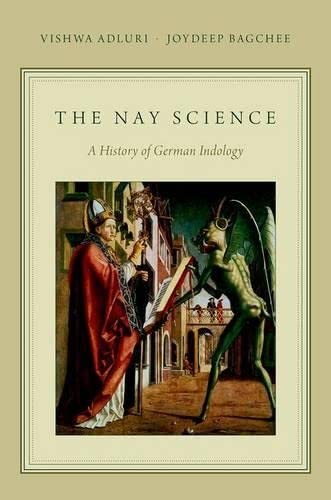
The Nay Science offers a new perspective on the problem of scientific method in the human sciences. Taking German Indological scholarship on the Mahabharata and the Bhagavadgita as their example, Adluri and Bagchee develop a critique of the modern valorization of method over truth in the humanities.The authors show how, from its origins in eighteenthcentury NeoProtestantism onwards, the critical method was used as a way of making theological claims against rival philosophical and/or religious traditions. Via discussions of German Romanticism, the pantheism controversy, scientific positivism, and empiricism, they show how theological concerns dominated German scholarship on the Indian texts. Indology functions as a test case for wider concerns: the rise of historicism, the displacement of philosophical concerns from thinking, and the belief in the ability of a technical method to produce truth.Based on the historical evidence of the first part of the book, Adluri and Bagchee make a case in the second part for going beyond both the critical pretensions of modern academic scholarship and the objections of its poststructuralist or postOrientalist critics. By contrasting German Indology with Plato's concern for virtue and Gandhi's focus on praxis, the authors argue for a conception of the humanities as a dialogue between the ancients and moderns and between eastern and western cultures.
⚠️ WARNING (California Proposition 65):
This product may contain chemicals known to the State of California to cause cancer,
birth defects, or other reproductive harm.
For MAP (Minimum Advertised Price) violations and Intellectual Property (IP) or Trademark concerns, please contact:
support@ergodebooks.com
⚠️ California Proposition 65 Warning: Some products sold on this website may expose you to chemicals known to the State of California to cause cancer, birth defects, or other reproductive harm. For more information, visit www.P65Warnings.ca.gov.