
Title
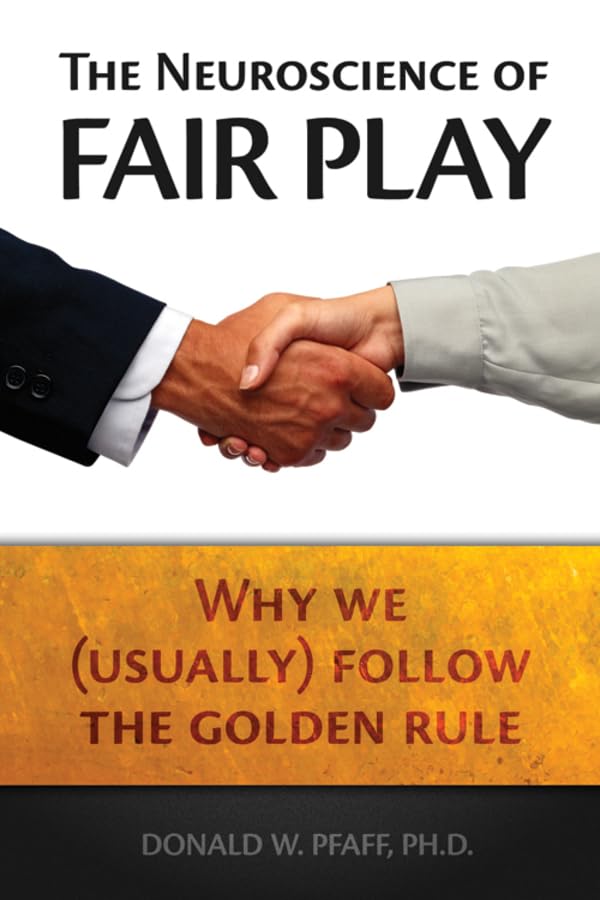
The Neuroscience of Fair Play: Why We (Usually) Follow the Golden Rule,Used
Sold by Ergodebooks, an authorized reseller.
Returns accepted within 30 days | support@ergodebooks.com
Shipping Information
- Free Standard Shipping — United States only
- Processing Time: 3–5 business days
- Estimated Delivery: 6–10 business days after dispatch
- Double-boxed, fully insured & discreetly packaged
- Tracking number sent via email once dispatched
Returns & Refund
Returns accepted within 30 days of delivery.
Damaged or Defective Item
Free return shipping + replacement or full refund
Wrong Item Received
Free return shipping + replacement or full refund
Change of Mind
Return shipping at customer's expense · 25% restocking fee applies
Payment Option

We remember the admonition of our mothers: Treat others as you want them to treat you. But what if being nice was something we were inclined by nature to do anyway? Renowned neuroscientist Donald Pfaff upends our entire understanding of ethics and social contracts with an intriguing proposition: the Golden Rule is hardwired into the human brain.Pfaff, the researcher who first discovered the connections between specific brain circuits and certain behaviors, contends that the basic ethics governing our everyday lives can be traced directly to brain circuitry. Writing with popular science journalist Sandra J. Ackerman, he explains in this clear and concise account how specific brain signals induce us to consider our actions as if they were directed at ourselvesand subsequently lead us to treat others as we wish to be treated. Brain hormones are a part of this complicated process, and The Neuroscience of Fair Play discusses how brain hormones can catalyze behaviors with moral implications in such areas as selfsacrifice, parental love, friendship, and violent aggression.Drawing on his own research and other recent studies in brain science, Pfaff offers a thoughtprovoking hypothesis for why certain ethical codes and ideas have remained constant across human societies and cultures throughout the world and over the centuries of history. An unprecedented and provocative investigation, The Neuroscience of Fair Play offers a new perspective on the increasingly important intersection of neuroscience and ethics.
⚠️ WARNING (California Proposition 65):
This product may contain chemicals known to the State of California to cause cancer, birth defects, or other reproductive harm.
For more information, please visit www.P65Warnings.ca.gov.
- Q: What is the main theme of 'The Neuroscience of Fair Play'? A: The main theme of 'The Neuroscience of Fair Play' is the exploration of how the Golden Rule, which suggests treating others as one wishes to be treated, is hardwired into the human brain through specific brain circuitry and hormones.
- Q: Who is the author of this book? A: 'The Neuroscience of Fair Play' is authored by Donald W. Pfaff, a renowned neuroscientist, in collaboration with science journalist Sandra J. Ackerman.
- Q: What is the binding type of this book? A: This book is available in hardcover binding, ensuring durability and a quality reading experience.
- Q: How many pages does 'The Neuroscience of Fair Play' have? A: 'The Neuroscience of Fair Play' contains 300 pages, providing an in-depth exploration of its subject matter.
- Q: When was 'The Neuroscience of Fair Play' published? A: 'The Neuroscience of Fair Play' was published on December 15, 2007.
- Q: What condition is the book in? A: The book is in new condition, ensuring that readers receive a pristine copy.
- Q: What topics are covered in this book? A: 'The Neuroscience of Fair Play' covers topics such as ethics, social contracts, brain circuits, moral implications of behaviors, and the intersection of neuroscience and ethics.
- Q: Is this book suitable for someone not familiar with neuroscience? A: Yes, the book is written in a clear and concise manner, making it accessible to readers without a background in neuroscience.
- Q: Can this book help understand human behavior? A: 'The Neuroscience of Fair Play' offers insights into human behavior by linking ethical codes to brain circuitry, making it a valuable read for those interested in psychology and ethics.
- Q: What is the significance of the Golden Rule in this book? A: The book argues that the Golden Rule is not just a social construct but a principle embedded in our biology, influencing how we interact socially and ethically with others.